

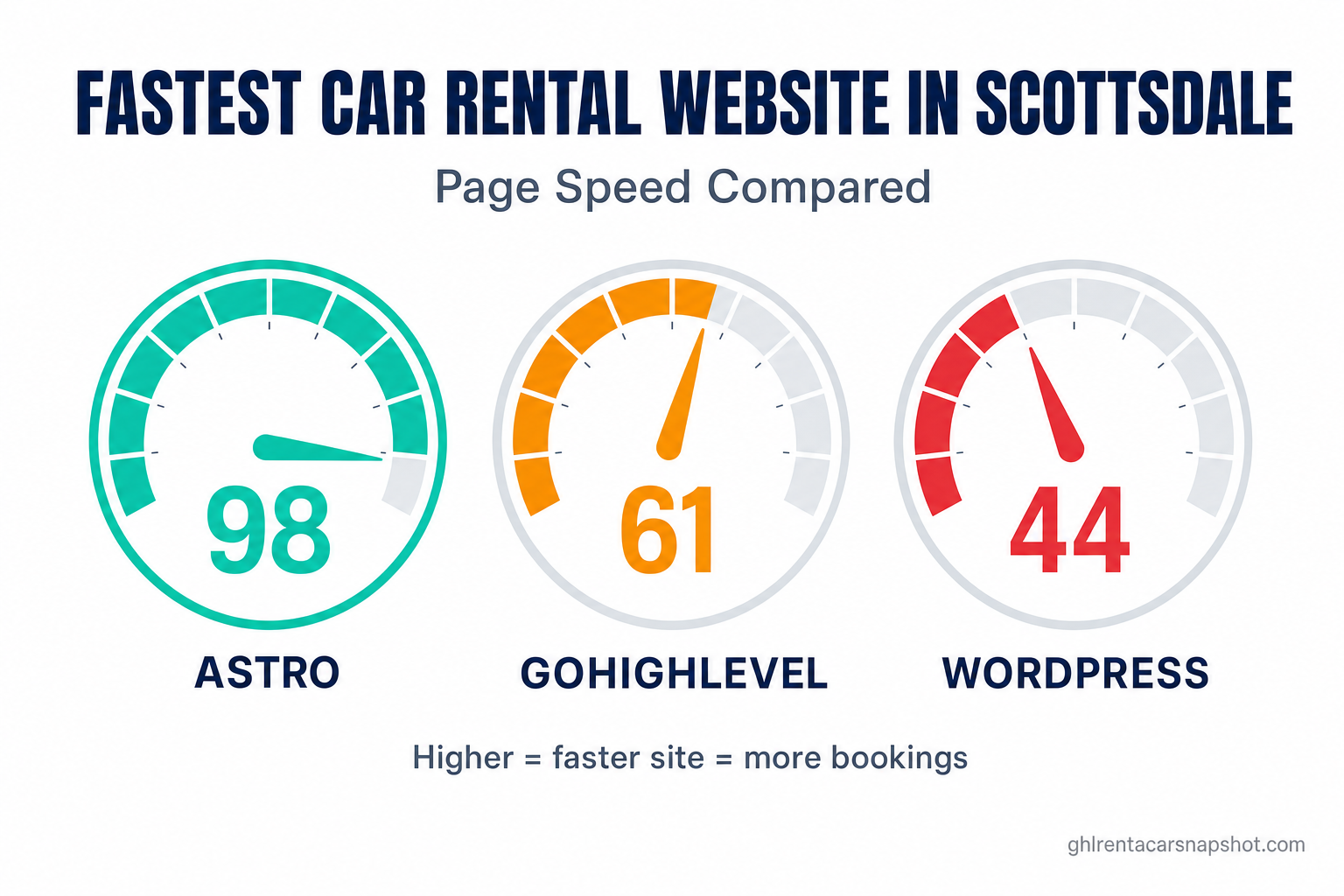
A Scottsdale renter comparing lots for a Barrett-Jackson weekend or a Sky Harbor pickup decides in seconds — on a phone, on cellular, standing in a terminal. For a car rental website, the fastest platform is almost always a static-first build like Astro: it ships little to no JavaScript, loads in well under Google’s three-second bar, passes Core Web Vitals, and keeps the booking that a plugin-heavy WordPress, Wix, or GoHighLevel page-builder site would lose to a slow loading screen. WordPress passes Core Web Vitals on only about 40% of sites; a properly built Astro site targets a 90+ PageSpeed score, guaranteed. This is the head-to-head, with real numbers, for Scottsdale operators and the agencies who build for them.
Key Takeaways
- Speed is a booking decision, not a vanity metric. Google’s research shows that as a mobile page’s load time goes from 1 to 3 seconds, the probability a visitor bounces jumps 32% — and 90% by 5 seconds (Think with Google). 53% of mobile visits are abandoned if a page takes longer than 3 seconds to load (Think with Google, “The Need for Mobile Speed”).
- A tenth of a second moves money. In Deloitte and Google’s 30-million-session study, a 0.1s speed improvement lifted travel conversions 10.1% and retail conversions 8.4% (web.dev, “Milliseconds Make Millions”).
- WordPress and page builders carry weight Astro doesn’t. The median site now ships ~620 KB of JavaScript, about 44% of it unused (HTTP Archive, Web Almanac 2024). WordPress passes Core Web Vitals on only 40% of sites, Wix 57%, Squarespace 60% (Web Almanac 2024, CMS).
- Astro ships zero JavaScript by default and hydrates only the interactive pieces via islands architecture (Astro docs) — which is exactly why a rental booking page built on it opens fast on cellular.
- Scottsdale is a high-value, mobile-first rental market. The city drew a record 11 million visitors and $3.7 billion in economic impact in 2024 (Experience Scottsdale via KTAR), fed by a Sky Harbor airport that handled a record 52.3 million passengers (Phoenix Sky Harbor).
Table of contents
- Why website speed is a booking decision in Scottsdale
- The three ways Scottsdale rental lots build a website
- Page speed compared, head-to-head
- Speed is only half of it: SEO, AEO, and editing
- What “90+ PageSpeed, guaranteed” actually means
- What a fast Scottsdale rental site looks like done-for-you
- Frequently asked questions
Why website speed is a booking decision in Scottsdale
Scottsdale is close to a best-case rental market and a worst-case market to look slow in. The demand is enormous and it arrives on a phone. The city welcomed a record 11 million visitors in 2024, generating $3.7 billion in economic impact and supporting roughly 36,000 jobs (Experience Scottsdale, via KTAR). Those travelers land at Phoenix Sky Harbor, which handled a record 52,325,266 passengers in 2024, up 7.5% year over year (Phoenix Sky Harbor) — all inside a U.S. car rental market worth roughly $40 billion in 2025 (Auto Rental News). Layer on Scottsdale’s dense luxury-and-exotic rental scene, and you have a lot of renters comparing a lot of lots, fast.
Here’s the operational problem: most of those decisions happen on mobile data, and mobile visitors are ruthless about speed. Google’s neural-network analysis of load times is blunt — as a mobile page’s load time grows from 1 second to 3 seconds, the probability of a bounce increases 32%; at 5 seconds it’s up 90%; at 6 seconds, 106% (Think with Google). And the headline stat every operator should tape to the monitor: 53% of mobile site visits are abandoned if a page takes longer than three seconds to load (Think with Google, “The Need for Mobile Speed”).
Increase in mobile bounce probability as page load time rises (percentage points). Source: Think with Google, mobile page speed benchmarks.
That bounce isn’t abstract — it’s a renter who was ready to book a Wrangler for a Sedona day trip and instead closed the tab and opened the next lot’s site. The reverse is just as measurable. In Deloitte and Google’s study of 30 million mobile sessions across 37 brands, a mere 0.1-second improvement in load speed lifted travel-site conversions by 10.1% and retail conversions by 8.4%, with average order value up 9.2% (web.dev, “Milliseconds Make Millions”). For a rental booking funnel — the exact travel-and-transaction pattern in that data — speed is one of the cheapest conversion levers you have. And mobile is the surface that matters: 48% of U.S. smartphone users are comfortable researching, booking, and planning an entire trip on their phone (Think with Google).
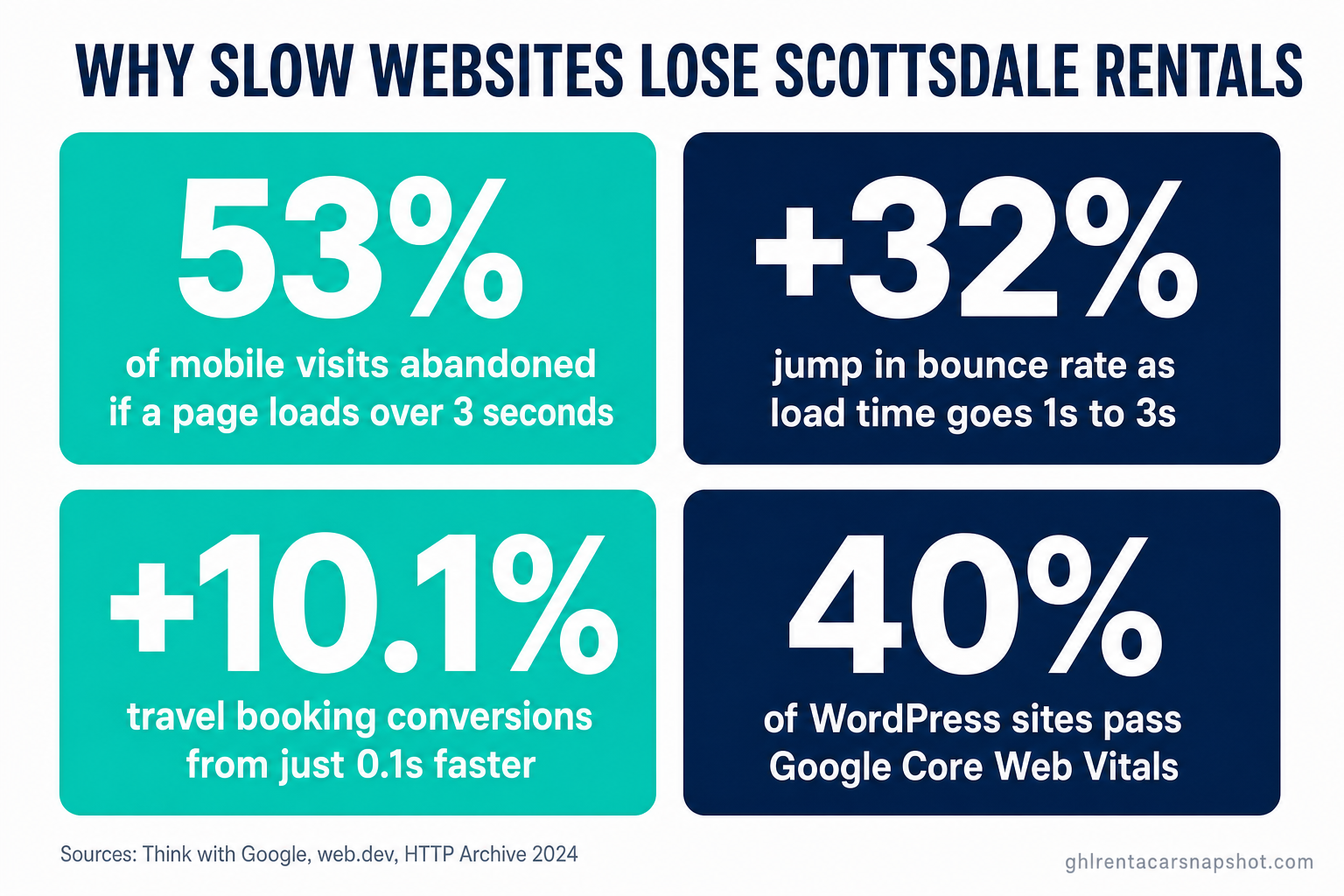
Every number in that panel points the same direction: on a rental storefront, the platform that opens fastest keeps the most renters — and that’s decided before you ever pick a theme or write a headline.
The three ways Scottsdale rental lots build a website
Almost every rental website in the metro is built one of three ways. They are not equally fast, and the difference isn’t a rounding error.
- WordPress (and Wix / Squarespace page builders). The default. WordPress alone powers about 43% of all websites (W3Techs, via Barn2). You get a theme, a stack of plugins for booking, forms, sliders, and SEO, and a page builder like Elementor or Divi. It’s flexible and familiar — and every plugin adds JavaScript, CSS, and database queries the browser has to download and run before a renter sees your fleet.
- GoHighLevel’s built-in website/funnel builder. If you already run GHL for your CRM and automations, its drag-and-drop site builder is right there. It’s genuinely good for landing pages and funnels wired to your pipelines. But it’s a hosted page-builder: convenient, not built for raw page-speed, and you’re inside its rendering and template constraints.
- A static-first framework like Astro. Astro renders your pages to plain HTML at build time and ships zero JavaScript by default, using “islands architecture” to hydrate only the genuinely interactive pieces — a booking widget, a chat bubble — and nothing else (Astro docs). Served from a global edge network, the page is essentially pre-built and instant. This is the same architecture behind many of the fastest sites on the web — and it’s what we build rental sites on.
Page speed compared, head-to-head
Speed isn’t a matter of opinion; it’s a matter of what the browser has to download and execute. The median web page in 2024 ships about 620 KB of JavaScript on desktop, and roughly 44% of that JavaScript is never even used (HTTP Archive, Web Almanac 2024), on top of a median total page weight around 2.4 MB (Web Almanac 2024, page weight). Plugin-driven and page-builder platforms sit at the heavy end of that curve; a static Astro build sits far below it because it doesn’t ship code it doesn’t need.
The clearest real-world scoreboard is how often each platform actually passes Google’s Core Web Vitals. Across millions of real sites, the 2024 data shows a wide gap:
Share of sites on each platform with “good” Core Web Vitals, 2024. Source: HTTP Archive Web Almanac 2024, CMS chapter. A properly built static Astro site targets a 90+ Google PageSpeed score.
Read that against the bounce data above: a platform that passes Core Web Vitals on 40% of its sites is, more often than not, the slow experience Google’s research says loses half your mobile visitors. Here’s the head-to-head for a rental storefront:
| Dimension | WordPress / Wix / Squarespace | GoHighLevel site builder | Astro (static-first) |
|---|---|---|---|
| How it’s served | Server + plugins render per request | Hosted page-builder render | Pre-built HTML from the edge |
| JavaScript shipped | Heavy — theme + every plugin | Moderate — builder runtime | Near-zero by default |
| Typical Core Web Vitals | Passes on ~40–60% of sites | Builder-dependent | Built to pass all three |
| PageSpeed target | Often 40–70 on mobile | Varies | 90+ guaranteed, often 100 |
| Booking-page speed on cellular | Slow start, layout shift | Acceptable | Instant first paint |
| SEO control (schema, meta, slugs) | Plugin-dependent | Limited templates | Full, per-page |
| AEO / llms.txt for AI search | Manual, awkward | Not built for it | Generated automatically |
| Location pages at scale | Manual, plugin bloat | Manual | Programmatic, fast |
| Who maintains it | You (or an hourly dev) | You | Done-for-you |
| Best for | General sites, blogs | Funnels tied to GHL | A fast public rental storefront |
Speed is only half of it: SEO, AEO, and editing
Fast is the entry ticket. What compounds is that a static-first build is also easier for Google — and now for AI answer engines — to read and rank, and easier for us to keep updated on your behalf.
Speed is a ranking signal. Google confirms that page experience, including Core Web Vitals, is used by its ranking systems — a genuine tiebreaker between pages of similar quality (Google Search Central). For a competitive term like “exotic car rental Scottsdale” or “SUV rental near Sky Harbor,” being the faster, cleaner page is a real edge, especially because “near me” mobile searches convert fast — the majority of local mobile searches lead to action within a day. It’s the same logic behind our Scottsdale-adjacent local SEO playbook: fast, well-structured location pages win local intent.
AEO — being quotable by AI. Renters increasingly ask ChatGPT, Perplexity, and Google’s AI Overviews “where should I rent an exotic car in Scottsdale?” Getting cited means clean HTML, real structured data, and an llms.txt file that tells AI crawlers what your site is. A static Astro build generates that automatically; on WordPress it’s a manual, plugin-wrangling chore. We break down the full approach in AI search optimization for car rental.
Editability without breaking things. On a plugin site, a “quick” seasonal rate change or a new vehicle class can mean an hourly dev invoice — or a plugin update that quietly breaks your booking form. On a managed Astro build, you send the change and it’s handled, with the speed and schema intact. That reliability is why we treat the website as the fast storefront and let GoHighLevel run the booking and follow-up automations behind it.
What “90+ PageSpeed, guaranteed” actually means
When we build a rental website, we build it on Astro and guarantee a 90+ Google PageSpeed score — often a perfect 100 — on both mobile and desktop. That’s not marketing; it’s a consequence of the architecture. No plugin bloat, near-zero JavaScript, static pages served from Cloudflare’s global edge. The result is the fast first paint that Google’s research ties directly to more completed bookings.
Compare that to the median site shipping 620 KB of JavaScript, nearly half of it unused, and you can see why a static build wins the one metric renters actually feel. For a deeper dive on how much revenue slow pages leak, see our Miami rental website-speed breakdown and our website conversion optimization guide.
What a fast Scottsdale rental site looks like done-for-you
You don’t need to learn Astro, wrestle plugins, or babysit page-speed scores. Here’s what the done-for-you build includes, at transparent pricing:
- A single rental website — $497 one-time + $97/month. The monthly covers managed Cloudflare hosting, your domain, SSL, and maintenance, including up to 10 support tickets a month for changes like new vehicle classes, seasonal rates, or new location pages. You pay only the monthly up front; the one-time fee is charged after 10 days, once the site is live and you’re happy.
- Add automatic blogging — $197/month total — and we publish two new posts a week, written around your fleet, your Scottsdale-area locations, and the rental search terms that pull in bookings.
- Multi-lot or franchise groups — up to 5 rental websites for $1,200 one-time + $297/month total — ideal for operators running multiple locations or brands.
Every build ships fast on Astro, feeds bookings into GoHighLevel, and comes with an AI chat widget on the storefront so a Scottsdale renter’s late-night “is the Corvette free this weekend?” gets answered and captured, not lost. If you’re weighing a bigger move, we also handle the full migration to GoHighLevel and custom reservation software — but for most lots, a fast storefront plus GHL is exactly the right stack.
Frequently asked questions
Is Astro really faster than WordPress or GoHighLevel for a car rental website?
For a public rental storefront, yes, and it's not close on the metric that matters. Astro ships zero JavaScript by default and serves pre-built HTML from the edge, while WordPress and page-builders download a theme plus every plugin's code before a renter sees your fleet. The real-world proof is Core Web Vitals pass rates: WordPress passes on about 40% of sites and Wix around 57% (HTTP Archive Web Almanac 2024), whereas a properly built Astro site targets a 90+ PageSpeed score. Faster first paint is exactly what Google's data ties to fewer bounces and more completed bookings.
Do I have to give up GoHighLevel to get a fast website?
No — and you shouldn't. The best setup for a Scottsdale lot is a fast Astro website as the public storefront, wired to feed every booking and inquiry into GoHighLevel for follow-up, reminders, deposits, and reviews. You keep GHL doing what it's great at (automation and pipelines) and gain a storefront built for speed and SEO. It's the best of both, not an either/or.
Why does page speed matter so much for a car rental in Scottsdale specifically?
Because the demand is huge and mobile-first. Scottsdale drew a record 11 million visitors and $3.7 billion in economic impact in 2024, fed by a Sky Harbor airport that handled a record 52.3 million passengers — most of them comparing rental lots on a phone, on cellular. Google's research shows 53% of mobile visits are abandoned when a page takes longer than three seconds to load. On peak weekends, a slow site quietly hands those renters to the faster lot down the road.
What is a 'good' page speed score, and what do you guarantee?
Google's Core Web Vitals define 'good' as Largest Contentful Paint under 2.5 seconds, Interaction to Next Paint under 200 milliseconds, and Cumulative Layout Shift under 0.1, at the 75th percentile of real visitors. We build on Astro and guarantee a 90+ Google PageSpeed score — often a perfect 100 — on both mobile and desktop, which comfortably clears those thresholds.
What does a fast car rental website cost, and what's included?
A single Astro-built rental website is $497 one-time plus $97/month, which covers managed hosting, your domain, SSL, maintenance, and up to 10 change tickets a month. Add automatic blogging (two posts a week) for $197/month total, or build up to five sites for multi-location operators at $1,200 one-time plus $297/month. You pay only the monthly up front; the one-time fee is charged after 10 days once you're happy with the live site.
Will switching to a new website hurt my Google rankings?
Not when it's migrated correctly. A faster, cleaner site with proper schema, redirects, and Core Web Vitals compliance typically helps rankings, because Google uses page experience as a ranking signal and rewards the faster page between two of similar quality. We handle the redirects and structured data so you keep your existing equity and gain the speed advantage — licensing, rates, and rental-agreement terms always remain the operator's responsibility.
About the author: Julian Cardoza is an Independent Fleet Operations Advisor based in Phoenix, Arizona. He spent eleven years running the counter and the back lot at independent rental locations across the Southwest before going solo. He learned the hard way that a full lot on paper still loses money when the website is too slow to catch the booking — and now helps Scottsdale-area rental companies wire up fast storefronts and GoHighLevel automation so no inquiry falls through the cracks.
Related reading:
- Why Miami Car Rental Websites Lose Bookings to Slow Load Times
- Car Rental Website Conversion Optimization: Turn Visits Into Bookings
- How to Migrate Your Car Rental Business to GoHighLevel (Step-by-Step)
- AI Search Optimization for Car Rental: Getting Cited by ChatGPT & Perplexity
- GoHighLevel Integrations for Car Rental Operators
Editorial note: figures cited are drawn from the third-party research linked inline and reflect those sources as of publication. Page-speed and Core Web Vitals data come from Think with Google, web.dev, and the HTTP Archive Web Almanac; platform and Astro details from Astro’s documentation and W3Techs; Scottsdale market figures from Experience Scottsdale and Phoenix Sky Harbor. GHL Car Rental Snapshot builds GoHighLevel automation systems and Astro websites for car rental operators — it is not a car rental company, insurer, or payment processor. Pricing, market data, and platform features change; confirm current sources before making decisions.