

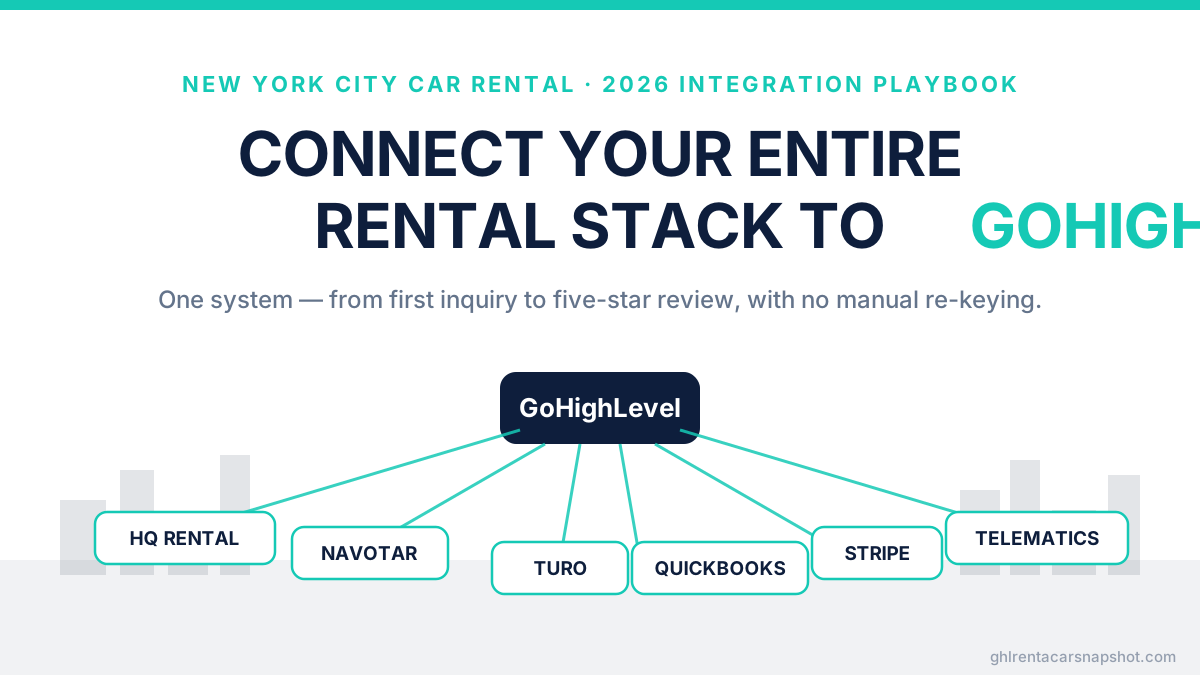
A New York City rental operator rarely loses a booking because demand is thin — they lose it in the gap between two tools that don’t talk to each other. The reservation lives in HQ Rental or Navotar. The renter’s phone number is in a spreadsheet. The deposit is in Stripe. The review request never goes out because nobody re-keyed the return into the review tool. Every one of those handoffs is done by hand, at the counter, on the busiest weekend of the month — and every handoff is where a car quietly stays parked. The fix isn’t another app. It’s custom GoHighLevel development that wires your existing rental stack — booking software, payments, telematics, reviews, and accounting — into one system, so a reservation flows from first inquiry to five-star review without a single manual copy-paste.
This is the 2026 integration playbook for New York City car rental companies (and the GHL agencies who serve them): why a disconnected stack costs more than any one tool, what “custom GoHighLevel development” actually means for a lot, the specific integrations worth building first, and what the work costs and takes.
Key Takeaways
- New York is one of the deepest rental markets in the country. The Port Authority’s airports — JFK, LaGuardia, Newark, and Stewart — handled a record 145.9 million passengers in 2024 (Port Authority of NY & NJ), and NYC drew 64.3 million visitors — its second-highest total ever (NYC Mayor’s Office / NYC Tourism + Conventions). The bookings are there; the leak is internal.
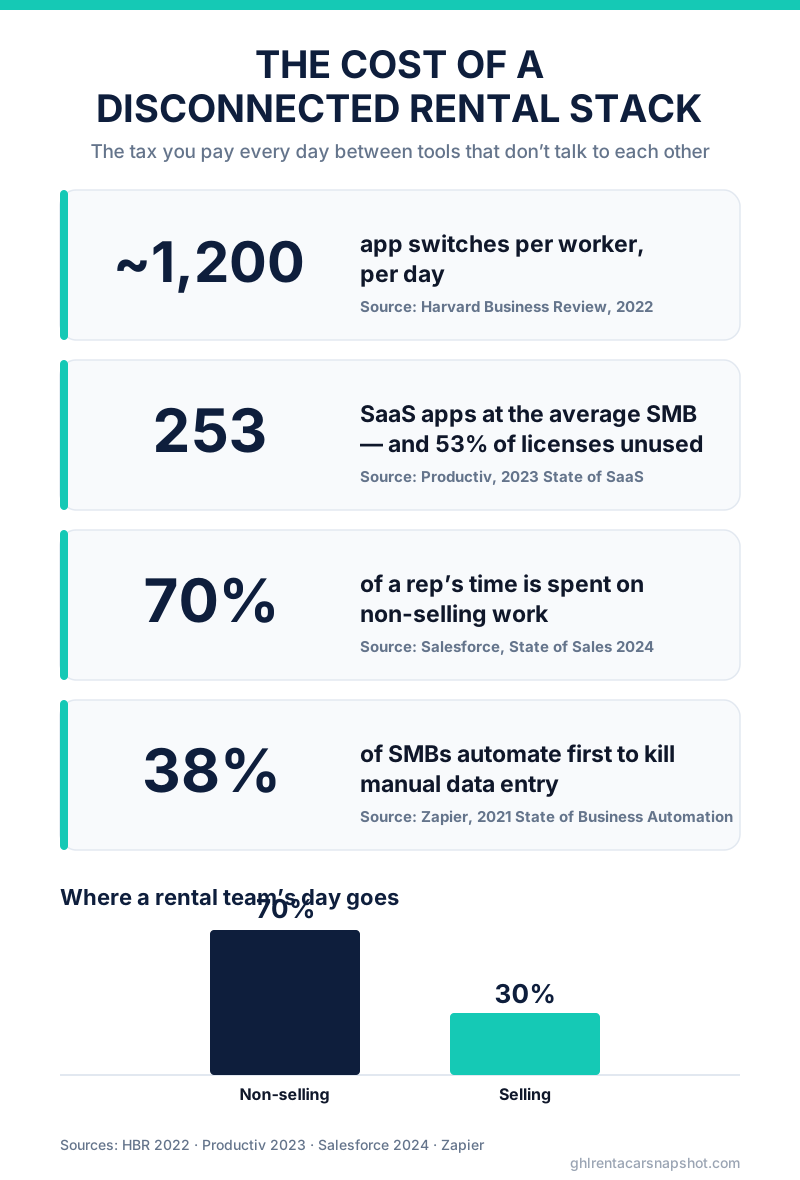
- A disconnected stack taxes you every day. The average worker switches between apps and windows nearly 1,200 times a day, and reopening those tools burns about four hours a week (Harvard Business Review, 2022). Your counter staff pay that tax on every reservation.
- Sales-type work is mostly not selling. Reps spend roughly 70% of their time on non-selling tasks like admin, data entry, and tool-switching (Salesforce, State of Sales 2024) — for a rental lot, that’s time not spent turning inquiries into keys.
- Integration is how small lots punch up. 88% of small and mid-size businesses say automation lets them compete with bigger companies, and the single most common thing they automate is manual data entry (38%) (Zapier, 2021 State of Business Automation).
- The plumbing pays. Marketing automation returns about $5.44 for every $1 spent (Nucleus Research) — but only when your systems are connected enough to act on the data.
Table of contents
- Why New York City punishes a disconnected rental stack
- The hidden tax: what a disconnected stack actually costs
- What “custom GoHighLevel development” actually means
- The 6 integrations every NYC rental lot should wire first
- Bolt-on or build: when custom development is worth it
- What it costs and how long it takes
- A realistic 60–90 day rollout
- Frequently asked questions
Why New York City punishes a disconnected rental stack
Start with the demand, because it sets the stakes. New York is a rental market with almost no ceiling on inbound volume. The Port Authority’s airports handled a record 145.9 million passengers in 2024 — the busiest year in their history for the second straight year — including 52.3 million international travelers (Port Authority of NY & NJ). JFK alone moved about 63.3 million passengers. Layer the city’s tourism on top: NYC welcomed 64.3 million visitors in 2024, its second-highest total on record and roughly $51 billion in direct visitor spending (NYC Mayor’s Office / NYC Tourism + Conventions) — all inside a U.S. car rental industry worth roughly $60–63 billion in 2025 (IBISWorld).
Here’s the operator’s problem: none of that demand arrives in one place, and none of it stays in one place. An airport renter DMs you from the terminal. A corporate account emails a booking request. A weekend renter fills out the form on your website. A repeat customer calls. Then the reservation goes into your rental software, the payment into Stripe, the ID photo into a text thread, the return into a whiteboard, and the review request into… nothing, usually. In a market moving this fast, every seam between those systems is a place a booking can slip — and New York gives you no slack, because the renter comparing three lots will simply book the one that answered cleanly and never notices the one that fumbled the handoff.
The rental lots that struggle aren’t lazy and they’re not short on leads — they’re short on plumbing. Their tools are all fine on their own. The money leaks in the gaps between them, where a human has to remember to copy a phone number from one screen to another at 6pm on a Friday. Close those gaps and the same team, the same fleet, and the same ad spend suddenly convert more, because nothing falls on the floor.
The hidden tax: what a disconnected stack actually costs
Most operators never see this cost as a line item, because it’s paid in minutes and missed follow-ups instead of dollars. But it’s real, it compounds, and the research is blunt about its size.
Start with the switching itself. The average worker toggles between apps and windows nearly 1,200 times a day, and the act of reopening and reorienting inside those tools consumes about four hours a week — close to 9% of the work year (Harvard Business Review, 2022). A counter agent bouncing between a reservation screen, a payment portal, a text app, and a spreadsheet is the textbook case. Then look at where the day actually goes: sales reps spend roughly 70% of their time on non-selling work — admin, data entry, and tool-switching — leaving only about 30% for selling (Salesforce, State of Sales 2024). Swap “selling” for “booking cars and following up on deposits” and you have a picture of a rental front desk.
The stack keeps growing, too, which makes it worse. The average small or mid-size business now runs about 253 SaaS apps, and more than half — 53% — of the licenses it pays for sit unused (Productiv, 2023 State of SaaS). You don’t need 253 tools; you need the six or eight that run your lot to actually pass data to each other. That’s exactly what small operators know instinctively: 88% of SMBs say automation lets them compete with larger companies, 94% report doing repetitive tasks a machine could handle, and the number-one thing they automate is manual data entry (38%), followed by lead management and follow-up (30%) (Zapier, 2021 State of Business Automation).
And the sharpest edge of a disconnected stack is speed. When an inquiry lands in one system but the person who can answer it is looking at another, you respond slowly — and rental is unforgiving about slow. The landmark Lead Response Management study (Dr. James Oldroyd, MIT, with InsideSales) found that contacting a new lead within five minutes instead of thirty makes you about 100× more likely to reach them and 21× more likely to qualify them (Harvard Business Review). A connected stack is what makes a five-minute response the default instead of a heroic exception.
What “custom GoHighLevel development” actually means
GoHighLevel is a strong backbone for a rental operation — CRM, pipelines, calendars, SMS and email, reviews, and AI agents in one place. But two things are always true for a real lot: GHL doesn’t do everything a rental business needs out of the box, and your rental-specific tools don’t talk to it on their own. Custom GoHighLevel development is the work that closes both gaps. It comes in three flavors:
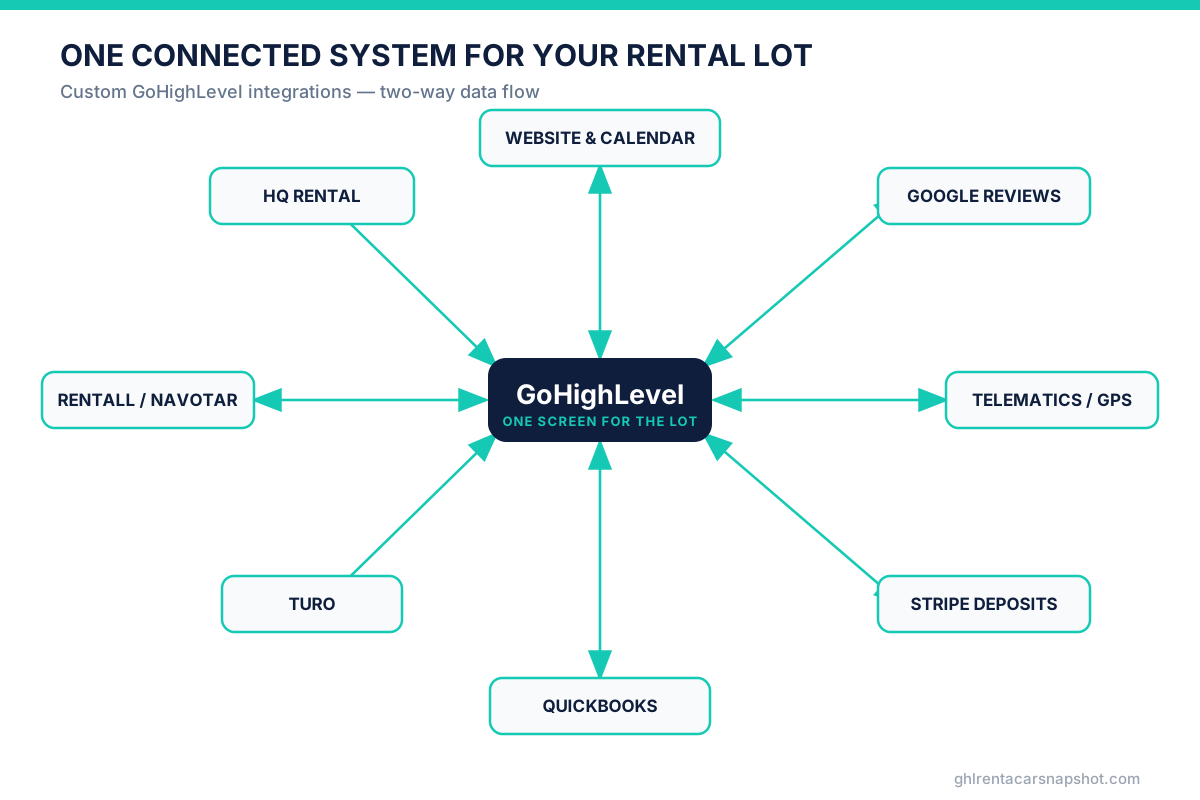
- Integrations — two-way connections that make data flow between GHL and the tools you already run: HQ Rental Software, RENTALL, TSD, Navotar, Turo, QuickBooks, Stripe, Calendly, and your telematics/GPS provider. A reservation created in HQ Rental appears on the GHL contact record; a pipeline change in GHL creates the booking back in HQ Rental. No re-keying.
- Extensions — features GHL simply doesn’t ship: a mobile renter portal for license/ID upload and e-signature, a deposit-hold flow, a fleet-utilization dashboard, a rental-agreement checklist, or a niche calculator built as custom code on top of your sub-account.
- Replacements & bridges — a voice-AI bridge (VAPI/Retell) that logs and tags every inbound call inside GHL, an embedded AI booking chatbot connected to your calendar, or a full migration off a legacy CRM into GHL.
The distinction that trips people up: this is different from standalone custom software. If your project involves the GoHighLevel API or a GHL sub-account — connecting to it, extending it, or moving into it — it’s GHL development. If it’s a standalone app that may never touch GHL, that’s custom software. Most rental lots need the former, because they’re not trying to leave GHL; they’re trying to make it the one screen that runs the lot.
The 6 integrations every NYC rental lot should wire first
You don’t build all of it at once. Here’s the order that pays back fastest for a New York operator, from the booking that starts everything to the review that compounds it.
1. Booking software ↔ GHL (two-way reservation sync)
This is the keystone. A webhook-driven connector pushes reservation status from HQ Rental, RENTALL, TSD, or Navotar into the GHL contact record in real time — and creates bookings back in your rental software when a GHL pipeline stage changes. Now every renter is a CRM contact with their dates, vehicle class, and status attached, and your automations can finally fire off real reservation data instead of a half-filled form. This is the backbone that the whole reservation-automation layer sits on.
2. Payments & deposits ↔ GHL (Stripe)
Wire Stripe to GHL so a card-on-file hold, a deposit, or a paid balance updates the contact and the pipeline the instant it happens. Keys shouldn’t leave the lot before the hold clears, and your team shouldn’t have to check a separate dashboard to know it did. Connected payments also mean a failed or missing deposit can trigger an automated nudge instead of a silent no-show.
3. Renter identity & documents ↔ GHL (portal)
Airport and exotic renters especially need license, ID, and e-signature captured before pickup. A branded mobile renter portal — custom-built on GHL data — lets the renter upload documents, sign the rental agreement, and see booking status from their phone, with everything landing on the contact record. That’s the difference between a clean counter handoff and a line of people fumbling with paperwork at 11pm.
4. Telematics / GPS ↔ GHL
For multi-vehicle lots, pulling mileage, location, and availability from your telematics provider into GHL turns your CRM into an operational view: which cars are actually free this weekend, which are overdue, which just came back and need a return-photo and review trigger. It’s also what makes a real fleet-utilization dashboard possible.
5. Reviews ↔ GHL (reputation on autopilot)
The return event should automatically fire a review request by SMS and email to the happy renter — no one remembering to send it. Connected to GHL’s review-harvesting workflow, every completed rental becomes a shot at a public five-star review, which is the flywheel that lowers your cost per future booking.
6. Accounting ↔ GHL (QuickBooks)
Close the loop by syncing invoices, deposits, and AR reconciliation between GHL and QuickBooks — updated by deal value and vehicle class. Your bookkeeper stops re-typing every transaction, and the numbers in your CRM match the numbers in your books without a monthly reconciliation marathon.
Bolt-on or build: when custom development is worth it
Not every connection needs a custom build. For simple, low-volume syncs, no-code tools like n8n, Make, or Zapier are the right first stop — they’re fast and cheap. Custom development earns its keep when the integration is high-volume, two-way, real-time, or business-critical — exactly the reservation and payment flows above, where a dropped webhook means a double-booked car or a missing deposit, not a cosmetic glitch.
The honest framing is the same one we laid out for off-the-shelf versus custom software: buy or bolt-on for the 90% of your operation that looks like everyone else’s, and commission custom code only for the workflow that’s genuinely yours and worth defending. For most New York lots, the custom line falls right at the reservation-and-deposit core — the part that has to be bulletproof — while the edges can start as no-code and harden later. And the payoff for getting the core right is measurable: marketing automation returns about $5.44 for every dollar spent, with a roughly 14.5% lift in sales productivity (Nucleus Research). (CRM’s oft-quoted ROI is even higher — Nucleus’s famous figure is $8.71 per $1 from 2014 — though the firm’s more recent analysis puts the average closer to $3.10 as the category matured. Either way, connected beats disconnected.)
What it costs and how long it takes
Custom GHL development is quoted per project, fixed-price, and scoped before anyone writes code. Real ranges for a rental operation:
- Platform-to-GHL connector (HQ Rental, RENTALL, Navotar, Turo → GHL): around $3K, typically 2–4 weeks.
- Full migration into GoHighLevel from a legacy CRM or booking tool: $5–15K, 2–5 weeks depending on data volume.
- Embedded AI booking chatbot connected to your GHL calendar: $5–15K, 3–4 weeks.
- Custom fleet-management or utilization dashboard: $15–40K, 6–10 weeks.
- GHL Marketplace app (for agencies reselling to sub-accounts): $25K+, 6–10 weeks.
Prefer pay-as-you-go? There’s a $75/hr retainer. And once it’s live, ongoing maintenance via a dedicated GHL VA plus developer starts at $997/mo — the same hire-a-VA model that keeps the system tuned without you touching it. The point of quoting it plainly: integration isn’t a mystery expense. For a New York lot doing real airport and corporate volume, a reservation-sync connector that stops even a handful of dropped bookings a month pays for itself fast.
A realistic 60–90 day rollout
No honest partner promises an overnight rebuild, and a good integration is staged on purpose. Here’s the truthful arc for a New York lot going from a disconnected stack to one connected system.
- Weeks 1–2 — Audit and map. We inventory every tool you run, and map each field, pipeline, and reservation status to its GHL equivalent. This is where the hidden double-entry and dropped-handoff points get named.
- Weeks 2–4 — Wire the core. The reservation sync and payments/deposit integration go live first. Bookings, dates, vehicle class, and deposit status now flow into GHL automatically. The biggest leaks — slow responses and lost reservation data — close immediately.
- Weeks 4–8 — Add the layers. Renter portal, telematics view, review triggers, and QuickBooks sync come online in the order that pays back fastest for your lot. Each is tested against real bookings before it’s trusted.
- Months 2–3 — Compound. With one connected system, your team stops re-keying, responses get fast by default, and every return automatically becomes a review request. The same fleet and ad spend convert more, because nothing falls through the seams anymore.
The goal isn’t to hand you more software. It’s the opposite — to make the tools you already pay for behave like one system, so a New York renter who inquires at 9pm on a Friday gets a fast, clean answer and a booked car, and your team spends the weekend renting vehicles instead of copying data between screens. That’s the whole promise of connecting your stack, and it’s the same operational thesis behind booking software that scales and AI that answers every call.
Frequently asked questions
Can you connect HQ Rental, RENTALL, TSD, Navotar, or Turo to GoHighLevel?
Yes — connecting rental platforms to GHL is a core build. We create two-way integrations (via API, webhooks, or scheduled sync) between GoHighLevel and HQ Rental Software, RENTALL, TSD, Navotar, Turo, QuickBooks, Stripe, Calendly, and your telematics/GPS provider. If a platform has an API or a data export, it can be wired into GHL so reservations, contacts, and payments flow both ways instead of being re-keyed by hand. See our GHL development service for the full list.
How is GHL development different from custom software?
GHL development covers software that connects to, extends, or replaces parts of GoHighLevel — rental-platform integrations, custom fleet dashboards on GHL data, renter portals, and voice-AI bridges that log calls to GHL contacts. Our custom software service covers standalone apps and AI agents that may never touch GHL. If your project involves the GHL API or a GHL sub-account, it's GHL development.
Do I need to leave my current rental software to use GoHighLevel?
Usually not. The most common build is an integration that keeps your rental software (HQ Rental, Navotar, RENTALL, TSD) as the system of record and syncs it two-way with GoHighLevel, so GHL becomes the marketing, follow-up, and reporting layer on top. If you'd rather consolidate, a full migration into GHL is also an option — we audit and map your data, rebuild pipelines, import everything, and verify record counts before cutover.
How much does a GoHighLevel integration cost for a car rental company?
Fixed-price quotes start around $3K for a platform-to-GHL connector and $5–15K for migrations or AI booking chatbots; custom fleet-management dashboards run $15–40K, and GHL Marketplace apps start at $25K. There's a $75/hr retainer if you prefer pay-as-you-go, and ongoing maintenance via a dedicated GHL VA plus developer starts at $997/mo. Every project is scoped with a fixed timeline before work begins.
How long does an integration take to build?
A platform-to-GHL reservation connector is typically 2–4 weeks; an AI booking chatbot 3–4 weeks; a full migration into GHL 2–5 weeks depending on data volume; and a custom fleet-utilization dashboard 6–10 weeks. Integrations are staged so the highest-value connections — reservation sync and payments — go live first and start paying back while the rest is still being built.
Is a custom integration worth it for a small NYC lot?
Often, yes — because New York's volume makes each dropped booking expensive. Small and mid-size businesses report that automation lets them compete with larger firms (88% say so), and the top thing they automate is manual data entry. A reservation-sync connector that stops even a few lost bookings or missed deposits a month typically pays for itself quickly. For very simple, low-volume syncs, a no-code tool (Zapier, Make, n8n) is a fine, cheaper starting point.
About the author: Priya Sandoval is a GHL Agency Owner & Snapshot Builder based in Austin, Texas. She runs a boutique GoHighLevel agency that resells done-for-you snapshots to local service businesses, with car-rental operators as her fastest-growing segment. She’s obsessed with the unglamorous plumbing — pipelines, tags, integrations, and trigger timing — that turns a one-time renter into a repeat booking.
Related reading:
- How to Migrate Your Car Rental Business to GoHighLevel (Step-by-Step)
- Off-the-Shelf vs Custom Car Rental Software: What to Choose in 2026
- Why Car Rental Companies Outgrow Off-the-Shelf Booking Software
- AI for Car Rental Businesses: How to Book Every Call 24/7
- Car Rental Fleet Utilization Rate: How to Raise It in 2026
Editorial note: figures cited are drawn from the third-party research linked inline and reflect those sources as of publication. Airport, tourism, market-size, app-switching, response-time, and ROI figures are cohort, survey, or market findings, not a prediction for any specific lot; results depend on execution, fleet, market, and offer. CRM/automation ROI figures vary by study and vintage and are cited with that context. GHL Car Rental Snapshot builds GoHighLevel automation systems, integrations, and websites for car rental businesses — it is not a car rental company, insurer, or payment processor. Market data and platform capabilities change; confirm current sources before making decisions.