
It is 9:15 on a Friday and you are halfway under a returning Tahoe, checking a scuff the last renter swears was already there. Your phone buzzes twice and you ignore it. By the time you are back at the counter there is a missed call with no voicemail, an Instagram DM asking “anything for this weekend,” a website form from 8:52, and a text from a Turo guest about an early pickup. Four people wanted to give you money this morning. You will reach maybe two this afternoon, and one has already booked the lot down the road.
That is the real leak in most independent rental businesses. Not the website, not the pricing, not the fleet. A booking inquiry can arrive through six different doors, each in its own app, and the ones you do not answer fast enough quietly go somewhere else. The fix is not “try harder.” It is one inbox that catches every channel and fires a real answer in under a minute, whether you are under a truck or asleep.
Table of contents
- What scattered leads actually cost you
- The six doors a car rental lead walks through
- Door 1: The phone call you missed
- Door 2: The website form and live chat
- Door 3: Google Business Profile
- Door 4: Instagram and Facebook DMs
- Door 5: Turo and marketplace messages
- Door 6: One inbox that catches all of it
- The 60-second answer and the follow-up that books
- Three scenarios: 5, 25, and 80 cars
- Texting leads without a TCPA or 10DLC problem
- Common objections, answered
- Frequently asked questions
What scattered leads actually cost you
Speed is the whole game, and the data is brutal. When Harvard Business Review audited 2,241 US companies by submitting a test inquiry and timing the reply, only 37% answered within an hour, 24% took more than a day, and 23% never answered at all (Harvard Business Review, 2011; author copy, BYU ScholarsArchive). Firms that reached a lead within the first hour were far more likely to have a real qualifying conversation than firms that waited even one hour longer.
A rental inquiry is more perishable than most. The person asking “anything this weekend” is shopping three lots at once, often Thursday night for a Saturday pickup, and whoever answers first with a car and a price usually wins. Now stack the channel problem on top: a phone lead, an Instagram DM, and a Google message sit in four apps, three of which you are not watching while you detail a car. So the real response time is not “how fast do I reply,” it is “how long until I notice,” and that can be hours.
There is a second cost, and it is why the direct channel matters. Every booking you push to Turo hands over 10% to 40% of the trip depending on the host’s protection plan (NerdWallet). Answering your own inbox fast turns marketplace-priced demand into direct bookings you keep in full, and it ends your dependence on one platform that can change the rules or vanish, as Getaround did when it shut its entire US business in February 2025 (TechCrunch).
How fast US companies reply to an inbound sales lead, from an audit of 2,241 firms (figures approximate, rounded). Source: Harvard Business Review, “The Short Life of Online Sales Leads” (2011).
The six doors a car rental lead walks through
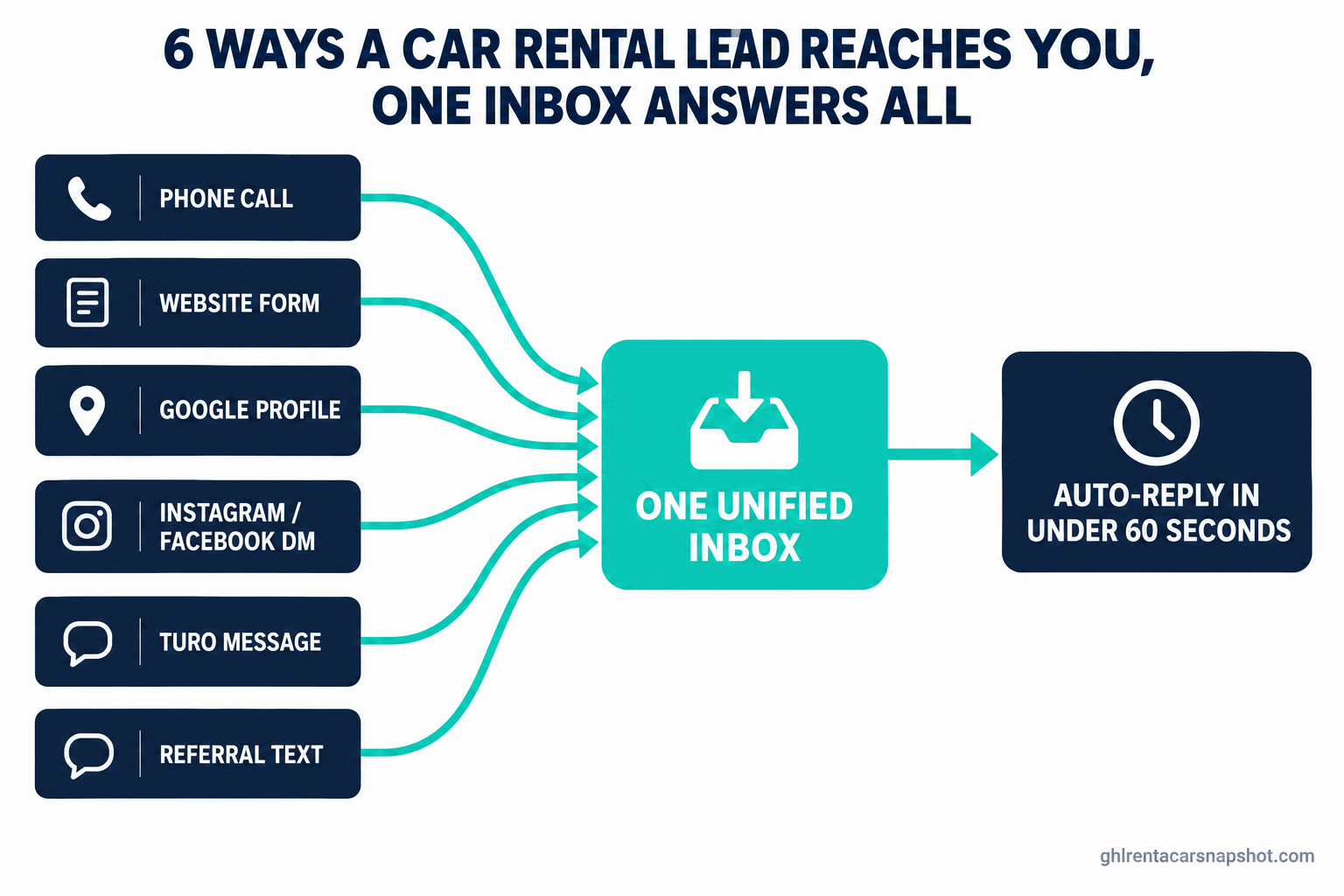
Before you can answer every lead, admit how many ways one can reach you. For a modern independent lot it is usually six, and almost none of them talk to each other out of the box.
| The door | How the lead arrives | What usually happens |
|---|---|---|
| Phone | A call, often missed, no voicemail | Gone, with no record it existed |
| Website | A quote form or live chat | Email notification you see hours later |
| A call or message from your Business Profile | Sits in the Google app nobody checks | |
| Instagram / Facebook | A DM or a comment on a reel | Buried under non-buying messages |
| Turo / marketplace | An in-app guest message | Answered, but only from that one app |
| Referral / repeat | A text to your personal number | Lost in your own phone’s thread list |
The system’s job is to funnel all six into one place that answers automatically in seconds. Here is each door, how it leaks, and how to plug it.
Door 1: The phone call you missed
The phone is still the highest-intent door and the biggest leak. A missed call to a rental lot almost never turns into a voicemail. The caller hangs up and dials the next lot, so you are not losing to a slow reply, you are losing to no reply.
The fix is a missed-call text-back: the second a call goes unanswered, an automatic text fires to that number, a short human line that reopens the conversation where people actually reply. It recovers more bookings than almost anything else you can set up. The full build is in the missed-call text-back playbook.
Hi, this is {business}, sorry we missed your call. We’re with a customer at the counter. What dates and what kind of vehicle are you after? I can check availability and send you a quote right here.
Door 2: The website form and live chat
Your website has two doors in one: the quote form and the live chat widget. A form fires an email that sits in an inbox you check between returns, and a chat widget that only works when you are watching it is just a slower form.
Plug both by making them send, not just notify. A submitted form should trigger an instant text and email back inside a minute, confirming you got it and asking for anything missing. The chat widget should be backed by an AI assistant that answers the common questions (SUV this weekend, what is the deposit, do you deliver to the airport) and captures the number when it cannot, so an after-hours visitor still books. That after-hours capture is the point of a real website chatbot for bookings, since a lot of rental shopping happens at night.
A specific reply, not a thank-you page:
Thanks {first name}, got your request for a {vehicle type} on {dates}. We have options in that class. The daily rate is {rate} with a refundable security hold. Want me to lock one in, or send you two choices to pick from?
Door 3: Google Business Profile
For a local rental business, your Google Business Profile is often the first place a new customer finds you, and it has its own messaging and call buttons. Those leads land in the Google interface, which is not an app you live in, so your highest-intent local buyers get your slowest answer.
Route Google calls through the same missed-call text-back as your main line, and pull Google messages into the one inbox so they get the same instant reply as a website form. A searcher who taps “call” on your profile has already seen your rating and photos and is usually ready to book, so treat a Google message like a phone call, not a social comment. While you are there, turn review requests on too: the same system that answers a Google lead should ask a happy renter for a review, which feeds the profile that brings the next lead, the five-star review pipeline.
Door 4: Instagram and Facebook DMs
Social is where the “anything for this weekend” messages and reel comments live. The problem is noise: real buying questions sit mixed in with spam and people who will never rent, so the DMs that matter get buried, and a buyer who messaged Saturday gets an answer Monday, which is to say never.
Two automations fix this. First, comment-to-DM: a comment on a reel triggers an automatic DM that moves the conversation private. Second, a DM auto-reply that greets instantly, asks the qualifying questions, then hands off or books. The mechanics per platform are in the Instagram DM automation and Facebook Messenger automation builds. Same rule: the first reply is instant and asks the same two questions, dates and vehicle.
Hey {first name}, thanks for reaching out. Yes, we may have something for {dates}. What kind of vehicle are you thinking, and is this an airport pickup or at our lot? I’ll check and get you a price right now.
Door 5: Turo and marketplace messages
Turo and other marketplaces keep messages inside their own app, and you cannot automate replies there the way you can your own channels. That is fine. A marketplace message is a real lead, and your best chance to start a relationship you can move off-platform for the next rental.
Answer the in-app message fast, deliver a clean trip, and after the rental invite that guest to book direct next time, where no 10-to-40% cut comes out (NerdWallet). Follow each platform’s rules, but a great experience plus a simple “book us direct next time and save” turns rented demand into owned demand. The economics are in Turo versus your own booking system; keeping one fleet in sync across both is in the double-booking guide.
Door 6: One inbox that catches all of it
This is the piece that turns six leaks into one system. Every channel above connects into a single conversations inbox: one screen, one thread per person, no matter how they first reached you. It is the core of the CRM and workflow automation the whole system runs on, and three things happen the moment a lead lands there:
It gets an instant auto-reply. The 60-second answer fires before a human touches it, so response time never depends on whether you are busy.
It gets tagged and sourced. The lead is tagged by channel and by what they asked for, so you know an Instagram SUV inquiry from a Google airport call. That tag drives the right follow-up and tells you which doors actually produce bookings.
It gets routed to a pipeline stage. New inquiry, quoted, booked, no-show risk. Each lead sits in a stage, so nothing lives only in your memory. With staff, it is assigned to a person and an unanswered one escalates instead of rotting.
The 60-second answer and the follow-up that books
Catching the lead is half the job. The other half is a reply that is fast, specific, and does not stop after one text. Most lots send one answer and wait, but the booking usually comes on the second or third touch, so the follow-up has to be built, not left to willpower. The sequence below runs automatically the moment a lead hits the inbox and stops the instant the person replies or books. Swap in your details, and keep every message about the rental they asked about.
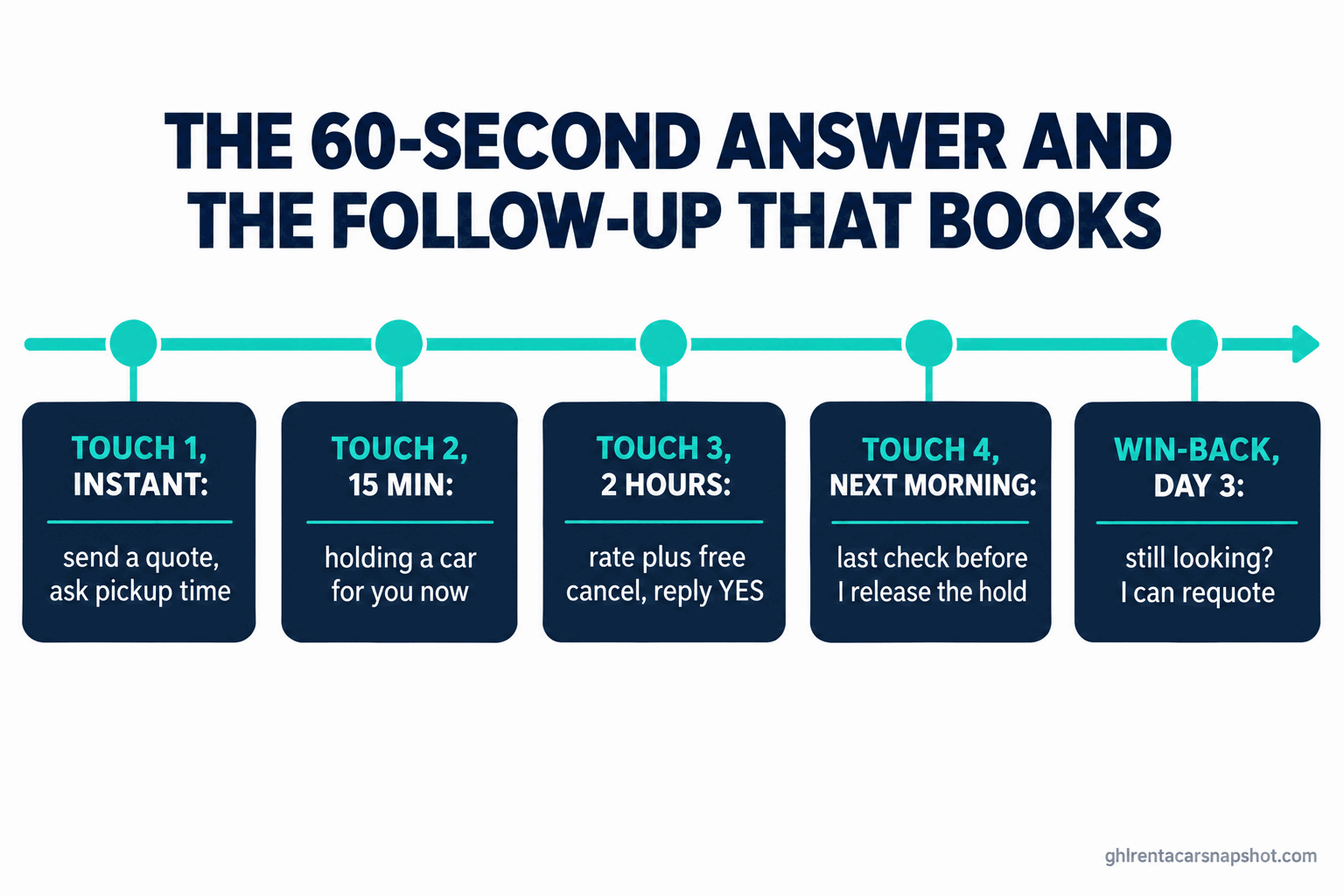
Touch 1, instant (under 60 seconds, any channel):
Hi {first name}, thanks for reaching out to {business}. You’re after a {vehicle type} for {dates}, is that right? We have options in that class. I can send you a quote and lock one in now. What’s the pickup time you’re thinking?
Touch 2, 15 minutes later if no reply:
Still here, {first name}. Weekend cars in that class go fast, so I’m holding one for now. Want the direct booking link, or two options to pick from?
Touch 3, 2 hours later if still no reply:
No rush {first name}, just don’t want you to miss the {vehicle type} for {dates}. It’s {rate}/day with a refundable hold, free to cancel up to {window} before pickup. Reply YES and I’ll send the link.
Touch 4, next morning if no reply:
Morning {first name}. Last check on your {dates} rental before I release the hold. Still want it? One reply and you’re booked.
The win-back, 3 days after a quote with no booking:
Hi {first name}, did you find a car for {dates}, or still looking? If your plans shifted I can quote new dates. We’d love to get you on the road.
Four or five short messages, spaced so they feel like a person following up, not a machine nagging. It is the same discipline behind recovering a half-finished reservation, its own build in the abandoned-booking recovery system. The gap between a lot that books 30% of its inquiries and one that books 60% is almost never the first message. It is whether touch three ever gets sent.
Three scenarios: 5, 25, and 80 cars
The system is the same shape at every size. What changes is how much runs on software versus one person’s attention.
The side-hustle host, 5 cars. Run a lean version by hand plus two automations: the missed-call text-back and a website form auto-reply, with Google calls forwarded to the same number and Instagram DMs checked twice a day at set times. That covers your leakiest doors while you drive or detail. You do not need the full inbox yet, you need the phone and the website to answer themselves.
The growing lot, 15 to 30 cars with help. Now more than one person touches leads, and “someone will check the DMs” stops being true. This is where the unified inbox earns its keep: every channel into one screen, each lead tagged by source, assigned to a person, escalated if it sits unanswered. The follow-up runs on its own so a busy afternoon never costs a booking, and the source tags start showing you that Google and referrals close while a certain paid channel just burns time.
The multi-location operator, 50 to 80-plus cars. Across locations, consistency and reporting are everything. Every lead, response time, and booking logs against its source and location, so you can spot the lot that answers fast and the one that leaks. Here the inbox is a coaching tool: response time becomes a number you manage, and a lead that waits too long alerts a manager instead of getting a shrug.
Texting leads without a TCPA or 10DLC problem
The second you text leads, three rulebooks apply, and getting this wrong turns a booking machine into a liability. The good news is most of these messages are the low-risk kind.
A reply to someone who just messaged you about a rental is a response to their inquiry, not a cold marketing blast, which is the safe category as long as you do not bolt a promotion onto it. But the plumbing still has to be compliant. As of June 30, 2026, A2P 10DLC campaign registration requires a public Privacy Policy URL and a Terms and Conditions URL, or the campaign is rejected and your texts never send (Twilio). Ignore older advice built on the FCC “one-to-one consent” rule, which was vacated in January 2025 and no longer applies (Womble Bond Dickinson). And if you rent in or to Florida, the Florida Telephone Solicitation Act lets a recipient sue for $500 per violating text, up to $1,500 if willful (Pillsbury). The full rulebook, with sample consent language, is in the TCPA and 10DLC guide for rental texts.
Common objections, answered
“Won’t an instant automated text feel fake?” Not if it is written like a person and asks a real question. “What dates and what vehicle” does not read as a robot, it reads as a counter clerk who picked up fast. What feels fake is silence followed by a canned “thanks for contacting us” three hours later.
“I already answer my phone, so why do I need this?” Because you cannot answer it while detailing a car, at the airport on a drop-off, or asleep. The system is not for the calls you catch. It is for the three you miss on a Friday morning and the DM at 11pm, which are exactly the leads going to the lot that does have a system.
“Do I need to be technical to set this up?” No. A missed-call text-back and a form auto-reply are standard automations, not custom code, and every modern platform has them. The unified inbox is a connect-your-channels setup, not a development project. If you would rather not wire it yourself, it is pre-built in the CRM and workflow automation module.
“What if most of my business is on Turo?” Then the inbox is how you stop being a tenant on someone else’s platform. Every direct lead you answer and keep is margin the marketplace never touches and a customer you own, instead of one you rent back at 10 to 40% a trip.
Frequently asked questions
How fast should a car rental business respond to a lead?
As close to instant as possible, and within a minute at the outside. Harvard Business Review's audit of 2,241 US companies found only 37% answered a lead within an hour and 23% never answered at all. Rental inquiries are especially perishable because shoppers compare several lots at once, so an automatic reply in under 60 seconds is the goal.
What is a missed-call text-back and why does it matter for a rental lot?
It sends an instant text to any caller you did not answer. Missed calls to a rental lot rarely turn into voicemails, so the caller just dials the next lot. A text that reopens the conversation and asks for dates and vehicle type converts a dead call into a live booking thread, and it is usually the single highest-return automation a lot can set up.
How do I handle leads from Instagram, Facebook, Google, and my website in one place?
Connect each channel into a single conversations inbox so every message lands on one screen as one thread per person. From there an instant auto-reply fires, the lead is tagged by source, and it is routed to a pipeline stage. That replaces checking six separate apps with one place that answers automatically and escalates anything left unanswered.
Is it legal to text people who submit a booking inquiry?
Replying to someone who just messaged you about a rental is a response to their inquiry, which is lower-risk than cold marketing, as long as you do not add a promotion. You still need compliant plumbing: as of June 30, 2026, A2P 10DLC registration requires a Privacy Policy and Terms and Conditions URL. Florida's FTSA allows $500 to $1,500 in damages per violating text, so follow the rules carefully there.
Why answer my own leads if Turo already sends me bookings?
Because Turo keeps 10% to 40% of every trip depending on your protection plan, and it is one platform that can change terms or shut down, as Getaround did in February 2025. Answering your own leads fast turns marketplace-priced demand into direct bookings you keep in full, and builds a customer base that is yours, not rented.
How many follow-up messages should I send a lead who doesn't reply?
Four to five over about 24 hours, then a win-back a few days later. Most bookings come on the second or third touch, so stopping after one message leaves money on the table. Each follow-up should be short, specific to the vehicle and dates they asked about, and should stop the moment they reply or book.
It is the next Friday, and you are under another returning Tahoe. Your phone buzzes twice and you ignore it, because this time you can. The missed call already got a text back asking for dates and vehicle. The 8:52 website form got a quote inside a minute. The Instagram DM got greeted and qualified while you checked the scuff, and the Turo guest got an answer and a note to book direct next time. By the time you slide out from under the truck, three of the four are already in a booking thread, and not one had to wait on you. That is what a lead inbox is for: it answers the door before you even hear the knock.