

It is 7:15am on a Friday and you fire off a batch of texts: “Your car is ready” to three pickups, “Bring it back by 10 or the day rolls over” to two returns. Ninety seconds of work that used to be five phone calls. Except two of those texts never land, because the number you sent from was never registered. And one went to a renter in Miami who has sued two businesses this year under a Florida law you have never heard of. That one text just became a legal problem.
Here is the short version so you can breathe. You are allowed to text renters. Operational reminders about pickup times, return times, and deposits are the safest messages you can send, as long as you did three things first: registered your number for A2P 10DLC, captured real consent at booking, and built a clean way to honor STOP. Get those right and reminders are low risk. Get them wrong and a single bad send can cost $500 to $1,500 per text under federal law, the same again under Florida’s mini-TCPA, and a blocked number that kills every message. This post walks the system, the failure points, and the reminder copy you can paste in today.
Key Takeaways
- Reminders are the safe kind of text, if you did the setup. Transactional messages tied to a booking carry far less risk than promotional blasts, but they still need registration and a consent trail.
- Unregistered texts do not get delivered. Since February 2025, US carriers block unregistered A2P traffic on 10-digit numbers outright, and T-Mobile can charge $2,000 to $10,000 per violation (JustCall).
- One new deadline matters. From June 30, 2026, A2P campaign registration requires a public Privacy Policy URL and a Terms and Conditions URL, or it is rejected (Twilio).
- Florida is the trap. The Florida Telephone Solicitation Act lets renters sue you directly for $500 to $1,500 per text (Pillsbury).
- The old “one-to-one consent” rule is dead. It was vacated in January 2025 and repealed, so ignore any 2024 advice built around it (Womble Bond Dickinson).
Table of contents
- What the law requires when you text a renter
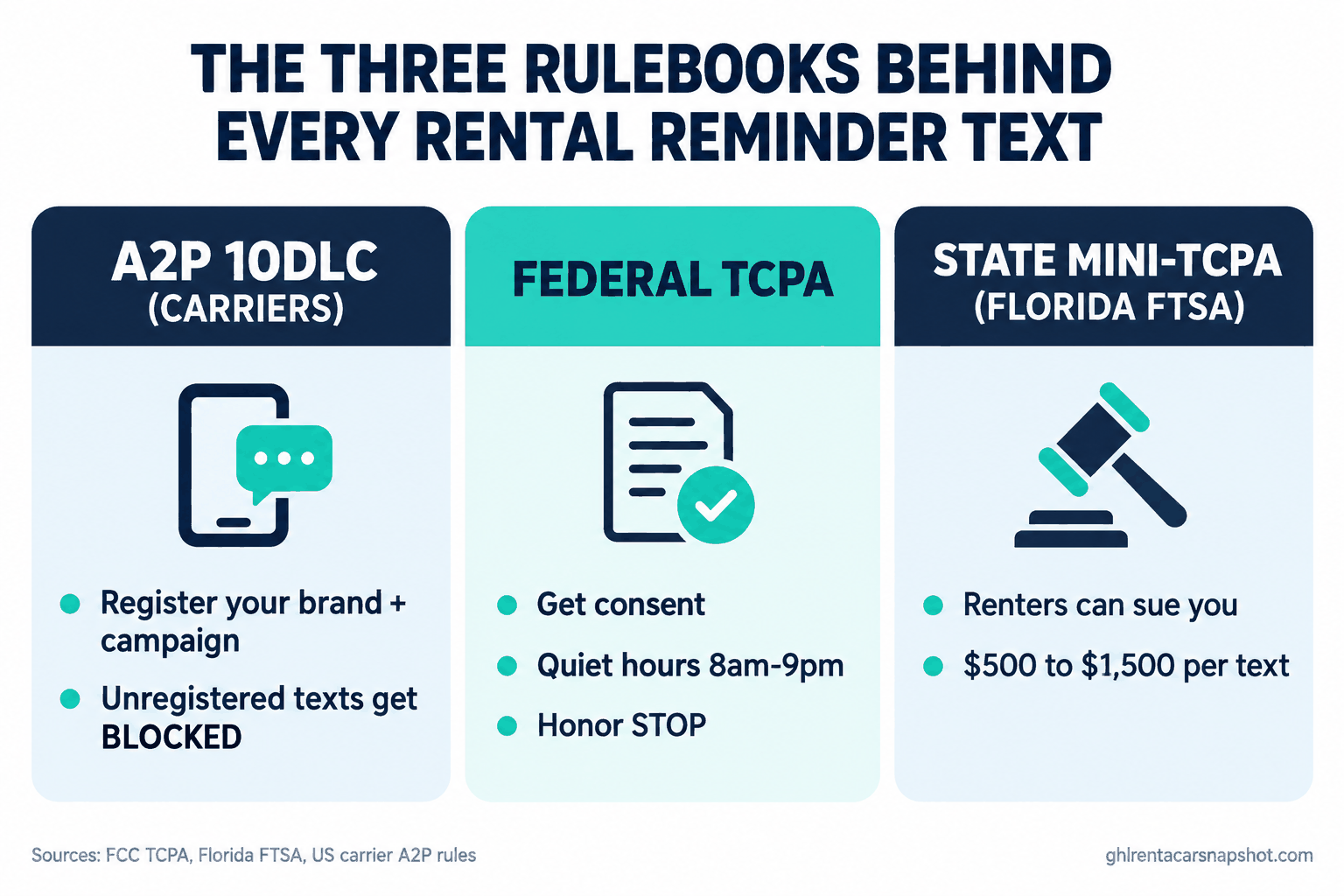
- The three rulebooks you are really under
- Stage 1: Register for A2P 10DLC (and the June 30 change)
- Stage 2: Get consent the right way at booking
- Stage 3: Write reminders that pass
- Stage 4: Honor STOP the way the FCC now demands
- Stage 5: Quiet hours and the transactional line
- Stage 6: Keep records that survive a demand letter
- Three scenarios: solo host, 30-car lot, multi-state
- Florida, and why one state can end your program
- Steal these: reminder texts that stay legal
- Common objections, answered
- Frequently asked questions
What the law requires when you text a renter
Texting works because renters read it. SMS open rates sit around 98%, far above email (Sender), which is why a reminder cuts no-shows and also why the rules exist. Reminders are the safest category, because a message about a booking the renter made is transactional, not a “20% off this weekend” blast that needs the strictest consent. But “less risk” is not “no rules.” Whatever you send, you have to be a registered sender, hold a record of consent, stay inside quiet hours, and stop the moment someone says stop.
The three rulebooks you are really under
Most operators think there is one rule. There are three, and they answer to different masters.
- A2P 10DLC carrier registration. Not a law, the phone carriers. Application-to-person texting on a normal 10-digit number has to be registered through The Campaign Registry before AT&T, T-Mobile, and Verizon will carry it. Skip it and your texts are not filtered, they are dropped (JustCall).
- The federal TCPA. Governs consent, quiet hours, and opt-outs nationwide. Damages run $500 per text, or $1,500 for a willful violation (ActiveProspect), enforced through private lawsuits.
- State mini-TCPA laws. Several states add their own rules, and Florida’s is the one that should worry a rental operator, because it lets renters sue you directly.
Registration gets your text delivered; the TCPA and the state laws decide whether it becomes a lawsuit. The calendar has moved fast:
- ⚖️Jul 2021
Florida FTSA right to sue
Florida's mini-TCPA takes effect.
- ❌Jan 2025
One-to-one consent vacated
Court strikes the FCC rule; later repealed.
- 🚫Feb 2025
Unregistered 10DLC blocked
Carriers stop delivering unregistered texts.
- 🔕Apr 2025
TCPA revocation rule live
Honor opt-outs sent any reasonable way.
- 🔗Jun 2026
Privacy + Terms URLs required
Registration rejected without both.
Stage 1: Register for A2P 10DLC (and the June 30 change)
Before consent, before copy, register. A2P 10DLC registration has two parts: your brand (legal business name and EIN) and your campaign (what you send, sample messages, how people opt in). Your provider (usually GoHighLevel or Twilio) submits both to The Campaign Registry, and approval tells carriers your traffic is legitimate.
Skip it and there is no soft landing. Since February 2025, every major US carrier blocks unregistered A2P traffic on 10-digit numbers, so messages simply do not arrive (JustCall), and T-Mobile can charge $2,000 to $10,000 per violation. Texting from an unregistered personal cell is the most expensive “free” move you can make.
Put one dated change on your calendar. From June 30, 2026, campaign registration requires a valid, public Privacy Policy URL and a Terms and Conditions URL. Submit without them and it is rejected with a hard error (Twilio 30933, 30934). Updating a campaign after that date hits the same check, so both pages need to be live on your site first.
Stage 2: Get consent the right way at booking
Consent is the spine of the whole thing, and a rental hands you a clean place to get it: the booking form. When a renter reserves a car, put a clear, separate opt-in for texts right there, not buried, not pre-checked. A defensible record has four parts: the exact wording they agreed to, when (a timestamp), where (booking form, phone, in person), and the number tied to it. “We always text renters” is not a defense; a logged, timestamped opt-in tied to a booking is.
Two levels matter. Transactional consent covers messages about the rental they booked: confirmations, reminders, deposit notices. Low bar, because the renter initiated it. Marketing consent covers promotions and re-rent offers, needs express written consent, kept separate. Use two boxes if you do both, and only send offers to people who ticked the marketing box.
Stage 3: Write reminders that pass
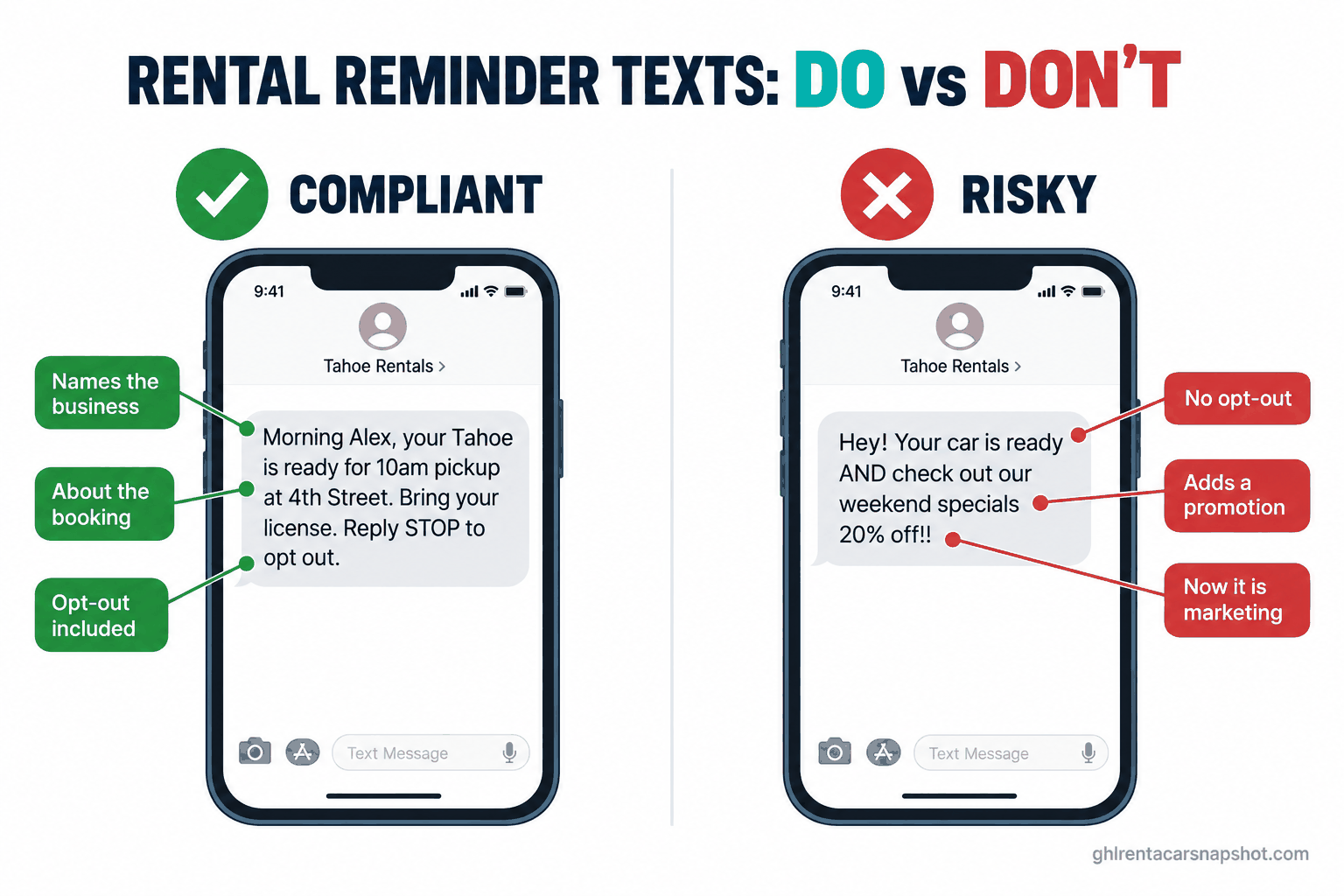
The rules here are concrete. Every automated text should do three things: name your business, stay relevant to the booking, and tell people how to stop. The first message to a renter should include the opt-out plainly, like “Reply STOP to opt out.” You do not need it on every message forever, but it belongs on the first one.
Keep reminders about the rental. “Your Tahoe is ready for 10am pickup at 4th Street, reply if you’re running late” is transactional and safe. Bolt “and check out our weekend specials” onto the end and you have turned it into marketing, which needs the stricter consent from Stage 2. The plumbing is the same automation behind missed-call text-back or a no-show recovery flow, and our TCPA-compliant SMS guide walks the consent, registration, and STOP handling one screen at a time.
Stage 4: Honor STOP the way the FCC now demands
Opt-out used to be simple: honor STOP. As of April 11, 2025 it is stricter, and this is where older systems fall down. Under the FCC’s revocation-of-consent rule, a renter can withdraw consent in any reasonable way that clearly says they want the texts to end, not just the exact word STOP (BCLP).
That means STOP, QUIT, END, CANCEL, UNSUBSCRIBE, and REVOKE all have to work, and a full-sentence “please stop texting me” counts too. Once someone opts out, stop within 10 business days, and in practice make it instant. You may send one confirmation text, as long as it carries no promotion.
Stage 5: Quiet hours and the transactional line
The TCPA sets quiet hours: no marketing texts before 8am or after 9pm in the recipient’s local time zone (National Law Review). This is a live litigation trend, with plaintiffs suing over texts sent at 7:52am even after opting in, so treat the window as a hard rule. And the time zone is the renter’s, not yours.
The bright spot: purely operational messages have more latitude than marketing, and the strongest argument that a text is transactional is that it is genuinely about the booking with no promotional content. That is the same discipline behind a full SMS marketing playbook: automate the operational spine, gate the promotional layer behind explicit consent.
Stage 6: Keep records that survive a demand letter
Compliance you cannot prove is compliance you do not have. Every stage above produces a record, and the operators who sleep at night keep them: the consent capture (wording, timestamp, source, number), the registration approval, the message logs, and every opt-out event with its date. Most of these cases start with a demand letter, not a courtroom, and the operator who can answer with a timestamped opt-in, a registered campaign, and a clean opt-out log is not the easy target the sender was fishing for. Store them where you can pull one renter’s history in a minute.
Three scenarios: solo host, 30-car lot, multi-state
The rules are the same for everyone, but the practical shape changes with size.
The solo host, 8 to 15 cars, one state. Probably a former Turo host building a direct book. Your whole load: register one brand and campaign, add one opt-in checkbox to the booking form, use one reminder template with STOP on it, keep your logs in one place. An afternoon covers you, and your biggest risk is a habit: texting from an unregistered personal cell. Still weighing the marketplace? The Turo versus your own booking system math is the companion read.
The 30-car lot with staff. Now more than one person can send a text, which is where sloppiness creeps in. You need one registered campaign plus a hard rule that nobody texts renters from their own phone, so all outbound is logged. Train the counter on what a reminder can and cannot say, and make opt-out handling automatic.
The multi-state operator. You are under several state mini-TCPAs at once, and they do not match. Build to the strictest state you operate in, usually Florida, and apply that everywhere: one high bar is simpler than tracking five. Time-zone-aware sending stops being optional, and your records must be airtight, because a bigger footprint draws more plaintiffs.
Florida, and why one state can end your program
If you rent cars in Florida, or to Floridians, read this twice. The Florida Telephone Solicitation Act, the FTSA, is the most aggressive mini-TCPA in the country for a rental operator, because Florida is a huge rental market and the law hands consumers a private right of action worth $500 per text, trebled to $1,500 for willful violations (Pillsbury).
That private right of action is the whole problem: an individual renter, or a lawyer trawling for them, can sue you directly, and a cottage industry does exactly that. A 2023 amendment (HB 761) added a 15-day cure window, but the core right to sue survived (Bradley). The exposure stacks on the federal TCPA, so one bad blast to a Florida list can be counted under both laws.
Downside of a non-compliant text, in US dollars. TCPA and FTSA figures are per text (standard vs willful); the T-Mobile figure is a per-violation carrier fee for unregistered traffic, at the top of its range. Sources: ActiveProspect, Pillsbury, JustCall.
The takeaway is not “never text Floridians.” It is that Florida is where sloppy consent turns expensive fastest, so run the strict version of every stage.
Steal these: reminder texts that stay legal
Here is the copy. Each one names the business, stays about the booking, and carries a stop instruction where it belongs. Swap in your details.
Booking confirmation (first message, opt-out included):
Hi {first name}, it’s Sunrise Rentals. You’re booked: {car}, pickup {date} at {time}, {location}. We’ll text a reminder before pickup and before return. Reply STOP to opt out, HELP for help.
Pickup-day reminder (morning of, inside quiet hours):
Morning {first name}, your {car} is ready for {time} pickup at {location}. Bring your license and the card on file. Reply here if you’re running late.
Return reminder (a few hours before due):
Hi {first name}, reminder your {car} is due back by {time} today at {location}. Need another day? Reply and we’ll check the calendar before the late fee kicks in.
Deposit-release notice (after return, transactional):
Thanks {first name}. Your {car} is checked in and your deposit hold has been released. It can take a few days to clear with your bank. Reply with any questions.
Opt-out confirmation (auto, no promotion, within five minutes):
You’re unsubscribed from Sunrise Rentals texts and won’t get more. If this was a mistake, reply START to opt back in.
None of them bolt a promotion onto an operational message. Keep any “book us again, here’s 15% off” text on a separate track that only reaches renters who gave marketing consent.
Common objections, answered
“Can’t I just text people, they booked a car from me?” Booking a car gives you a strong basis for transactional reminders. But “they booked from me” does not cover an unregistered number that gets blocked, a missed opt-out, or a promotional blast. The setup is an afternoon, once. The lawsuit is not.
“I already pay for rental software with texting built in. Am I covered?” Partly. The software sends the message, but registration, consent capture, and honoring opt-outs are things you configure, not defaults. Plenty of operators have texting switched on with no A2P registration behind it, so their reminders are quietly blocked. Check three things today: is your brand and campaign registered, does your booking form log consent, and does an odd-worded opt-out suppress the contact.
“Do I need a lawyer for this?” For a day-to-day reminder program, no. Register, capture consent cleanly, keep reminders operational, honor STOP, keep records. If you run large promotional campaigns across many states, or get a demand letter, that is when you call a professional.
Frequently asked questions
Is texting a pickup or return reminder legal without separate marketing consent?
Usually yes. A reminder about a booking the renter made is a transactional message, the lowest-risk category. You still need to be a registered A2P 10DLC sender, have a consent record from the booking, and honor opt-outs. You just cannot add a promotion to it, which would turn it into marketing and pull in stricter consent rules.
What is A2P 10DLC and do I really need to register?
A2P 10DLC is the carrier framework for texting from standard 10-digit business numbers. Your provider registers your brand and campaign with The Campaign Registry. It is not optional: since February 2025, US carriers block unregistered business texts entirely, so your reminders never arrive, and carriers like T-Mobile can charge $2,000 to $10,000 per violation.
What changes on June 30, 2026?
A2P 10DLC campaign registration will require a valid, public Privacy Policy URL and a Terms and Conditions URL. Register or update a campaign without both and it is rejected with a hard error, so make sure both pages exist on your website and are publicly reachable first.
What is the Florida FTSA and why does it matter for car rental?
The Florida Telephone Solicitation Act is Florida's mini-TCPA. It gives consumers a private right of action to sue over texts, worth $500 to $1,500 per message. Florida is a top rental market with active plaintiff activity, so if you rent to Floridians, one non-compliant send can be expensive. A 2023 amendment added a 15-day cure window but kept the right to sue.
Does replying STOP still cover me for opt-outs?
STOP has to work, but as of April 11, 2025 you must honor a renter withdrawing consent in any reasonable way, including full-sentence requests and keywords like QUIT, CANCEL, END, and UNSUBSCRIBE. You have to stop within 10 business days. Make sure your system catches free-text opt-outs, not just the exact word STOP.
Reminders are one of the highest-return, lowest-effort things a rental operator can automate. Do the setup once, register, capture consent, keep the copy clean, honor every stop, keep your records, and you get the upside with almost none of the downside. It is 7:15am again next Friday. This time every text lands, and not one is a problem.