

An independent Orlando rental lot competes for the same renter as Enterprise, Turo hosts, and a dozen other counters near the airport — and most of them are outspending you on Google Ads. So how does a small operator win? You build a blog content engine: a steady stream of genuinely useful, Orlando-specific articles that rank in Google for the searches renters actually type, get quoted inside AI answers, and compound into free bookings long after each post is published — instead of renting attention by the click. Paid ads stop the moment the budget does; a content engine keeps working every weekend for years.
This is a practical, step-by-step playbook for Orlando car rental operators (and the GoHighLevel agencies running their marketing) on why a consistent blog beats one-off pages, what the current data says about content versus paid, and the exact six-step engine that turns “car rental Orlando” searches into card-on-file reservations.
Key Takeaways
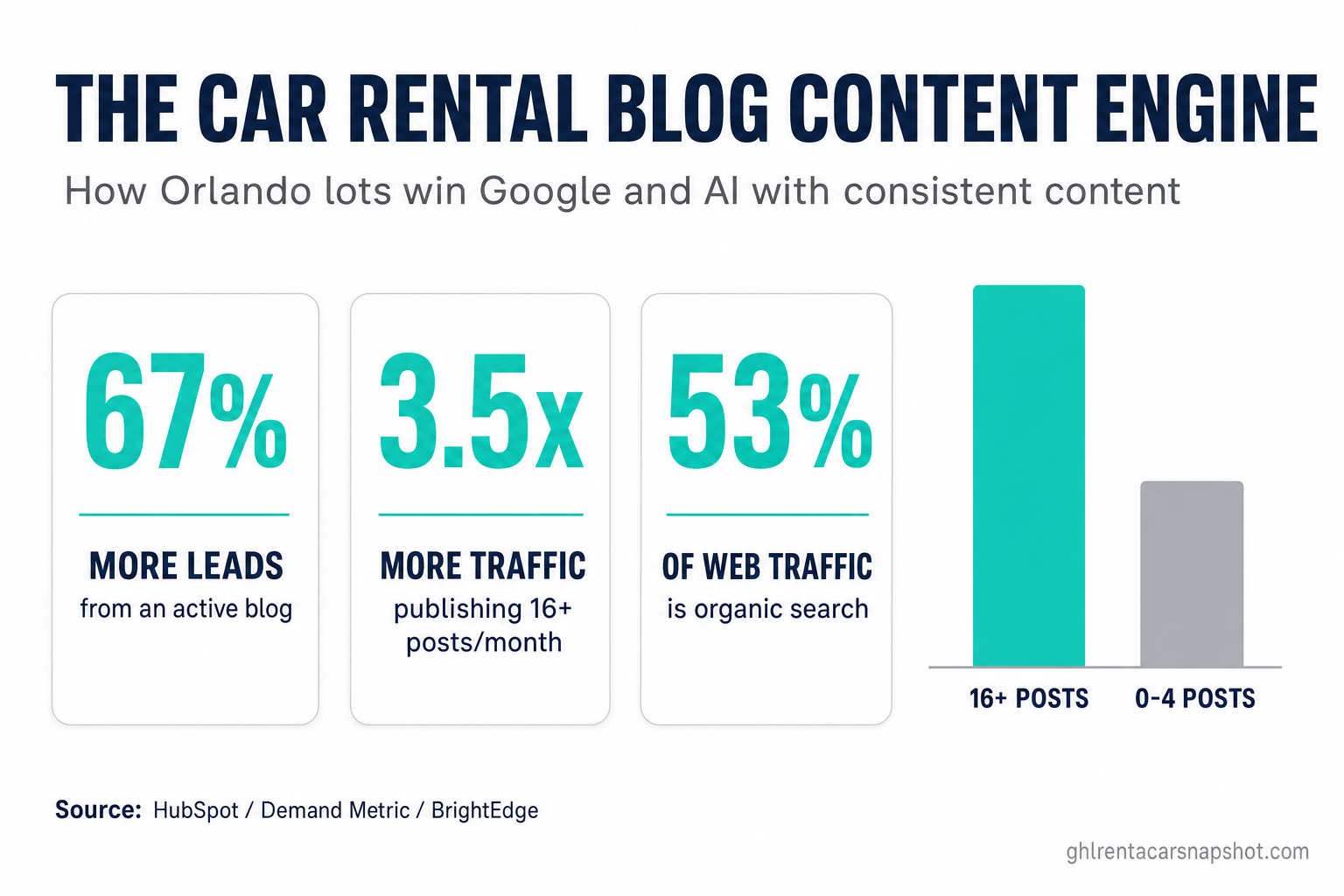
- Companies with an active blog generate about 67% more monthly leads than those without (Demand Metric, via HubSpot), and content marketing costs roughly 62% less than traditional advertising while producing about 3× the leads (Demand Metric). For a lot that can’t out-bid the majors on ads, that gap is the whole game.
- Consistency is the lever: businesses publishing 16+ posts a month get nearly 3.5× more traffic than those publishing 0–4 (HubSpot). A content engine — not a stray post every quarter — is what moves the needle.
- Organic search drives roughly 53% of all website traffic — more than paid, social, and referral combined (BrightEdge). It’s the largest, cheapest channel your Orlando site owns.
- AI answers are compressing clicks: Pew found users click a search result on just 8% of pages that show an AI summary, versus 15% without one (Pew Research Center) — so being inside the answer, via well-structured content, now matters as much as ranking below it.
- Orlando is the demand: 75.3 million visitors came in 2024 (Visit Orlando) and 57.7 million passengers moved through MCO in 2025, now the 7th-busiest U.S. airport (Orlando Weekly) — a river of high-intent renters searching before they land.
Table of contents
- What a “blog content engine” actually is
- Why Orlando rental demand rewards content
- The math: content vs paid ads for a rental lot
- AI answers changed the target — and content is how you hit it
- The 6-step Orlando car rental content engine
- DIY vs a done-for-you content engine
- How the content engine feeds bookings
- Frequently asked questions
What a “blog content engine” actually is
A one-off blog post is a flyer. A content engine is a printing press.
Most rental lots that “have a blog” have three stale posts from the year they launched the site. That isn’t a content engine — it’s a graveyard. A content engine is a repeatable system that ships useful, search-shaped articles on a fixed cadence, each one built to rank for a specific renter question, structured so Google and AI assistants can quote it, and internally linked so it funnels readers toward your fleet and booking page.
The difference is compounding. A Google Ad is a lit match — bright while the budget burns, dark the instant it stops. A ranked article is a solar panel: it costs to install, then generates bookings every weekend without another dollar of spend. Ten, twenty, fifty of those working together is an asset that grows in value while your competitors keep re-buying the same clicks.
Three traits separate an engine from a graveyard:
- Cadence. New, genuinely useful posts on a schedule (a post or two a week), not a burst once a year.
- Search intent. Every post answers a real query an Orlando renter types — “car rental near Orlando airport,” “monthly car rental Orlando,” “do I need insurance to rent a car in Florida.”
- Structure. Answer-first writing, clean headings, schema, FAQs, and internal links — so the post is legible to Google’s crawler and to the AI models now writing the answers.
Why Orlando rental demand rewards content
Orlando is arguably the best content-marketing environment a car rental company could ask for, because the demand is enormous, tourist-driven, and almost entirely research-first.
The numbers are staggering. Orlando welcomed 75.3 million visitors in 2024 — a record — generating roughly $92.5 billion in economic impact (Visit Orlando). Most of them fly in: Orlando International Airport (MCO) handled 57.7 million passengers in 2025, climbing to the 7th-busiest airport in the United States (Orlando Weekly). Zoom out and the U.S. car rental market was worth an estimated $65+ billion in 2025, with Florida one of its largest single markets (MMCG Investment Research).
Here’s why that specifically rewards content: a tourist booking a car for a Disney week doesn’t know your lot exists. They start with a question in Google — “best way to rent a car in Orlando,” “Orlando airport car rental without a big deposit,” “SUV rental for a family of 6 near Orlando.” Every one of those is a post you could rank for. The renter who reads your answer, trusts it, and clicks through arrives pre-sold — the opposite of a cold ad interruption.
The math: content vs paid ads for a rental lot
If you run Google Ads for an Orlando lot, you already know the pain: competitive rental keywords are expensive, the majors bid them up, and the moment you pause the campaign, the bookings vanish. Content flips that economics.
The benchmark data is consistent and blunt. Companies with an active blog generate around 67% more monthly leads than those without one (Demand Metric, via HubSpot), and the classic Demand Metric analysis found content marketing costs about 62% less than traditional advertising while generating roughly three times as many leads (Demand Metric summary). And organic isn’t a rounding error — BrightEdge’s research pegs organic search at about 53% of all website traffic, larger than paid, social, and referral combined (BrightEdge).
But the real unlock is cadence, and this is where most lots leave money on the table:
That 3.5× isn’t magic — it’s coverage. More consistent posts mean more renter questions answered, more keywords ranked, more internal links, and more freshness signals to Google. A single post can’t do that; a steady engine does it automatically. A 2025 StrataBeat study found the same pattern holds in the AI era: B2B companies publishing 9+ posts a month grew Google traffic 35.8% year over year, versus 16.5% for those publishing just 1–4 (StrataBeat, via HubSpot).
AI answers changed the target — and content is how you hit it
The reason a content engine matters more in 2026, not less, is that Google now often answers the question itself. AI Overviews and assistants like ChatGPT and Perplexity increasingly summarize “best Orlando airport car rental” at the top of the page, and that changes renter behavior.
The click compression is real: Pew Research found users click a traditional search result on just 8% of pages that display an AI-generated summary, compared with 15% of pages without one — and only about 1% click a link inside the summary itself (Pew Research Center).
That sounds like bad news for content — until you see what it actually means. If clicks are scarcer, then being cited inside the answer is the new front page. And AI answers are built from content: they pull structured, authoritative, well-organized pages and quote them. AI Overviews now appear on a large and growing share of searches — roughly half of tracked queries by some measures — and the vast majority cite three or more sources (BrightEdge / industry tracking). A lot with zero content is invisible to that layer. A lot with a deep, well-structured Orlando content library becomes one of the sources the AI quotes.
The 6-step Orlando car rental content engine
Here’s the actual engine — the repeatable loop that turns Orlando search demand into ranked, AI-citable pages that feed your booking funnel.
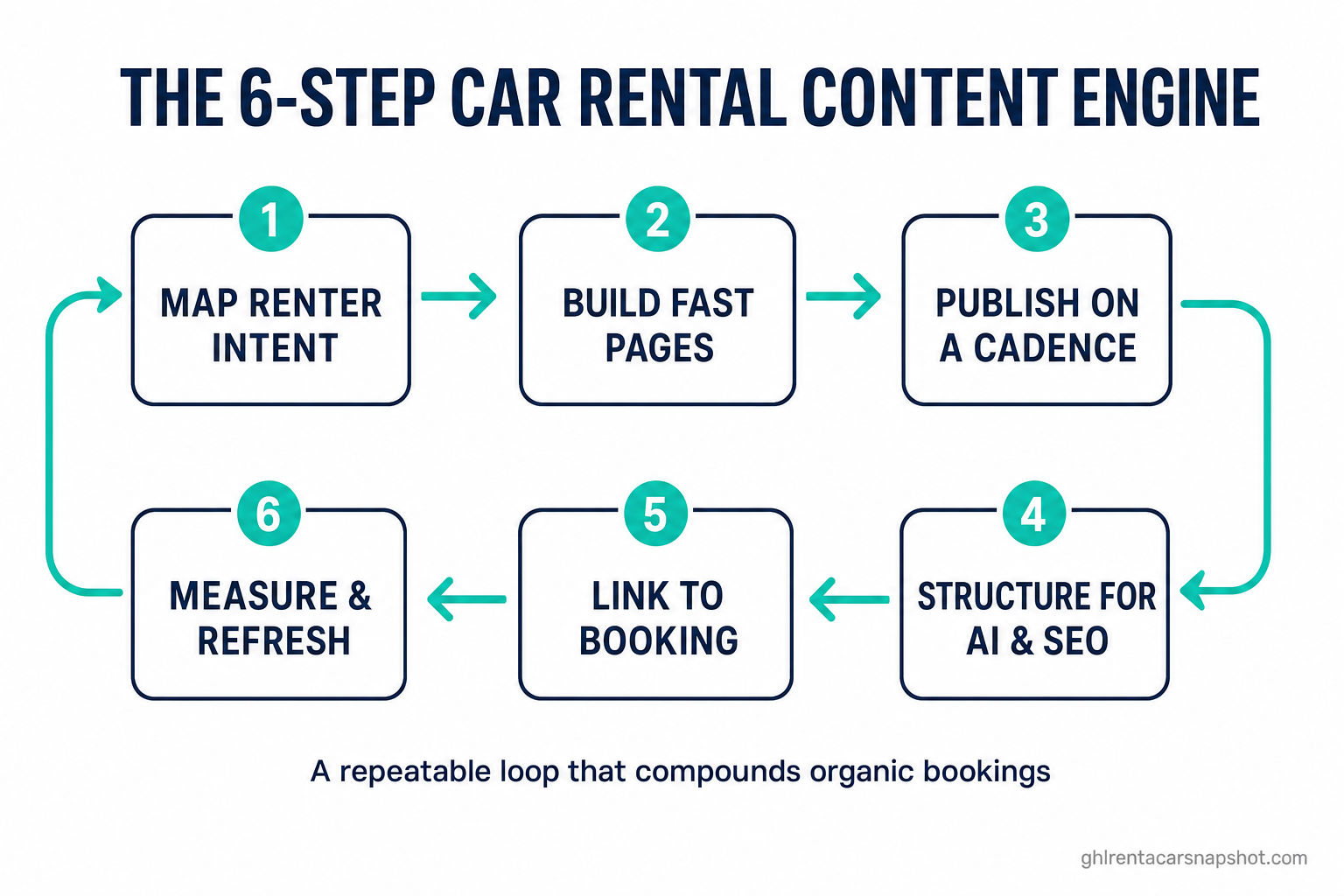
- Map Orlando renter intent. List the real questions and searches your renters have — airport pickup, monthly and weekly rentals, no-big-deposit options, SUV/van for families, exotic rentals for a special weekend, “car rental near [Disney / Universal / Convention Center].” Each becomes a post or a location page targeting one high-intent keyword.
- Build fast, dedicated pages. Publish each piece on a static-first, Astro-built site that loads in under two seconds on mobile and passes Core Web Vitals — because a slow page throttles everything the engine produces.
- Publish on a real cadence. Ship consistently — a post or two every week — so coverage, freshness, and keyword footprint compound. This is the step DIY operators almost always abandon by week three; it’s also the step that produces the 3.5× traffic gap.
- Structure every post for AI and search. Answer-first intro, clean H2/H3 headings shaped like questions, an FAQ with FAQPage schema, BlogPosting and LocalBusiness schema, alt text, and a real sitemap plus
llms.txtso both Google and AI crawlers can read the fleet cleanly. - Internal-link to the money pages. Every post should route the reader toward your fleet classes, location pages, and booking form with natural internal links — turning a reader into a lead, not just a pageview.
- Measure and refresh. Watch which posts rank and convert, update them to keep them fresh (a confirmed ranking signal), and feed the winners back into step one. The engine gets smarter every cycle.
The lots that win with content aren’t the ones that write the cleverest post — they’re the ones that never stop shipping. One good Orlando article a week for a year is fifty ranked assets working every weekend. The magic isn’t the writing; it’s the cadence nobody can keep up by hand.
DIY vs a done-for-you content engine
You can run this engine yourself. The honest question is whether you’ll still be running it in month four — because between the counter, the lot, and turnaround, consistency is the first thing to slip.
| DIY blogging | Done-for-you content engine | |
|---|---|---|
| Cadence | Slips when the lot gets busy | Fixed schedule, ships regardless |
| SEO/AEO structure | Easy to skip schema, FAQs, internal links | Built into every post |
| Site speed | Whatever your platform does | Static-first Astro, 90+ PageSpeed |
| Keyword research | Guesswork | Mapped to real rental search intent |
| Time cost | 4–8+ hours per post | Zero of your hours |
| Compounds over time | Only if you never stop | Yes — by design |
This is exactly what our Auto Blog Posting service is built for: on an Astro site we build and host for you, we research, write, and publish 2 niche-specific posts every week — mapped to your fleet, your Orlando locations, and the rental searches that actually pull bookings — for $197/month total (the site plus the content engine). No hourly writer bills, no cadence that collapses when the weekend rush hits.
How the content engine feeds bookings
A content engine wins the visit — but a visit isn’t a booking. The renter who reads your “Orlando airport car rental” post, trusts it, and clicks through still needs an instant reply, a held deposit, and a reminder before pickup, or they drift to the next lot while your counter is busy.
That’s the handoff. Content is the top of the funnel; automation is what converts it. A ranked post should feed straight into instant missed-call text-back and follow-up and the broader AI booking systems that catch every inquiry the content generates — so a Tuesday-night reader becomes a Friday card-on-file reservation instead of a lost tab. Get both halves right — a content engine that earns the click and automation that answers in seconds — and you stop leaking Orlando’s weekend demand.
For the numbers behind where rental websites leak and how the funnel stacks up, see the 2026 car rental industry benchmarks and the website conversion playbook.
Frequently asked questions
Does a car rental business really need a blog in 2026?
Yes — arguably more than ever. Organic search still drives roughly 53% of all website traffic (BrightEdge), companies with an active blog generate about 67% more leads than those without (Demand Metric/HubSpot), and AI answers are now built from structured content. For an Orlando lot that can't out-bid the majors on ads, a consistent blog is the most cost-effective way to capture the 75+ million visitors researching before they book.
How often should an Orlando car rental company publish?
Consistency matters more than any single post. HubSpot's data shows businesses publishing 16+ posts a month get nearly 3.5× the traffic of those publishing 0–4, and a 2025 StrataBeat study found 9+ posts a month grew traffic 35.8% year over year versus 16.5% for 1–4. A practical, sustainable target is 1–2 genuinely useful posts per week, every week — the cadence is the whole point.
Will AI Overviews make blogging pointless?
The opposite. AI Overviews compress clicks — Pew found users click a result on just 8% of pages that show an AI summary versus 15% without — which means being cited inside the answer is the new goal. AI answers are assembled from well-structured content and typically cite three or more sources. A lot with no content is invisible to that layer; a lot with a deep, structured Orlando library becomes a source the AI quotes.
How is content marketing cheaper than Google Ads for a rental lot?
Ads cost money every single click and stop the instant you pause the budget; competitive rental keywords are bid up by the national chains. A ranked article keeps generating bookings for years at no additional cost per visit. Demand Metric's benchmark is that content marketing costs about 62% less than traditional advertising while producing roughly 3× the leads. Most operators run both — ads for immediate demand, content for the compounding, durable base.
What should the blog posts actually be about?
Real renter questions and Orlando-specific intent: airport pickup logistics, monthly and weekly rentals, deposit and insurance questions for Florida, family SUV and van options, exotic rentals for special weekends, and neighborhood or attraction-based location pages (near Disney, Universal, the Convention Center). Each post targets one high-intent keyword, answers it first, and links to your fleet and booking pages.
About the author: Priya Sandoval runs a boutique GoHighLevel agency in Austin, Texas that resells done-for-you snapshots to local service businesses, with car-rental operators as her fastest-growing segment. She is obsessed with the mechanics that turn a one-time renter into repeat revenue — pipelines, cadence, and the unglamorous plumbing of content and automation that actually ships and converts.
Related reading:
- How Car Rental Companies Get Found in AI Search: The 2026 AEO Guide
- Local SEO for Car Rental Businesses: The 2026 Google Ranking Playbook
- Car Rental Website Speed in Miami: Why Fast Sites Book the Weekend
- Car Rental Website Conversion: Turn More Visitors Into Booked Rentals
- Missed-Call Text-Back for Car Rentals: Stop Losing Weekend Bookings
Editorial note: figures cited are drawn from the third-party research linked inline and reflect the sources as of publication. Content-marketing benchmarks (Demand Metric, HubSpot, StrataBeat) are cross-industry medians, not a prediction for any specific lot; AI Overview coverage and click data are evolving fast — confirm current sources before making decisions. GHL Car Rental Snapshot builds GoHighLevel automation systems and fast Astro websites — it is not a car rental company, insurer, or payment processor. Market data and search-ranking factors change over time.