

You crossed 18 cars this summer, the spreadsheet finally broke, and now you have two tabs open: Fleetwire, which shows you a price in four seconds, and HQ Rental Software, which shows you a price too but hangs a $950 onboarding fee off the side of it. One question before Friday: for a fleet your size, which is the right buy? Not the cheapest. The right one.
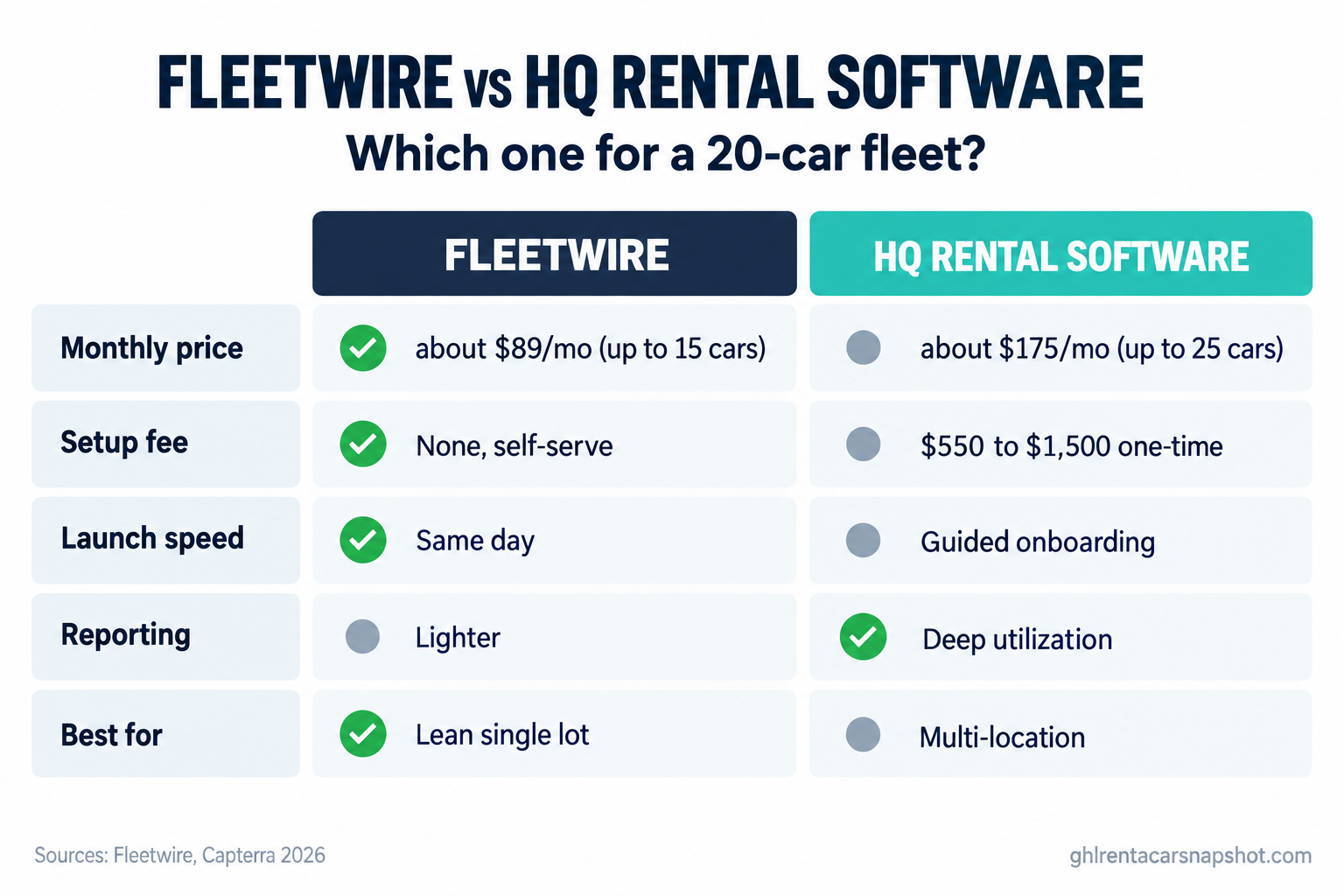
Here is the short version so you can close a tab. For a 20-car fleet, Fleetwire is the faster, cheaper start but you sit just past its published 15-vehicle band, and HQ Rental Software is the deeper, pricier platform that fits a 20-car shop almost exactly in its $175/mo Standard tier, before a four-figure setup fee. Fleetwire wins on speed and monthly cost. HQ wins on depth, reporting, and multi-location. Below is the full head-to-head across the eight things that decide it, plus the third option neither vendor mentions on a demo call.
Key Takeaways
- Fleetwire publishes real prices; HQ makes you look them up. Fleetwire lists about $34/mo up to 5 vehicles and $89/mo up to 15 (Fleetwire). HQ’s cited tiers are $120 / $175 / $250 a month, plus a one-time onboarding fee of $550 to $1,500 (Capterra).
- A 20-car fleet is awkward on Fleetwire, clean on HQ. You are one band above Fleetwire’s $89 tier, and squarely inside HQ’s Standard plan (up to 25 vehicles).
- The sticker is not the bill. Add Stripe fees and per-check ID verification on Fleetwire, and a four-figure onboarding fee on HQ.
- Both make you responsible for texting law. A2P 10DLC and Florida’s FTSA apply no matter which platform sends the message.
- Your biggest cost is usually commission, not software. On Turo, 2026 plans keep 10% to 30% of every booking (Turo), dwarfing any subscription here.
Table of contents
- The 60-second answer
- What the wrong pick costs
- How the two really differ
- The 8 things that decide it
- Steal these renter messages
- Same question, three fleet sizes
- The texting rules either way
- Objections, answered
- FAQ
The 60-second answer for a 20-car fleet
If you want to be live this weekend, keep costs low, and you run a single location with mostly direct and Turo-synced bookings, Fleetwire is the right buy. You sign up yourself, import your cars, and take reservations the same day. The catch: at 20 vehicles you are above the published $89 up-to-15 band, so check fleetwire.io for your tier’s figure first.
If you run more than one lot, you care about utilization reports and rate rules, you have staff who need separate logins, and you are fine paying a setup fee once, HQ Rental Software is the right buy. A 20-car fleet fits its Standard plan at about $175 a month, up to 25 vehicles, with depth you will grow into.
Neither is wrong. They are built for different operators. The rest of this post tells you which one you are, because the demo call will not.
What picking the wrong one actually costs you
The wrong software does not announce itself. It leaks money for six months, then you rip it out and start over.
Too light and you outgrow it mid-season: you hit the vehicle cap, the reporting cannot tell you which cars are idle, and you migrate in July, your busiest month. Too heavy and you pay a four-figure setup fee for features you never use. HQ’s onboarding fee runs from about $550 on Basic to $1,500 on Professional (Capterra), real money before your first reservation.
And the cost that swamps both: if you still hand Turo a slice of every rental, the subscription argument is almost a rounding error. Turo’s 2026 plans pay hosts 70%, 80%, or 90% of trip price by protection plan, so Turo keeps 10% to 30% (Turo host share), on a base of over 175,000 hosts and 350,000 vehicles as of mid-2023 (SEC EDGAR). A fifth of your gross dwarfs $89 or $175 a month. We did that math in Turo vs. your own booking system.
How Fleetwire and HQ Rental Software really differ
Strip away the feature lists and these two tools have different personalities.
Fleetwire is the self-serve tool for the operator who graduated from spreadsheets and Turo. It publishes its price, gives a 14-day free trial with no card, and leans into the car-sharing world: automated ID verification, digital agreement signing, automated messaging, and calendar sync with the big platforms. One person can run it.
HQ Rental Software is the heavier platform for the shop becoming a company. More rate control, more reporting, multi-location, deeper admin. It gates most pricing behind a demo and charges to onboard you, which tells you who it is for: operators who want a sales engineer to set it up and do not blink at a setup fee.
Here is the published price ladder side by side.
Published monthly price by fleet-size tier, US, 2026. A 20-car fleet sits above Fleetwire’s $89 band and inside HQ’s $175 Standard tier (HQ excludes onboarding). Sources: Fleetwire, Capterra.
The 8 things that decide it at 20 cars
1. Price at your fleet size, and what the sticker hides
At 20 cars, Fleetwire has you one notch above its clean $89 up-to-15 band, so budget for its next tier and confirm the live number. HQ fits you in Standard at about $175/mo for up to 25 vehicles (Capterra), with headroom before the cap.
Now the part the pricing card hides. On Fleetwire you also pay Stripe’s processing and roughly $1 to $2 per premium ID check. On HQ you pay the onboarding fee once, so year one differs from year two: HQ Standard at 20 cars is $175 × 12 + $950, about $3,050 in year one and $2,100 after.
Where it breaks: operators compare Fleetwire’s $89 against HQ’s $175 and stop there. Add HQ’s $950 onboarding and Fleetwire’s per-check fees and the gap narrows or flips. Price the first twelve months, not the first.
2. Setup and migration off your spreadsheet
Fleetwire is same-day: import cars, set rates, connect Stripe, live without talking to anyone. HQ is a guided onboarding, slower but with someone walking you through rate rules you would otherwise botch.
Where it breaks: the migration itself. Nobody imports existing reservations and card-on-file holds cleanly the first time. Whichever you pick, run both systems in parallel for two weeks and reconcile daily, so a booking in the old tool does not become a double-booking in the new one. We wrote that playbook in how to stop double-booking a fleet across Turo and your website.
3. Booking engine and calendar sync
Both give you an online booking page and a fleet calendar. Fleetwire’s edge is native sync with Turo and the car-sharing platforms, useful if you are a power host still listing there. HQ’s edge is rate control: seasonal pricing, length-of-rental discounts, and rules a 20-car shop with mixed vehicle classes needs.
Where it breaks: a sync gap. If your direct site, Turo, and the front desk are not reading the same availability in real time, you rent the same car twice on a holiday weekend. Sync is only as good as its slowest channel.
4. Payments, deposits, and card-on-file holds
This is where a 20-car fleet lives or dies. You need a real pre-authorization hold on the card before keys leave, not a promise to charge later. Fleetwire runs on Stripe, so you get its auth-and-capture holds directly. HQ integrates multiple processors and gives more control over deposit rules per vehicle class, handy when exotic holds look nothing like economy holds.
Where it breaks: auth holds expire. A Stripe pre-authorization typically falls off after about a week, so a two-week rental needs a plan: a fresh hold or a different deposit mechanism. Cannot re-authorize, and you are exposed on long rentals exactly when damage risk is highest.
5. Digital rental agreements and e-sign
Both sign agreements digitally, the baseline in 2026. The real question is whether the signed PDF, the license photo, and the timestamped condition photos all live in one place on the reservation. That bundle is your evidence in a deposit dispute.
Where it breaks: the agreement signs but the photos live in someone’s phone. When a renter disputes a scratch, you need the out-photos and signed terms in one timestamped record. Scattered, you lose the chargeback. We broke down the flow in the digital rental agreement and e-sign guide.
6. Customer messaging and SMS
Fleetwire ships automated messaging in the core product. HQ has messaging too, usually configured during onboarding. Both send a pickup reminder. Neither makes you compliant with texting law (section below).
Where it breaks: the templates ship generic and nobody edits them. A reminder that says “Your rental is ready” with no location, no return time, and no opt-out line is both useless and a legal risk. The copy is the product here, not the send button.
7. Reporting and fleet utilization
At 20 cars you cannot eyeball utilization anymore. You need a report that shows which vehicles are earning and which are parked. This is HQ’s clearest advantage: deeper reporting and utilization views built in. Fleetwire reports the essentials, lighter.
Where it breaks: you track revenue but not utilization, so a car that rents often at a bad rate looks like a winner while a parked car looks fine. If your tool will not show it cleanly, calculate it with our fleet utilization-rate guide.
8. Support, contracts, and getting your data out
Fleetwire is month-to-month and self-serve, so leaving is easy, but support is lighter-touch. HQ gives more hands-on support, part of what the onboarding fee buys, but can make an export harder.
Where it breaks: the data-export question you never ask until you leave. Before you sign either one, confirm in writing that you can export customers, reservations, and vehicle history. A tool you cannot leave is a tool that can raise its price.
Fleetwire vs HQ Rental Software at 20 cars
| Plan | Fleetwire | HQ Rental Software recommended |
|---|---|---|
| Price | ~$89+/mo | ~$175/mo + setup |
| Feature 1 | Self-serve, same-day launch | Guided onboarding (paid) |
| Feature 2 | Published price, 14-day trial | Demo-gated pricing |
| Feature 3 | Native Turo / car-sharing sync | Deeper rate + deposit rules |
| Feature 4 | Stripe deposits, per-check ID fees | Multi-location, multi-user |
| Feature 5 | Lighter reporting | Strong utilization reporting |
| Feature 6 | Month-to-month, easy exit | $550-$1,500 one-time onboarding |
| Best for fast, lean launch | Best for depth + growth |
Steal these renter messages
The messaging feature is only as good as the words in it. Here are five texts a 20-car fleet should run on either platform. Each ends with an opt-out because A2P 10DLC and the TCPA expect it.
That block is the part both tools leave blank. The software sends it; you write it.
Same question, three fleet sizes
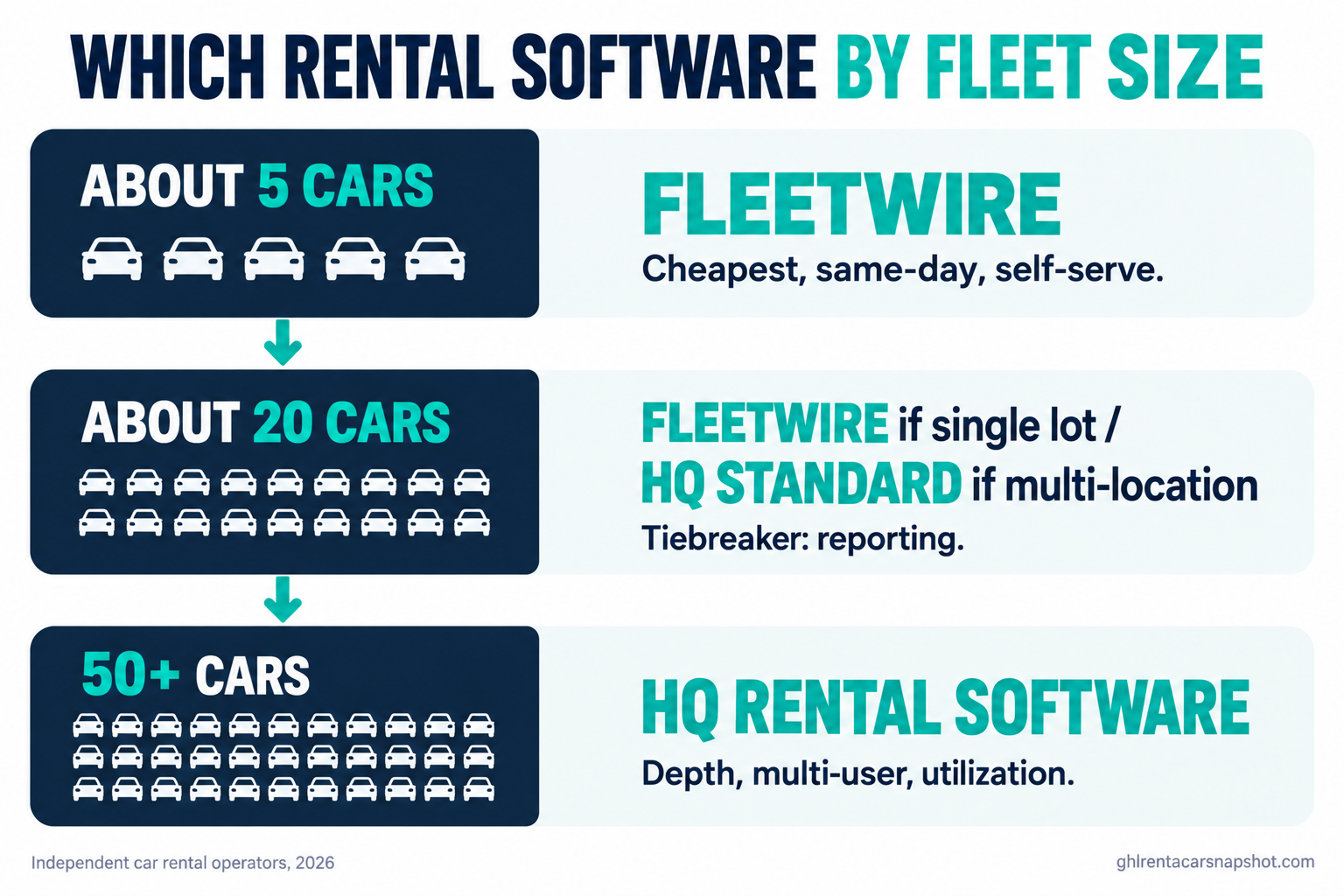
The right answer changes with the number of cars.
Solo operator, about 5 cars. Fleetwire, clearly. You sit right in the $34 up-to-5 band, you need speed and low cost, and HQ’s onboarding fee is hard to justify on five vehicles. Run Fleetwire, write good texts, put the savings toward your direct-booking site.
Mid-size shop, about 20 cars (you). The real contest, and it comes down to one question: single location or multi. Single lot, mostly direct and Turo-synced, pick Fleetwire and accept its upper band. Multiple lots or separate staff logins and you want reporting, pay HQ’s Standard plan and the onboarding fee once. The tiebreaker is reporting, because a 20-car fleet that cannot see utilization is flying blind, and that favors HQ.
Large fleet, 50+ cars. HQ, or something heavier. You are past Fleetwire’s comfortable range, you have rate complexity and multiple users, and you need the reporting. The onboarding fee is noise against your gross, and this is where owning your booking flow matters most.
Notice what is constant across all three: the rental platform runs the booking and deposit, but none runs your lead follow-up, abandoned-reservation recovery, or review pipeline. Same gap at 5 cars or 50.
The texting rules that bite either way
Both platforms send texts. Neither keeps you legal. That is your job, and it bites hardest in Florida, a top rental market with teeth in its law.
First, A2P 10DLC. To send business texts in the US you register your brand and campaign through the carriers. New campaign registrations submitted after June 30, 2026 must include a public PrivacyPolicyUrl and a TermsAndConditionsUrl, or they are rejected at review (Twilio). No privacy and terms pages on your site? Fix that first.
Second, Florida’s FTSA. The Florida Telephone Solicitation Act is a mini-TCPA with a private right of action, so renters and the lawyers who find them can sue over improper marketing texts. The 2023 amendment narrowed it to match the federal autodialer standard (Goodwin Law), but the private right of action is still live. Rent in Florida, get express written consent before marketing texts.
The practical rule: transactional texts (booking and return reminders) are lower risk because the renter gave you their number to do business. Marketing texts (promos, win-backs) need real consent. We go deeper in texting rental reminders without a TCPA or 10DLC disaster.
Common objections, answered
“Fleetwire is cheaper, so why pick HQ?” Because cheaper monthly is not cheaper total if you outgrow it and migrate mid-season, and at 20 cars reporting is not a luxury. Single-location and lean, Fleetwire wins. Multi-location or data-driven, HQ earns its price. Cheapest sticker and right choice are not always the same car.
“I already pay for HQ. Should I switch to save money?” Probably not for the monthly difference alone. Switching costs you a migration, retraining, and the risk of a double-booking during the overlap. Switch if HQ is genuinely too heavy for how you operate, not to save roughly $85 a month. And the harder skill on either tool is not technical, it is writing the messages and deposit rules and keeping your data clean.
“Can’t I just keep using Turo and skip all this?” You can, and you will keep paying Turo 10% to 30% of every booking to do it (Turo host share). A rental platform plus a direct-booking site is how you stop renting your own customers back from a marketplace, a strategy question worth more than the software one.
Frequently asked questions
Is Fleetwire or HQ Rental Software better for a 20-car fleet?
Single location, lean, mostly direct and Turo-synced: Fleetwire, though at 20 cars you are above its $89 up-to-15 band. Multi-location and reporting-driven, fine paying a setup fee once: HQ's Standard plan (about $175/mo, up to 25 vehicles) fits cleanly.
How much does Fleetwire cost?
Tiered pricing from around $24/mo, roughly $34/mo for up to 5 vehicles and $89/mo for up to 15, with a 14-day free trial. Stripe processing and about $1 to $2 per premium ID check apply on top. A 20-car fleet is in the next band up.
How much does HQ Rental Software cost, and is there a setup fee?
Commonly cited tiers are about $120, $175, and $250 a month by fleet size, plus a one-time onboarding fee reported between $550 and $1,500, and a 7-day trial. Most pricing is confirmed on a demo call, not a public page.
Does either platform keep me TCPA and A2P 10DLC compliant?
No. Both send texts, but registration and consent are your job. From June 30, 2026, new A2P 10DLC campaigns must list a privacy policy URL and a terms URL. In Florida, the FTSA adds a private right of action, so get express written consent for marketing.
What is the third option besides Fleetwire and HQ?
Running booking, deposit prompts, damage photos, reminders, and review requests on a GoHighLevel system as a one-time build instead of a stack of monthly subscriptions. It handles the follow-up and marketing neither rental platform is built for.
Finishing the tab-hopping
Back to Friday and your two open tabs. Want reservations this weekend at the lowest monthly cost? Buy Fleetwire today and spend the weekend writing the five texts above. Run more than one lot, or want to see which of your 20 cars is earning? Book the HQ demo, ask the setup-fee and data-export questions up front, and buy Standard.
Either way, remember the gap both tools leave open. They run the rental. They do not recover abandoned bookings, chase no-shows, protect deposits with timestamped photos, or turn a clean return into a 5-star review. That follow-up layer is where a 20-car fleet makes or loses its next ten cars. When you are ready to bolt it onto whichever platform you pick, the full pricing breakdown of every major vendor is the next read, and the plans page shows how the done-for-you build is priced.