

The car comes back Sunday night with a cracked rim and a scuff the renter swears was already there. You go to charge the deposit and the hold is gone. It expired on Thursday, three days before the car even went out, because you placed it the day they booked and never touched it again. Now there is nothing to pull from, and you are about to chase $900 you thought you were holding. You did everything right except the one thing that actually protects you: you let the hold die.
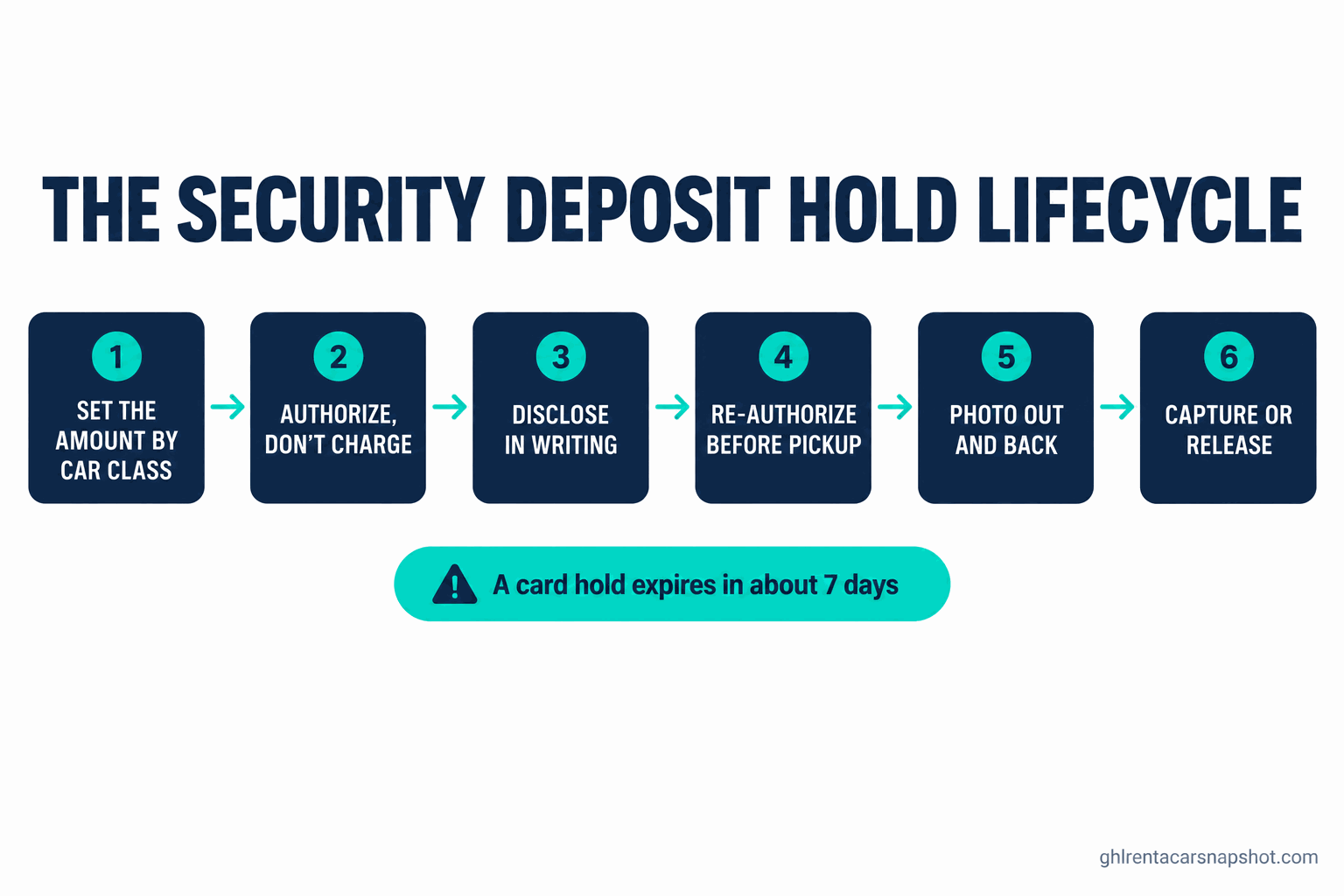
Here is the short version so you can fix it this week. A security deposit only protects you if the authorization is live the day the car returns. A credit-card hold is not a charge, and it is not permanent. Most authorizations release automatically after about 7 days (Stripe), so a hold placed at booking is usually dead by pickup. The fix is a system: set the hold by vehicle class, authorize (not charge) the card, disclose it, re-authorize right before pickup, tie it to timestamped photos, then capture or release the moment the car is back. Every step runs on a trigger instead of your memory.
Key Takeaways
- A hold is temporary, not a charge. Uncaptured authorizations release automatically after about 7 days by default, so a hold placed at booking is usually dead before the keys leave.
- Re-authorize right before pickup. That one trigger keeps a live hold on the car for the whole rental, and it is the step almost everyone skips. Car rental also qualifies for a 30-day extended authorization for longer trips.
- Disclosure kills disputes. A renter told the amount and release timing in writing does not call their bank; one chargeback averages about $128 on top of the refund.
Table of contents
- What a broken deposit hold costs you
- Hold vs. charge
- The deposit-hold system
- Stage 1: Set the hold amount
- Stage 2: Authorize, do not charge
- Stage 3: Disclose the hold
- Stage 4: Re-authorize before pickup
- Stage 5: Tie it to the car’s condition
- Stage 6: Capture or release on return
- Three scenarios: 3, 20, and 80 cars
- Texting renters without a TCPA problem
- Steal these: the scripts
- Common objections, answered
- Frequently asked questions
What a broken deposit hold costs you
When the authorization has expired, there is nothing to capture, so you are asking a renter who already has the car back to voluntarily pay for a scuff they are denying. Most do not, and a cracked rim on a nicer car runs real money.
The other cost is the dispute. Capture a hold with no disclosure and no evidence and the renter files a chargeback, which Mastercard puts at about $128 all-in to a US merchant on top of the refund (Mastercard, 2025). A “surprise deposit charge” is a dispute you often lose; winning it is its own chargeback-defense system.
Hold vs. charge: the thing most operators get wrong
A hold and a charge are not the same transaction, and treating them the same is where the money leaks. A charge moves money into your account now. A hold only reserves it: the renter’s available balance drops, but no funds change hands, and you later capture it (for damage) or release it. The reason the difference matters is shelf life. With Stripe, an uncaptured authorization releases automatically about 7 days after you create it by default, with windows from roughly 2 days for a card-present terminal swipe to 5 days for a Visa online charge and 7 for Mastercard, Amex, and Discover online (Stripe). So the “I’ll hold the deposit when they book” instinct is backwards: by pickup, that hold is dead. And charging the full deposit to refund it later is worse: a forgotten refund becomes a chargeback.
| Pre-authorization hold | Charge, then refund | |
|---|---|---|
| Money actually moves | No, it is reserved | Yes, out and back |
| Processing fees | Usually none until captured | You pay on the charge |
| Renter waits for cash | No, balance just frees up | Yes, days to see a refund |
| If you forget the last step | Hold releases on its own | A missed refund becomes a dispute |
The deposit-hold system, start to finish
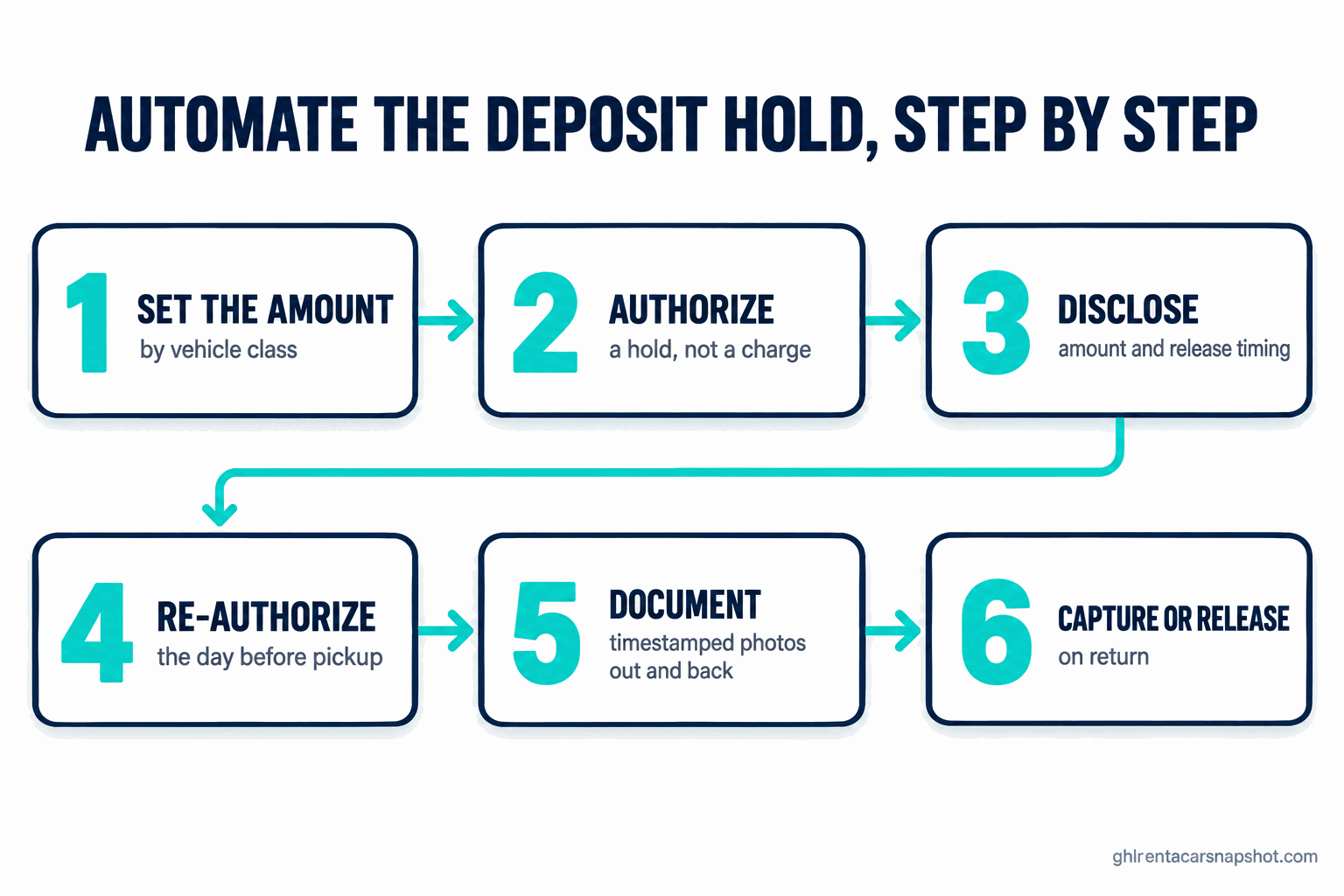
Six stages, each closing a gap where a deposit leaks, and each a trigger tied to the booking’s status rather than something you remember.
Stage 1: Set the hold amount by vehicle class
Decide the number before the booking, not at the counter. The hold should scale with what the car costs to fix, because an economy sedan and an exotic do not carry the same downside.
You do not have to guess at the range. Turo, the marketplace your renters already use, publishes its US deposit tiers, so they double as an anchor renters recognize: $200 when its system flags a trip, $250 in the San Fernando Valley area of Los Angeles, $500 on vehicles in New York, and $750 on Deluxe Class booked by under-30 guests and on Super Deluxe for everyone (Turo). The pattern to copy: the deposit tracks risk by location, class, and driver profile.
Set your tiers once, map each car to a tier, and let the booking system pull the right hold from the car selected. The renter picks the Mustang, the system knows it is tier three, the hold is $750. No counter math.
Stage 2: Authorize the card, do not charge it
When the booking is confirmed, place an authorization for the deposit amount, not a charge. In Stripe it is a PaymentIntent with manual capture, which the docs literally call “place a hold on a payment method” (Stripe). Square, Adyen, and Authorize.Net have the same flow under other names.
A credit card also beats a debit card here. A hold on a debit card pulls money straight out of the renter’s available balance, so a big hold can leave them short for the trip, and the release can lag for days. Require a credit card where you can; on a debit card, state the hold amount first.
Make the authorization its own step in the booking flow, alongside the signed rental agreement, the setup in the digital rental agreement and e-sign flow. A hold with a matching signed agreement is a far stronger position than a charge with nothing behind it.
Stage 3: Disclose the hold before you place it
A hold the renter knew about is protection. A hold they did not is a chargeback waiting to happen. The cheapest thing you can do to defend a deposit is tell the renter, in writing, before you place it: the exact amount, that it is a hold and not a charge, and when it releases. No US car-rental law spells out a disclosure script, so treat this as best practice, the most effective one you have, because it removes the renter’s only honest basis for a dispute, “I never agreed to this.” Put it in both the booking confirmation and the signed agreement.
Be honest about the one thing you do not control: the bank’s release timing. You release the hold; the renter’s bank decides when the money actually frees up, which can be a few business days even after you let go. Turo says the same, that it refunds automatically but banks add their own delay (Turo). Say that up front and you kill the “you still have my money” follow-up.
Stage 4: Re-authorize right before pickup
This is the stage that saves the whole system, and almost nobody runs it. Because the hold placed at booking is usually dead by the time the car leaves, place a fresh one the day before pickup.
Build it as a trigger: the day before the reservation starts, void any booking-time hold still alive and place a new authorization. Now the hold is freshest when the car is most exposed, and one re-auth carries a standard weekend rental through return. For longer rentals, use the extended authorization your category qualifies for: vehicle rental is a named eligible merchant category, so you can hold funds for up to 30 days on one authorization instead of 7 (Stripe). Read the real expiry off the authorization itself (Stripe exposes it as capture_before) instead of assuming a fixed window, because the networks adjust these.
How many days a card authorization stays valid before it is released, by method, as described in Stripe’s documentation. Car rental is an eligible category for the 30-day extended window. Source: Stripe, “Place a hold on a payment method” and Stripe, “Extended authorization”.
Stage 5: Tie the hold to the car’s condition
A hold is only worth what you can prove the car needed it for. Capturing for damage with no before-and-after evidence is how you win the charge and lose the chargeback, so the hold and the condition record move together.
At pickup, with the fresh authorization in place, document the car: timestamped photos of every panel, the wheels, the interior, the fuel gauge, and the odometer. At return, the same shots from the same angles. The gap between the two sets is your case for capturing any part of the hold, the same timestamped-photo habit that wins deposit and damage disputes. Make the photos a required gate: a booking is not markable “out” until the pickup photos are attached, nor “returned” until the return photos are. The staffer who skips it hands you the car that comes back wrong.
Stage 6: Capture or release the moment it returns
The rental ends one of two ways, and both are a single action.
Clean return: release the hold in full, immediately, and tell the renter. The faster it frees up, the fewer “where’s my deposit” messages you field.
Damage: capture only the amount the evidence supports, not the whole hold by reflex. Capture the repair estimate, send the matching photos and the invoice in the same message, and release the rest. A capture with proof and a refund of the difference almost never gets disputed; a full-deposit grab with no explanation almost always does. If a renter disputes anyway, the signed agreement, the disclosed amount, and the timestamped before-and-after set are the package that wins the case.
Three scenarios: 3, 20, and 80 cars
The system is the same shape at every size. What changes is how much runs on software versus discipline.
The side-hustle host, 3 to 5 cars. You can run this by hand. Use a processor with authorize-and-capture, set two or three tiers, and put one recurring task the evening before every pickup: re-auth the card, take the photos. A single daily reminder covers the one real risk.
The growing lot, 15 to 30 cars with staff. Now more than one person touches deposits, so “someone will remember” stops being true. You need the hold amount pulled automatically from the car’s tier, the pre-pickup re-auth as a scheduled trigger, and the photo gates enforced, so a new hire cannot underset a deposit or forget a re-auth.
The multi-location operator, 50 to 80-plus cars. Across locations and heavy volume, the deposit flow has to be identical everywhere and auditable. Every hold, re-auth, capture, and release logs against its booking, so you can answer a disputed charge from any location. At this size the deposit system is part of how you defend chargebacks at scale without it eating a manager’s week.
Texting renters about a hold without a TCPA problem
Every stage sends the renter a text: the disclosure, the re-auth notice, the release confirmation. The moment you text renters, three rulebooks apply.
A hold message about a booking the renter made is transactional, not marketing, which is the low-risk category as long as you do not bolt a promotion onto it. But the plumbing still has to be compliant. As of June 30, 2026, A2P 10DLC campaign registration requires a public Privacy Policy URL and a Terms and Conditions URL, or the campaign is rejected and your texts never send (Twilio). Ignore any old advice built on the FCC “one-to-one consent” rule, which was vacated in January 2025 and does not apply (Womble Bond Dickinson). And if you rent in or to Florida, the Florida Telephone Solicitation Act lets a renter sue for $500 per violating text, up to $1,500 if willful (Pillsbury). Full rules are in the TCPA and 10DLC guide for rental texts.
Steal these: the deposit-hold scripts
Swap in your details. Each stays strictly about the booking.
The disclosure (at booking, before you place the hold):
Hi {first name}, it’s {business}. To confirm your {car} for {dates}, we’ll place a refundable security hold of {amount} on your card the day before pickup. It’s a hold, not a charge, so no money leaves your account, and we release it in full within 1 hour of a clean return. Your bank may take a few business days to show the funds. Questions? Reply here.
The pre-pickup re-authorization notice (day before, after the re-auth lands):
Hi {first name}, your {car} is ready for pickup {date} at {time}. You’ll see a pending hold of {amount} on your card: that’s the refundable security hold we mentioned, not a charge. See you {day}.
The clean-return release (the second you release it):
Thanks for bringing the {car} back in great shape, {first name}. We’ve released your {amount} security hold in full; your bank may take a few business days to show the funds. We’d love to have you again.
The damage capture (with photos and invoice attached):
Hi {first name}, we’ve finished the return inspection on the {car}. We documented {damage} that wasn’t there at pickup (photos attached, timestamped out and back). We’ve captured {captured amount} to cover the {repair estimate} and released the remaining {released amount}. Full invoice attached. Reply with any questions.
Common objections, answered
“Won’t holding a deposit scare off bookings?” A disclosed, reasonable hold does not, because every renter who has used Turo or a major brand already expects one. What scares renters is a surprise charge they were not told about.
“I run everything on Turo, so Turo handles the deposit, right?” On Turo, yes. But it takes 10 to 30% of every trip, and it is one platform that can pull back, the way Getaround closed its entire US business in February 2025 (TechCrunch). The moment you take a direct booking, the deposit is yours to run.
“Do I need to be technical to set this up?” No. Every modern processor has authorize-and-capture built in, and the triggers are standard automation, not custom code. If you would rather not wire it yourself, it is a module in the reservation and workflow automation in the snapshot.
Frequently asked questions
How long does a credit card hold last on a rental car?
It is temporary. With Stripe, an uncaptured authorization releases automatically about 7 days after it is created by default, with windows from roughly 2 days for a terminal swipe to 5 for a Visa online charge and 7 for Mastercard, Amex, and Discover online. A hold placed at booking is usually dead by pickup, so you re-authorize right before the car goes out.
What is the difference between a hold and a charge on a rental deposit?
A charge moves money into your account now. A hold only reserves it: the renter's balance drops but no funds change hands. You later capture it (for damage) or release it, and on a clean return you capture nothing and it disappears, with no fees and no refund to remember.
Can I hold a security deposit for a week or month-long rental?
Yes. Vehicle rental is a named eligible category for an extended authorization, so you can hold funds on one authorization for up to 30 days instead of the usual 7, per Stripe's docs. Read the real expiry off the authorization (Stripe exposes it as capture_before) rather than assuming a fixed window.
How much should I hold as a security deposit?
Scale the hold to what the car costs to fix, not a flat rule. Turo's published US tiers are a useful anchor: $200 on a flagged trip, $250 in the San Fernando Valley, $500 on a New York vehicle, and $750 on its Deluxe and Super Deluxe classes.
How do I avoid chargebacks when I capture a deposit for damage?
Disclose the amount and release timing in writing before you place the hold, in the confirmation and the signed agreement, and document the car with timestamped photos out and back. When you capture, take only what the evidence supports, release the rest, and send the photos and invoice in the same message. That package almost never gets disputed.
It is Sunday night again. The car is back with a curbed front wheel, and this time the $750 hold is live, placed fresh on Saturday morning by a trigger you never had to think about. You pull up Friday’s pickup photos next to tonight’s, capture $280 for the wheel, release the other $470, and send the renter both photos and the invoice in one text. No chasing, no fight, no week lost to a deposit that died on a Thursday. That is what a deposit hold should feel like: boring and automatic, done before the car came back.