

The email lands on a Tuesday. Your rental software, the one you have run since it was called Navotar, is now RENTALL, and your renewal quote came in higher than last year with a line that says “contact your account manager” where the price used to be. You have 23 cars, a busy month ahead, and a tool you suddenly cannot price without a phone call. So the question is not academic: if you leave, where do you go, and is it worth the migration mid-season?
Here is the short answer. For most independent operators running 10 to 100 cars, the honest shortlist is Fleetwire for the cheapest self-serve start, HQ Rental Software for depth and reporting if you will pay a setup fee once, RentSyst if you think in per-vehicle pricing, and a fourth path neither is built for: owning your booking and follow-up on a platform you control. Below is the full comparison and what switching actually costs you in July.
Key Takeaways
- Navotar is now RENTALL. Navotar, Bluebird Auto Rental Systems, and Thermeon merged and rebranded to RENTALL (Auto Rental News). Pricing is now quote-gated, with no public price (G2).
- Fleetwire is the cheapest self-serve start: from around $24/mo with a 14-day trial (GetApp).
- HQ Rental Software is the only major with a public monthly ladder: about $120 / $175 / $250 a month by fleet size (Capterra), usually plus a one-time onboarding fee.
- RentSyst prices in euros, from about 55 euros a month for up to 15 vehicles (Capterra), a currency and support consideration for US lots.
- Your biggest line item is usually commission, not software. On Turo’s 2026 plans Turo keeps 10 to 30 percent of every booking (Turo), dwarfing any subscription here.
Table of contents
- The 60-second answer
- What actually happened to Navotar
- What switching wrong costs you
- The 5 options at a glance
- Option by option, with the catch
- Steal these migration messages
- Same decision, three fleet sizes
- The texting rules that follow you
- Objections, answered
- FAQ
The 60-second answer
Single lot, lowest cost, live this week: Fleetwire. More than one location with reporting and staff logins: HQ Rental Software, across its three public tiers for a setup fee once. Thinking in per-vehicle cost and fine with a European vendor: RentSyst. And if what pushed you off Navotar was watching a tool you do not control raise the price every renewal, the real fix might not be another rental platform at all. It might be owning the booking and follow-up layer yourself so no vendor can hold your renter list hostage again.
What actually happened to Navotar
Navotar did not disappear. It merged and rebranded. Navotar, Bluebird Auto Rental Systems, and Thermeon combined operations, and the Navotar product now ships as RENTALL (Auto Rental News). If you are a long-time Navotar customer, your account quietly became a RENTALL account.
Two things changed that matter to your wallet. First, the price went private. There is no public price list on the vendor site, and the directories confirm it: RENTALL “has not provided pricing information,” and its plans show as “custom quote available” (G2, Capterra). Third-party listings mention a start near $50 a month and a setup fee around $650 (Software Advice), but those are not vendor-confirmed and you only learn your real number on a call.
Second, operators noticed the climb. One Capterra reviewer put it plainly: the product was good value “when it’s called Navotar,” but after moving to RENTALL “price get increased every month.” That is one review, not a data set, but it is why “Navotar alternatives” is worth answering. We did the full demo-gated teardown in what the RENTALL demo call will not tell you.
What switching to the wrong tool costs you
The wrong software leaks money for six months, then you rip it out and start over. Too light and you outgrow it mid-season: you hit the vehicle cap, the reporting cannot tell you which cars sit idle, and you migrate in July while renters are at the counter. Too heavy and you pay a four-figure onboarding fee for features you never touch, like HQ’s (competitor sources put the floor around $550).
Then there is the cost that swamps the whole software conversation. If you still route rentals through Turo, the subscription argument is almost a rounding error. Turo’s 2026 plans pay hosts 70, 80, or 90 percent of the trip price by protection plan, so Turo keeps 10 to 30 percent of every booking (Turo), on a platform with roughly 150,000 hosts and 350,000 vehicle listings as of late 2024 (NBC 5 DFW). A fifth of your gross beats any line on this page, as we showed in Turo versus your own booking system. So the real decision is not which tool is cheapest, it is which one you will not have to leave again next year.
The 5 options at a glance
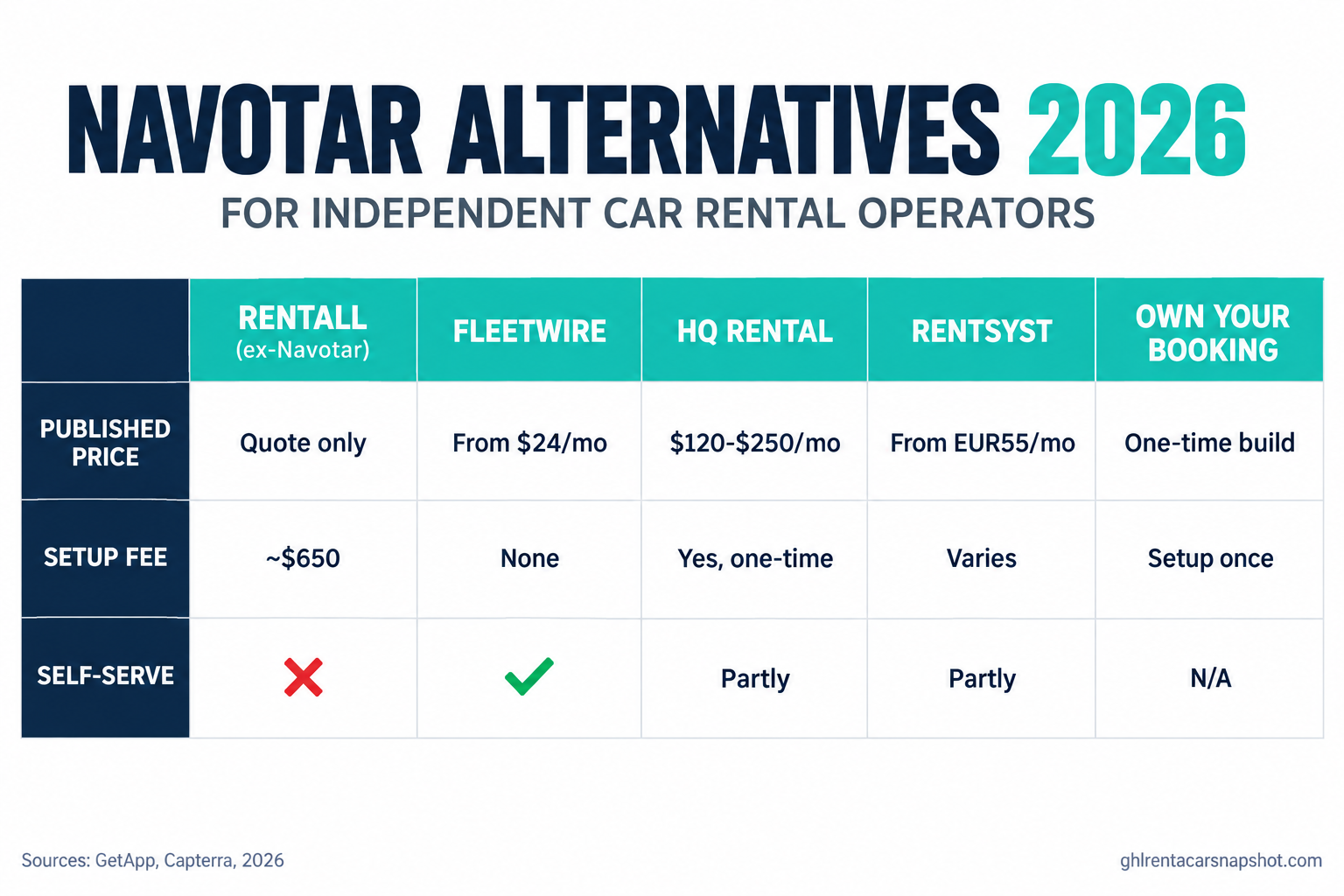
Here is the honest landscape. Prices are published or third-party-reported figures, so confirm your number on each vendor’s live page before you commit.
| Option | Published price | Setup fee | Self-serve signup | Reporting depth | Best for |
|---|---|---|---|---|---|
| RENTALL (ex-Navotar) | Quote only | ~$650 (reported) | No, demo-gated | Deep | Shops staying put, large fleets |
| Fleetwire | From ~$24/mo | None | Yes | Light to medium | Lean single lots, ex-Turo hosts |
| HQ Rental Software | ~$120-$250/mo | Yes, one-time | Partly, demo for most | Deep | Multi-location, data-driven shops |
| RentSyst | From ~€55/mo | Varies | Partly | Medium | Per-vehicle thinkers, EU-comfortable |
| Own your booking | One-time build | Setup once | N/A | You define it | Operators done renting their list |
The published price ladder makes the gap obvious once you line up the numbers that exist in public.
Monthly starting prices in USD (RentSyst converted from ~€55). RENTALL omitted: no public price to plot. Sources: GetApp, Capterra, Capterra.
Option by option, with the catch
The table tells you the shape. The catch is in the details, so here is each option and how it breaks.
Fleetwire: the fastest, cheapest start
Fleetwire is the self-serve tool for the operator who graduated from spreadsheets and Turo. It publishes a price from around $24 a month, gives a 14-day trial with no card, and leans into the car-sharing world: automated ID verification, digital agreement signing, automated messaging, and calendar sync with the big platforms (GetApp). Best for a lean single lot, 5 to 20 cars, that wants to be live this week.
Where it breaks: the tiers climb by vehicle band. Third-party pages cite roughly $34 up to 5 cars and $89 up to 15, so confirm your band on fleetwire.io before you assume the $24 headline is your number. Stripe fees and per-check ID verification stack on top, and reporting is lighter than HQ. We put the two head to head in the 20-car fleet buying guide.
HQ Rental Software: the one with a public price ladder
HQ Rental Software is the heavier platform for the shop becoming a company, and the rare major that publishes a monthly ladder: about $120, $175, and $250 a month by fleet size, with an Enterprise tier for 100-plus vehicles (Capterra, Software Advice). More rate control, reporting, multi-location, and admin. Best for a multi-location or data-driven shop of 15 to 50 cars that does not blink at a setup fee.
Where it breaks: the sticker is not the bill. HQ charges a one-time onboarding fee before you go live, and competitor sources put the floor around $550. Most setup happens on a demo call. Budget the onboarding fee as a real line and ask about data-export charges up front.
RentSyst: the per-vehicle option that bills in euros
RentSyst prices by vehicle. Its entry plan runs about 55 euros a month for up to 15 vehicles, scaling to roughly 2 euros per vehicle higher up (Capterra). It covers reservations, fleet management, and GPS and telematics as an add-on. Best for an operator who thinks in cost-per-car and is fine with a European vendor and support hours that may not match US time zones.
Where it breaks: the per-vehicle rates conflict across third-party listings, so the pricing is less transparent than it looks, and the euro bill moves with the exchange rate. Currency and support timing are the quiet costs for a US lot.
RENTALL: staying put, with eyes open
Staying is a real option if you are a larger fleet already deep into RENTALL’s reporting and your data would be painful to move. The product is mature and cloud-based. Best for a shop that relies on its depth and would spend more migrating than it would save.
Where it breaks: quote-only pricing with no public anchor means every renewal is a negotiation with no reference point, and the reviewer complaint about monthly increases is the risk you accept. If you stay, stay deliberately: renewal terms in writing, export cost known, so it is a decision and not inertia.
Own your booking and follow-up
Here is the path neither demo will pitch. Every tool above runs the booking and the deposit. None runs your lead follow-up, abandoned-reservation recovery, reminders, or review pipeline. That is the layer that grows a lot, and the one a vendor can never raise the price on if you own it. Best for an operator who got burned by a tool they did not control.
Where it breaks: it is a build, not a login. You wire it up in a platform like GoHighLevel or buy it done-for-you. The failure mode is treating it as a weekend project and leaving the automations half-finished. Done right, it is a one-time cost instead of a subscription that climbs.
Steal these migration messages
The hardest part of switching is moving your renters without dropping a booking. Here is copy you can lift and send. Keep transactional messages transactional, and get real consent before anything that reads as marketing.
The data-export request to your current vendor (email):
Subject: Full data export request, account [your account number]
Hi [account manager], we need a complete export of our data: all reservations (past and upcoming), customer records with contact details, vehicle and fleet records, and any stored agreements. Please confirm the file formats, any export fee, and the timeline. We want this in hand before our renewal date of [date]. Thanks, [name].
The reminder pair every tool should be sending (text, transactional):
Pickup, 24 hours out: Hi [first name], your [vehicle] pickup is tomorrow at [time], [address]. Bring your license and the card on file. Reply here with questions.
Return, morning of: Morning [first name], your [vehicle] is due back today by [time] at [address]. Need another day? Reply and we will check availability before you are charged a late fee.
The review request after a clean return (text, transactional-to-ask, then one follow-up):
Hi [first name], thanks for renting with [lot name]. If the car and pickup were easy, would you leave us a quick Google review? It genuinely helps a small lot like ours: [link].
Those messages keep your repeat renters through the switch. We go deeper on the reminder flow in texting pickup and return reminders without a TCPA or 10DLC disaster.
Same decision, three fleet sizes
The right answer changes with how many cars you run. Same five options, three winners.
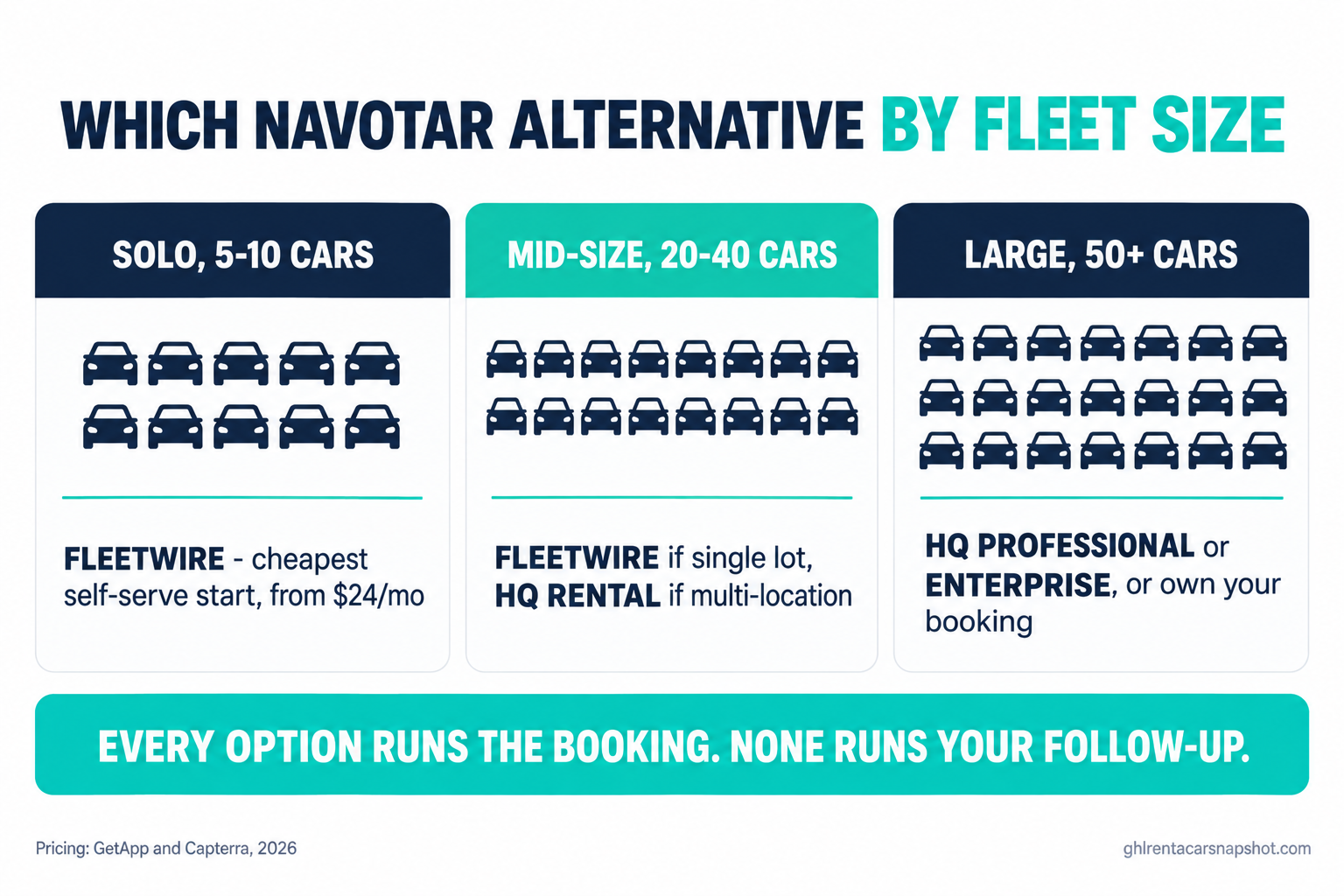
Solo operator, about 5 to 10 cars. Fleetwire, clearly. You sit near its cheapest band and HQ’s onboarding fee is hard to justify on a handful of cars. Stay off quote-only tools at this size: you have no bargaining power there. Put the savings toward a direct-booking site so you stop paying Turo a fifth of every rental.
Mid-size shop, about 20 to 40 cars. The real contest, and it comes down to one question: single location or multi. Single and lean, pick Fleetwire and accept its upper band. Multiple lots or separate staff logins and you want reporting, pay HQ’s Standard or Professional tier and the setup fee once. Here the follow-up layer matters most: a 30-car fleet that cannot recover an abandoned booking is leaving real weekends on the table.
Large fleet, 50-plus cars. HQ’s Professional or Enterprise tier, RENTALL if you are already deep in it, or something heavier. You have rate complexity, multiple users, and reporting needs light tools cannot meet. This is where owning your customer list matters most, because a vendor price increase is now a five-figure annual decision.
What stays constant: the platform runs the booking and the deposit, but none runs your follow-up, no-show recovery, or review pipeline. Same gap at 5 cars or 50.
The texting rules that follow you
Every tool here sends texts. None keeps you legal. That is your job whichever platform you pick, and it bites hardest in Florida, a top rental market with teeth in its law.
First, A2P 10DLC. To send business texts in the US you register your brand and campaign through the carriers. New campaign registrations submitted after June 30, 2026 must include a public privacy policy URL and a terms URL, live and reachable without a login, or they are rejected at review (Twilio, error 30933). No privacy and terms pages on your site? Fix that first.
Second, Florida’s FTSA. The Florida Telephone Solicitation Act is a mini-TCPA with a private right of action and statutory damages of $500 to $1,500 per offending text, so renters and the lawyers who find them can sue over improper marketing messages. The 2023 amendment narrowed the autodialer definition (K&L Gates), but the private right of action is still live.
The practical rule: transactional texts like booking and return reminders are lower risk because the renter gave you their number to do business. Marketing texts need real, logged consent. The compliance is yours either way, so keep the consent trail somewhere you own.
Objections, answered
“Switching mid-season sounds insane. Can’t I just stay on RENTALL?” You can, and for a large fleet deep in it, staying may be right. But stay on purpose: get your renewal in writing and know your data-export cost. “Too busy to switch” is exactly what a quote-only vendor counts on.
“Fleetwire is cheapest. Why pick HQ?” Because cheapest monthly is not cheapest total if you outgrow it and migrate again in July. At 20-plus cars, reporting is not a luxury, and HQ’s depth earns its price for a multi-location shop. Single-location and lean, Fleetwire wins.
“I’m not technical. Isn’t owning my booking too much?” The technical part is the easy part. The hard skill on any of these tools, Fleetwire and HQ included, is writing the messages, setting the deposit rules, and keeping your data clean. Buy the owned layer done-for-you and you skip the build.
“What if I already pay Turo and barely use software?” Then your real problem is not software, it is the 10 to 30 percent Turo keeps on every booking (Turo). A booking tool plus a direct-booking site stops you renting your own customers back from a marketplace, as we covered in stop double-booking your fleet across Turo and direct.
Frequently asked questions
Is Navotar still available, or did it become RENTALL?
Navotar rebranded to RENTALL after Navotar, Bluebird Auto Rental Systems, and Thermeon merged. Your Navotar account is now a RENTALL account: same lineage, new branding, but pricing moved behind a demo.
What is the cheapest Navotar alternative?
Fleetwire has the lowest published self-serve start, around $24 a month with a 14-day trial, though its tiers climb by vehicle band, so confirm your band on the vendor site.
How does HQ Rental Software's price compare to RENTALL?
HQ publishes a ladder of roughly $120, $175, and $250 a month by fleet size, plus a one-time onboarding fee (competitor sources cite a floor near $550). RENTALL publishes no price, so HQ gives you a number before the call and RENTALL does not.
Should I switch rental software in the middle of my busy season?
Usually no. Plan the migration for your slow period, export your data first, and send renters a transactional heads-up. The exception is if your current tool is raising prices and your contract lets you leave cheaply now.
Do any of these tools keep me TCPA and A2P 10DLC compliant?
No. They all send texts, but registration and consent are your job. From June 30, 2026, new A2P 10DLC campaigns must list a live privacy policy URL and terms URL, and Florida's FTSA adds a private right of action at $500 to $1,500 per violation.
What is the fifth option that isn't a rental platform?
Owning your booking and follow-up layer yourself, usually on GoHighLevel, so you control the renter list and the automations: follow-up, abandoned-reservation recovery, reminders, and reviews none of the rental platforms handle, as a one-time build.
Back to that Tuesday email
So the renewal quote sits in your inbox with no price on it. Before you reply: lean lot and want out fast, start a Fleetwire trial today. Multiple locations and want reporting, book the HQ demo and ask the onboarding-fee and data-export questions up front. Large and dug in, stay on purpose with your terms in writing.
Whichever tool you land on, do not make the same mistake twice. The reason a vendor could raise your price every renewal is that they held your renter list and your automations. Put those somewhere you own, bolted onto whatever booking tool you keep, and no Tuesday email can hold your lot hostage again. When you are ready, the plans page shows how the done-for-you build is priced.