

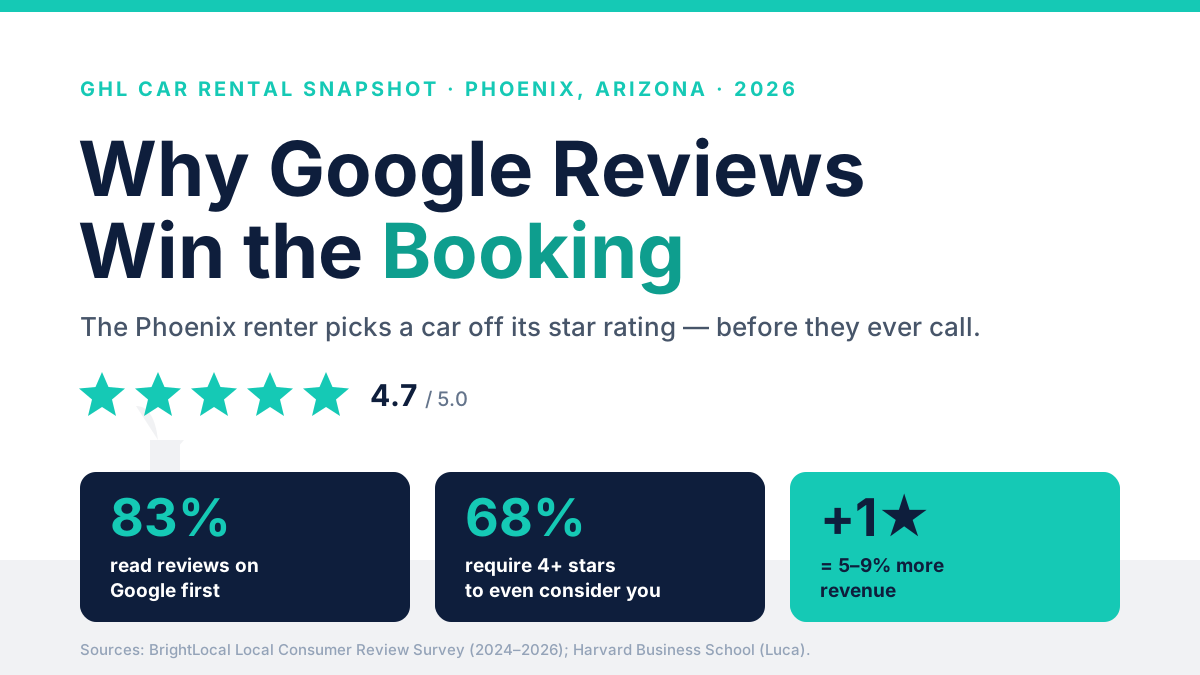
A traveler lands at Phoenix Sky Harbor on a Friday afternoon, needs a car for the weekend, and pulls up Google Maps before they pull up your website. They see three rental companies near the terminal. One shows 4.7 stars and 240 reviews, the last one posted yesterday. One shows 4.1 stars and 60 reviews, the newest from March. One shows 3.6 stars and a wall of unanswered complaints. They tap the first one — and for most Phoenix car rental companies, that quiet, three-second decision on the Google star rating is where the booking is won or lost, before a single call is placed. The data is blunt: 83% of consumers read reviews on Google, 68% now refuse to consider a business under four stars, and a one-star swing in rating moves revenue by 5–9%. In a record-demand market, your reputation isn’t a nice-to-have — it’s the shelf your lot sits on.
This is a data-driven look, for Phoenix car rental operators and the agencies serving them, at exactly how Google reviews decide the booking in 2026, what the “review gap” is costing you, and how review-harvesting automation closes it without adding a job to anyone’s day.
Key Takeaways
- Phoenix Sky Harbor served a record 52.3 million passengers in 2024 — its first year ever above 50 million, up 7.5% over 2023 (Phoenix Sky Harbor / City of Phoenix). Every one of those arrivals is a ground-transportation decision made on a phone.
- 83% of consumers primarily read reviews on Google, making it the single most trusted review platform (BrightLocal, Local Consumer Review Survey 2025). Your Google profile is your storefront window.
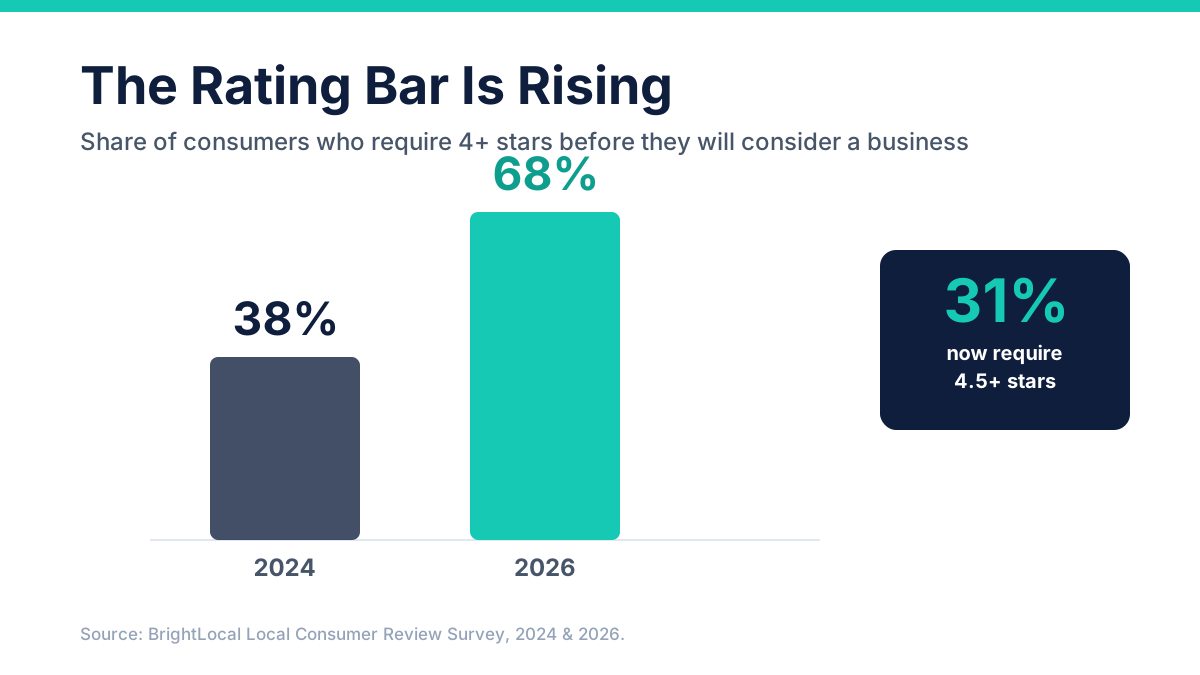
- The rating bar is rising fast: 68% of consumers in 2026 require at least 4 stars to consider a business, and 31% won’t use one under 4.5 — up from 38% requiring 4+ stars in 2024 (BrightLocal 2026; 2024).
- A one-star increase in rating drives a 5–9% increase in revenue, independent of the underlying service quality (Michael Luca, Harvard Business School).
- 69% of consumers left a review in the past year after a business simply asked (BrightLocal 2024) — which means the review gap is an asking problem, and asking is exactly what automation fixes.
Table of contents
- Phoenix demand is at a record — and Google is the shelf
- The rating bar is rising: what Phoenix renters now demand
- What one extra star is actually worth to a Phoenix lot
- How Google ranks your lot in the Phoenix map pack
- The review gap most Phoenix lots don’t know they have
- What review-harvesting automation looks like for a rental lot
- The bottom line for Phoenix operators
- Frequently asked questions
Phoenix demand is at a record — and Google is the shelf
Metro Phoenix is one of the strongest independent car-rental markets in the country right now, and the numbers keep climbing. Sky Harbor moved 52.3 million passengers in 2024, an all-time record and the first time the airport ever cleared 50 million in a year, up 7.5% over 2023 (City of Phoenix; Phoenix Sky Harbor). Zoom out to the state and Arizona visitors spent a record $29.7 billion in 2024 across roughly 41 million domestic overnight trips (Arizona Office of Tourism). Nationally, analysts put the U.S. car-rental market around $51 billion in 2026 (Mordor Intelligence).
Here’s the part that decides whether that demand reaches your lot: almost none of those travelers start on your website. They start on Google. 83% of consumers primarily read reviews on Google, more than any other platform (BrightLocal 2025). For a Phoenix renter comparing three airport-area lots, your Google Business Profile — the star rating, the review count, the freshness, the owner responses — is the entire storefront. They judge the shelf before they ever open the door.
That reframes the whole problem. In a record travel year, demand isn’t the Phoenix operator’s constraint. Being chosen off the shelf is. A full parking lot of clean, well-maintained cars loses to a competitor with a better rating and a fresher review feed — not because the cars are worse, but because the renter never got far enough to find out. This is the reputation layer sitting on top of the local SEO fundamentals every rental lot needs: local search gets you onto the shelf, reviews decide which product gets picked up.
The rating bar is rising: what Phoenix renters now demand
A few years ago, “having reviews” was enough. Not anymore. The threshold renters apply before they’ll even consider a business has moved sharply upward. In 2024, 38% of consumers said a business needed at least four stars to earn their trust. By 2026 that figure jumped to 68%, and 31% now won’t use a business rated below 4.5 stars (BrightLocal 2026; 2024).
Two more shifts matter for a rental lot. First, trust as a substitute for a personal referral: 50% of consumers now trust online reviews as much as a recommendation from friends or family (BrightLocal 2024). The out-of-town traveler who doesn’t know a soul in Arizona treats your review feed as the local friend they’d normally ask.
Second — and this is the one Phoenix operators underestimate — recency now matters as much as the rating itself. 74% of consumers look for reviews from the last three months, 32% want them from the last two weeks, and 18% only trust reviews from the last week (BrightLocal 2026). A 4.8-star lot whose newest review is four months old reads as “was good once.” A steady trickle of fresh reviews reads as “busy and trusted right now.” Reviews are a perishable asset, and most lots let them go stale.
What one extra star is actually worth to a Phoenix lot
This is where reputation stops being a soft metric and starts being revenue. The landmark Harvard Business School study by Michael Luca found that a one-star increase in a business’s rating drove a 5–9% increase in revenue — and critically, that lift was independent of the actual quality of the business (Harvard Business School). The rating itself moves money, because it moves the choice.
Volume and responsiveness compound it. A Womply analysis of more than 200,000 U.S. small businesses found that businesses that reply to at least a quarter of their reviews earn roughly 35% more revenue than those that ignore them, and businesses with more reviews than average earned meaningfully more than their peers (Womply). Responding isn’t just politeness — 89% of consumers expect a business to respond to reviews (BrightLocal 2024), and a lot that answers looks like a lot that cares about the return.
Put it in lot terms. If your Phoenix operation is sitting at 4.1 stars and a disciplined review system lifts you to 4.6 over a season, that’s not a vanity bump — on the Luca numbers it maps to a mid-single to high-single-digit revenue swing, on top of the map-pack visibility that a stronger, fresher profile earns you. For a lot that lives and dies by weekend and airport turnaround, that’s the difference between a car sitting idle and a car earning.
Operators tell me reviews are “handled” because they ask when they remember. Reviews aren’t handled by remembering — they’re handled by a system that asks every renter, at the right moment, without anyone on the counter having to think about it. Reputation is a machine, not a mood.
How Google ranks your lot in the Phoenix map pack
Reviews don’t just persuade the renter — they help decide whether the renter ever sees you. Google is explicit that local results are ranked on three things: relevance, distance, and prominence (Google Business Profile Help). Reviews feed two of the three.
- Prominence. Google’s own guidance states that review count and score factor into local ranking — “more reviews and positive ratings can improve your business’s local ranking.” A lot with 240 recent reviews and a 4.7 average is a more prominent entity than a 3.9-star lot with 30, and Google’s ranking reflects it.
- Relevance. Review text is user-generated content Google reads. When Phoenix renters mention “airport pickup,” “clean SUV,” or “easy weekend rental” in their reviews, they’re feeding Google the exact language that matches how the next traveler searches.
- Distance you can’t change — your lot is where it is. Which is exactly why prominence and relevance, the two levers reviews control, are where the winnable local-ranking battle actually lives.
So the Google map pack — the three-lot block that captures the lion’s share of “car rental near me” taps — rewards the lot with the strongest, freshest, most-responded-to review profile. Reviews are simultaneously the persuasion layer and a ranking input. Win them and you get chosen more often from a list you also appear higher on. This is the reputation engine that sits on top of the broader local SEO playbook for rental lots and turns the website traffic you work to earn into booked rentals.
The review gap most Phoenix lots don’t know they have
Here’s the good news buried in the data. The reason most Phoenix lots are under-reviewed isn’t bad service — it’s that they don’t ask, or they ask inconsistently. 69% of consumers say they left a review in the past year after a business simply prompted them to (BrightLocal 2024). Renters are willing. The ask is what’s missing.
On a busy lot, the ask breaks down in predictable ways:
- Nobody asks at the counter. The return is rushed — flight to catch, next customer waiting, damage check to do. “Hey, would you leave us a review?” is the first thing to fall off the list, every single time.
- The ask has no follow-through. A staffer mentions it verbally, the renter means to, life happens, and the review never gets written. A spoken ask with no link is a wish, not a system.
- Reviews go stale between busy seasons. The lot gets a cluster of reviews during a good month, then months of silence — and that silence is exactly what the 74%-want-recency renter reads as a warning sign.
- Unhappy renters get the same generic ask as happy ones, so a frustrated customer gets pointed straight at your public Google profile instead of into a private conversation where the issue can actually be fixed first.
The result is a review gap: a lot that earns four- and five-star experiences all season but only captures a fraction of them publicly, with nothing fresh in the feed when the next traveler is deciding. Every un-asked happy renter is a five-star review your competitor effectively gets to keep. Closing that gap doesn’t require better service — it requires a system that asks every renter, at the right moment, every time.
What review-harvesting automation looks like for a rental lot
“Review automation” sounds abstract until you see the actual sequence. For a car rental operation, review harvesting is a workflow wired into the moment a rental ends — and it runs whether or not anyone at the counter remembers. Here’s the shape of it:
- The trigger is the return, not a random blast. When a reservation is marked returned (or the return reminder fires), the renter is automatically queued for the ask while the good experience is still fresh — the peak moment, not a week later. This is the timing principle behind a working 5-star review pipeline.
- The ask goes out by text and email. SMS gets read; email gives room for the link and context. The message is short, branded, and TCPA-compliant, with the renter’s first name and a one-tap link straight to your Google review form — no searching, no friction.
- The happy/unhappy fork protects your rating. A quick “how was it?” step routes five-star sentiment straight to your public Google profile, and anything lukewarm into a private feedback channel that alerts you to recover the renter before they vent publicly. You capture the good and contain the bad.
- Responses are handled, not forgotten. New reviews notify your team (or a VA), and automated Google Business Profile reply drafts mean every review gets a timely, on-brand response — hitting the 89%-expect-a-reply bar without adding a daily task.
- The feed stays fresh year-round. Because the ask fires on every return, reviews arrive as a steady trickle instead of a once-a-season spike — which is exactly what the recency-focused renter (and Google’s freshness signal) rewards.
The point isn’t to manufacture reviews — it’s to stop losing the real ones you already earn. The experiences are happening on your lot every weekend. Automation just makes sure they show up on the shelf where the next Phoenix renter is deciding. It’s the reputation half of the same system that recovers missed calls with instant text-back and turns one-time renters into a repeat-renter flywheel.
The bottom line for Phoenix operators
Phoenix rental demand has never been higher — 52 million airport passengers and a record $29.7 billion Arizona travel year — and that’s precisely why the fight has moved from getting seen to getting chosen. The renter decides off the Google star rating before they call, the bar for that rating keeps rising, recency is now non-negotiable, and one extra star is worth 5–9% in revenue. Reviews are no longer reputation management; they’re the shelf your lot competes on.
The lots that win in Phoenix aren’t the ones with the best service — plenty of good lots stay invisible. They’re the ones with a system that captures every good experience, keeps the feed fresh, answers every review, and quietly intercepts the unhappy renter before they post. That system is review-harvesting automation, and it’s built into the Car Rental Snapshot. Book a 15-minute demo and see how many five-star reviews your lot is already earning — and currently letting slip away.
Frequently asked questions
How many Google reviews does a Phoenix car rental company need?
There's no magic number, but the direction is clear: 68% of consumers in 2026 require at least four stars to consider a business and 31% require 4.5+, so your average rating matters more than raw count (BrightLocal). Beyond the rating, recency is now critical — 74% of consumers look for reviews from the last three months. Practically, a Phoenix lot should aim to consistently out-review nearby competitors and keep a steady trickle of fresh reviews rather than hitting a one-time total, because a stale feed reads as a warning sign no matter how high the star count.
Do Google reviews actually affect where my rental lot ranks on Google Maps?
Yes. Google states that local results are ranked on relevance, distance, and prominence, and its own guidance says review count and score factor into prominence — 'more reviews and positive ratings can improve your business's local ranking' (Google Business Profile Help). Review text also feeds relevance, because Google reads the language renters use ('airport pickup,' 'clean SUV'). Distance you can't change, so reviews are the main winnable lever for the Phoenix map pack.
Is it legal to ask renters for reviews by text?
Yes, when done correctly. Asking a customer for a review after a completed rental is standard practice; the compliance piece is consent and opt-out for SMS. A properly built automation collects consent at booking, sends the request within TCPA guidelines, and honors STOP/opt-out automatically. What you may not do is gate or incentivize only positive reviews or post fake ones — that violates Google's policies. Routing sentiment privately first to recover unhappy renters is allowed; buying or filtering reviews is not.
What's the difference between asking for reviews myself and using automation?
The difference is consistency. Manual asking depends on a staffer remembering during a rushed return — which is exactly when it gets skipped — so you capture a fraction of the happy renters you earn. Automation fires on every return, sends a one-tap link by text and email, forks unhappy renters into private recovery, and keeps responses handled. Since 69% of consumers leave a review when simply asked (BrightLocal), the gap between 'ask sometimes' and 'ask every time' is most of your missing reviews.
How fast can a Phoenix lot get review automation running?
The review-harvesting workflow is part of the Car Rental Snapshot, which installs on your GoHighLevel account in about 24 hours, so the post-return review request, the happy/unhappy fork, and Google Business Profile response drafts can be live within a day of setup. The fastest path is to turn on the automatic post-return ask first — that alone starts capturing reviews you're currently missing — then layer the fork and auto-responses. A 15-minute demo maps it onto your specific return process.
About the author: Derek Okafor is a Rental Reputation & Revenue Strategist based in Orlando, Florida. He came up through hospitality and airport-area rental desks, where reviews and corporate accounts decide who survives the slow season, and now focuses on turning happy returns into public 5-star reviews and defending revenue with systems instead of hope.
Related reading:
- Building a 5-Star Review Pipeline for Your Rental Lot
- Local SEO for Car Rental Businesses: Get Found First
- Missed-Call Text-Back: Stop Losing Bookings to Voicemail
- Car Rental Website Conversion: Turn More Visitors Into Booked Rentals
- The Repeat-Renter Loyalty Flywheel
Editorial note: figures cited are drawn from the third-party research linked inline and reflect the sources as of publication. The Harvard Business School revenue figure (Luca) and the Womply revenue figures are foundational studies whose findings are directional, not guarantees, and should be treated as illustrative of the relationship between ratings and revenue rather than a promise of results. Market-size projections are analyst estimates that vary by methodology. GHL Car Rental Snapshot builds GoHighLevel automation systems for car rental businesses — it is not a car rental company, insurer, or payment processor, and does not create, buy, or filter reviews on your behalf. Review, search, and market data change; confirm current sources before making decisions.