

It is the 3rd of the month and your merchant statement drops: a $340 chargeback on a rental from two weeks ago. The renter brought the car back with a scraped bumper, declined the coverage, agreed to the repair at the counter, then called their bank and said they never authorized it. The bank sided with them. Your money is gone, and you have days to fight or eat it.
Here is the short answer. Most car rental chargebacks are not real fraud. They are friendly fraud, a customer who genuinely made the purchase disputing it anyway, usually over a post-rental charge like damage, fuel, tolls, or a late fee. You can win a lot of them, but only if the evidence is built before the dispute lands. Once the clock starts, you cannot create proof you never captured.
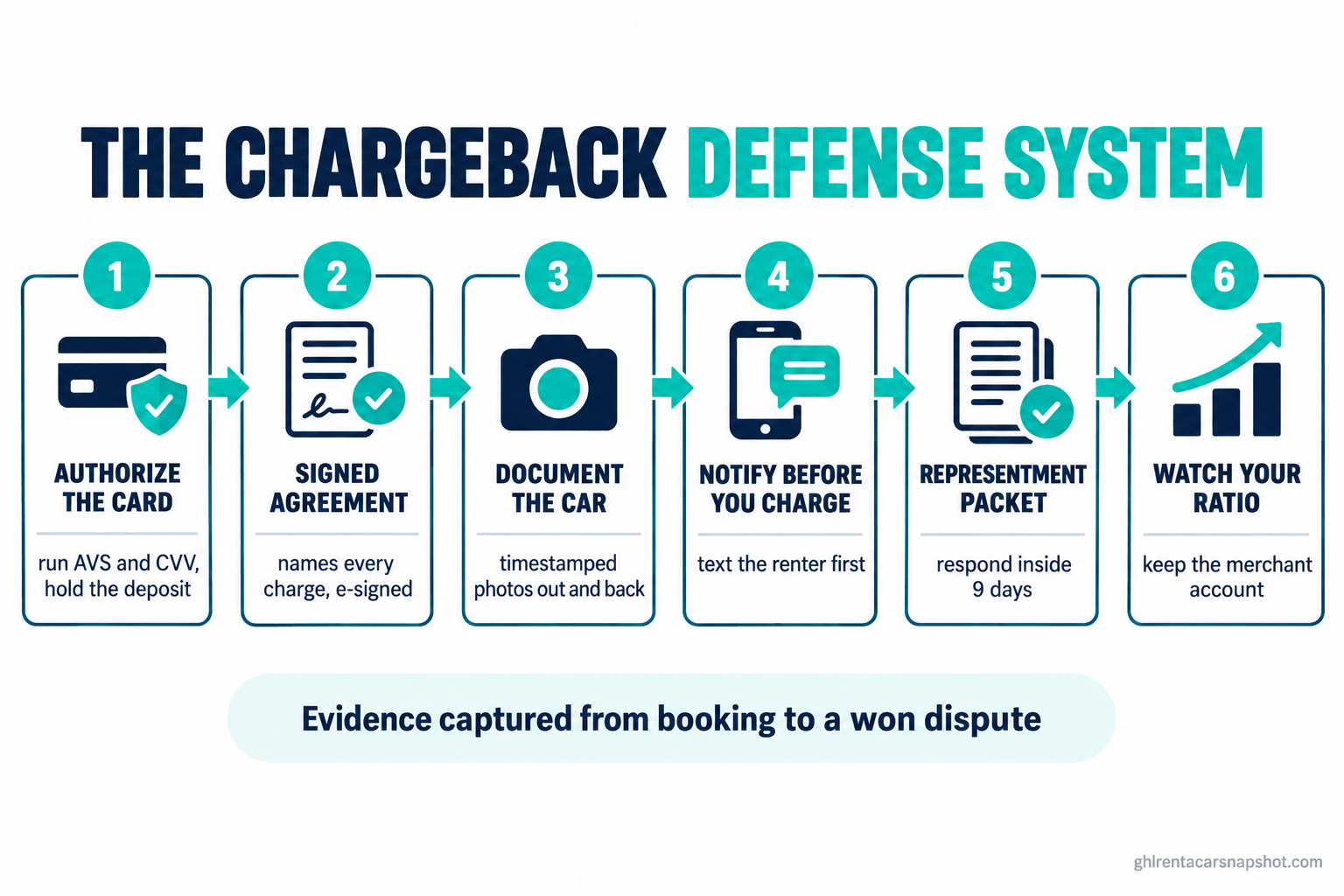
Table of contents
- What a chargeback actually costs you
- Why rental chargebacks happen: friendly fraud, not real fraud
- Stage 1: Authorize the card the right way
- Stage 2: Get a signed agreement that names every charge
- Stage 3: Document the vehicle every time
- Stage 4: Notify the renter before you charge
- Stage 5: Build a representment packet and answer in time
- Stage 6: Watch your chargeback ratio
- Three operators, three versions of the same system
- Steal these: the pre-charge text, the deposit script, the rebuttal
- A note on the compliance you cannot skip
- Common objections, answered
- Frequently asked questions
What a chargeback actually costs you
The number on the statement is the smallest part of the loss. You lose the sale, the service you already delivered, and a processor dispute fee on top, whether you win or lose.
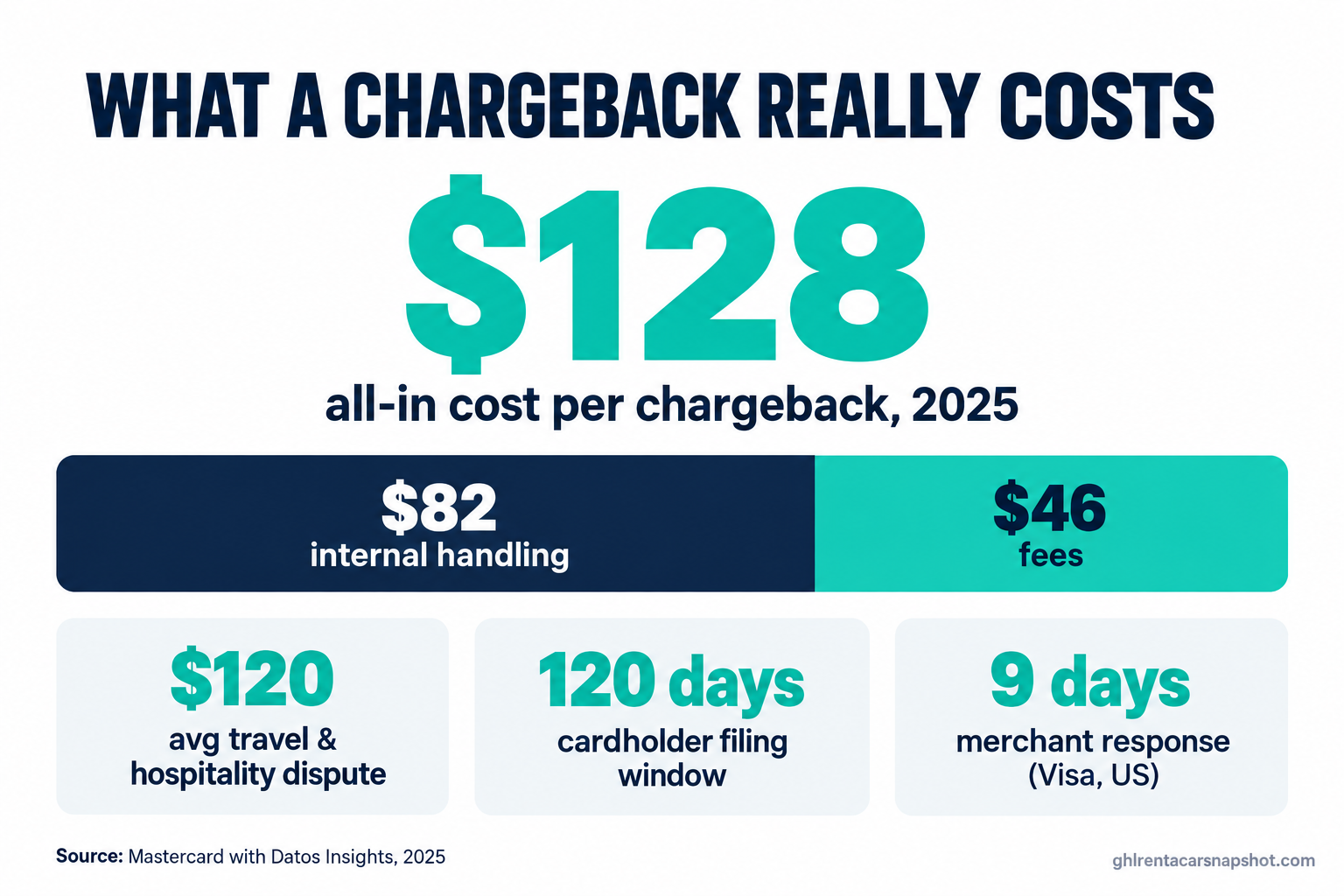
Mastercard, with Datos Insights, put the all-in cost of a chargeback at roughly $128 in 2025, about $82 of internal handling plus around $46 in fees, on top of the sale (Mastercard). Travel and hospitality, where your rental business sits, carries one of the higher average dispute amounts.
The volume is climbing too. Americans filed roughly 158 million transaction disputes in 2025, with friendly fraud the fastest-growing slice (Moneywise), and the LexisNexis True Cost of Fraud study found every $1 lost to fraud costs US merchants about $5.13 all in (via Chargeflow). For a small lot fighting 15 to 40 percent platform commission, a few lost disputes a month is a real hole in the year.
Average chargeback amount by industry, in US dollars. Rental sits in travel and hospitality, the highest bar. Source: Mastercard research with Datos Insights, 2025.
Why rental chargebacks happen: friendly fraud, not real fraud
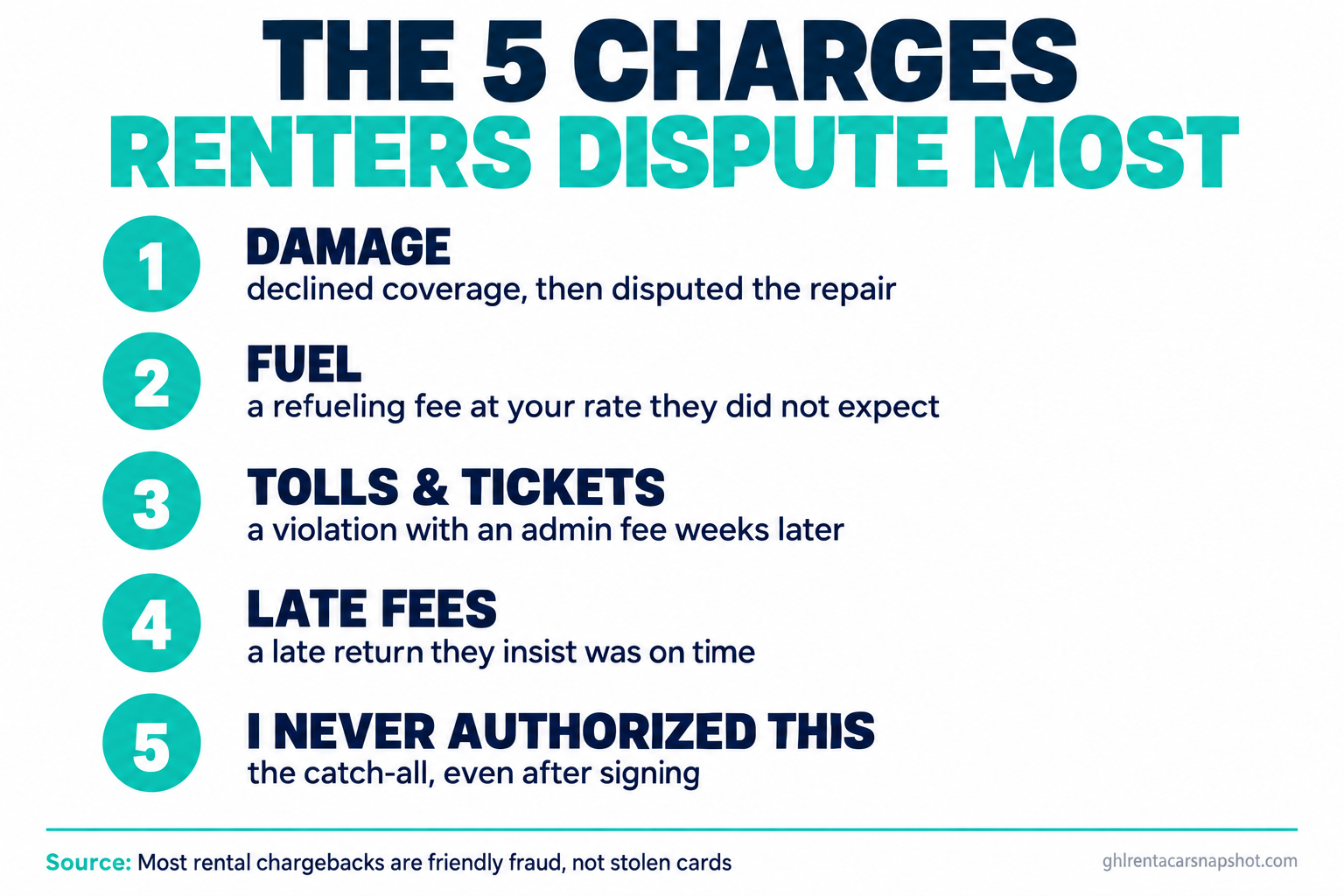
Real fraud, a stolen card, is the rare case. The chargeback that hits your account most often comes from a customer who really rented the car, then disputes a charge anyway. Rental is a magnet for it because so much money moves after the rental ends. As a dispute practice that handles rental cases puts it, rental companies charge fees when customers do not hold up their end, and customers dispute them anyway, even after paying a deposit for exactly that purpose (Chargeback Gurus). The disputes cluster around a short list:
- Damage. They declined coverage, brought the car back scraped, agreed to the repair, then disputed once the charge appeared.
- Fuel. A refueling fee they did not expect at the rate you charge.
- Tolls and tickets. A violation that lands weeks later with an admin fee attached.
- Late fees. A charge for a late return they insist was on time.
- “I never authorized this.” The catch-all: they claim the whole charge was unauthorized even though they signed for it.
The common thread is a charge the renter did not see coming. Fix that and prove the charge was agreed to and documented, and most disputes never happen, or lose when the bank sees your evidence.
Stage 1: Authorize the card the right way
Everything downstream depends on capturing the card cleanly. If you cannot prove it was present, authorized, and matched to the renter, a fraud-code dispute is nearly automatic.
Two things matter. First, run the card through address verification (AVS) and the security code (CVV) check, and keep the result, because for fraud and authorization disputes the evidence that wins is proof of proper authorization, and the AVS and CVV match records are part of it (Chargeback Gurus). Second, be deliberate about the deposit. A pre-authorization hold locks funds temporarily without moving them, which is not a charge. Renters dispute deposits because they do not understand when the hold releases, so capture it on the reservation with the amount and release terms in writing.
Stage 2: Get a signed agreement that names every charge
The rental agreement is your contract, and in a dispute it is the most important document you own. But a generic one is not enough: to win over a post-rental charge, it must name that charge and show the renter agreed.
The evidence that turns back a service dispute is the rental agreement explaining the conditions under which the charge applies, proof the customer signed it, and proof the conditions were met (Chargeback Gurus). So spell it out, in plain terms the renter initials: the fuel policy and refueling rate, the damage responsibility and any per-incident amount, how tolls and violations are billed, the late-return fee, and the deposit hold with its release window. When a renter disputes a fuel charge, you answer with the exact clause they signed. Get it signed digitally so it is timestamped, tied to the reservation, and impossible to lose. If you still pass paper across the counter, the digital rental agreement and e-sign flow is the piece to fix first.
Stage 3: Document the vehicle every time
A signed agreement proves the renter agreed to be charged. Documentation proves the charge was justified, and for damage disputes that is the whole case.
Photograph the car the same complete way at pickup and again at return, before the renter leaves: all four corners, both bumpers, wheels, windshield, interior, and the dash showing the odometer and fuel gauge. Timestamped pickup and return sets bracket the rental and turn “it was already like that” into a losing argument. This is the same record that protects you in a deposit dispute and an insurance claim, so one file serves three purposes. Keep the delivery proof too: the signed condition report, the fuel and mileage readings, and any message where the renter acknowledged the issue.
Stage 4: Notify the renter before you charge
This is the highest-return move in the system, and it costs one text message. Most friendly fraud starts with surprise: a charge the renter did not expect shows up, and the fastest path to a refund is to call the bank. Many rental chargebacks come not from fraud but from customers misunderstanding when funds move, and clear, upfront communication reduces both disputes and support work (Chargeback Gurus).
So before you run any post-rental charge, tell the renter. Send a short message naming the charge, the amount, the reason, and the proof, and give them a beat to respond. Either they accept it, and now you have their acknowledgment on record, or they push back to you instead of their bank, and you resolve it directly without a chargeback ever being filed. Disputed with the bank first, you are on defense in a 9-day window. Raised with you instead, it is just two parties talking, where you can send the photos and the signed clause.
Stage 5: Build a representment packet and answer in time
Representment is fighting the dispute with evidence. Two things decide it: the strength of your packet and whether you respond in time, since missing the deadline loses by default.
Under Visa’s rules, a cardholder generally has 120 days from the transaction to file most disputes, but you get far less to respond: as of July 21, 2025, the Visa dispute response window is 9 days in the US and Canada (Chargebacks911). The moment a notice arrives, assembling the packet is the task, not next week’s.
The packet is the same every time, pulled from the stages above: the signed agreement with the clause that names the charge, proof of signature, the AVS and CVV authorization record, timestamped pickup and return photos, the condition report, and any message where the renter acknowledged the charge or you notified them first. Visa has also expanded Compelling Evidence 3.0, which lets a merchant fight certain fraud disputes by showing two prior undisputed transactions from the same cardholder, dated 120 to 365 days before the disputed one (Chargebacks911). For a repeat renter who cries fraud, a history of clean rentals is itself evidence.
Does fighting pay off? It depends almost entirely on the evidence, as the win rates below show.
Share of challenged chargebacks won, by evidence quality (percent): about 1 in 8 with a weak or missed response, roughly 45% on average, and past 70% with strong pre-built evidence. Source: Chargebacks911 dispute data.
Stage 6: Watch your chargeback ratio
The biggest risk is not a single lost dispute, it is losing the ability to take cards at all. The card networks track your chargeback-to-transaction ratio, and crossing the threshold lands you in a monitoring program with fines, higher fees, and in the worst case a terminated merchant account. Auto rental is already flagged by processors as higher risk, so the margin for error is thin (Auto Rental News).
So track it. Watch your chargeback count against monthly volume, and treat a rising ratio as an operational fire. It usually traces to one or two gaps: no pre-charge notice, or a vague agreement. Close those and the ratio drops. This is also why taking direct bookings through your own system is worth the work: you control the card capture, the agreement, and the communication, where disputes are won or lost.
Three operators, three versions of the same system
The framework is identical at every size. What changes is where it breaks.
Solo ex-Turo host, 8 to 15 cars. You handle every rental, so consistency is your weak point: on a busy Saturday you skip the CVV prompt or forget the pre-charge text. Coming off Turo you also lose the platform’s dispute buffer. Start with the pre-charge notice, since it prevents the most disputes for the least effort.
The 30-car lot with staff. More than one person touches the transaction, so your weak link is the new hire who skips the notify-first rule. Standardize it: one card-capture procedure, one agreement with every charge named, one photo sequence, and no post-rental charge without a logged notice. Your risk is drift, the same discipline behind a solid late-return policy.
The multi-location operator. Several lots, disputes you never see until the ratio moves. You need one system every location runs the same way, and a monthly review of chargebacks by location to find which site is skipping a stage.
Steal these: the pre-charge text, the deposit script, the rebuttal
Here is the copy; adjust to your business.
Pre-charge notice, sent before you run any post-rental charge:
Hi {first name}, this is {business}. Before we finalize your rental of {vehicle}, we need to apply a charge of {amount} for {reason: refueling / damage / toll + admin fee / late return}, per the agreement you signed at pickup. We have photos and the signed terms on file. Reply with any questions in the next 48 hours before we process it.
Deposit-hold explainer, sent at pickup so the hold is never a surprise:
Your card has a refundable hold of {amount} for {vehicle}. This is a hold, not a charge, and it releases within {X} business days after you return the car in the agreed condition. Fuel, tolls, or damage, if any, are billed separately and we will message you first.
Chargeback rebuttal cover letter, submitted with your evidence packet:
Re: Dispute {case number}, cardholder {name}, transaction {date} for {amount}.
This charge is valid and was authorized by the cardholder. Attached: the signed rental agreement dated {date} with the initialed clause covering this charge; the card authorization record showing AVS and CVV match; timestamped pickup and return photographs; the signed return condition report; and our {date} message notifying the cardholder before the charge was processed. The cardholder rented the vehicle and agreed in writing to this charge. We request the dispute be resolved in the merchant’s favor.
They reference the record, and that tone alone settles a lot of disputes before they reach a bank.
A note on the compliance you cannot skip
Two of those moves are text messages, so they fall under the same rules as any business SMS. Before you automate a pre-charge notice or deposit explainer, register your brand and campaign under A2P 10DLC and keep your consent language clean, because carriers filter unregistered traffic and state laws like the Florida Telephone Solicitation Act carry a private right of action plaintiffs use aggressively. One thing to get right: do not follow outdated advice claiming a strict one-to-one consent rule applies, because that FCC rule was vacated in January 2025 before it took effect. The full playbook is in texting rental reminders without a TCPA or 10DLC disaster. One disclaimer: we build the automation, not the payments, so confirm current dispute rules with your processor and counsel.
Common objections, answered
“I already have a deposit, so why does this matter?” A deposit is not a shield against a chargeback, it is a common target of one. It only protects you if you can prove the charge against it was agreed to and justified, which is the whole point of the agreement, the photos, and the pre-charge notice.
“Isn’t fighting chargebacks a waste of time when the bank sides with the customer?” Banks side with the customer when the merchant has no evidence, which describes most operators. With a signed agreement naming the charge, an authorization record, and timestamped photos, the numbers flip, as the win rates above show.
“Do I need to be technical to run this?” No. Every stage is a habit plus a tool doing the filing: verify the card, get the agreement e-signed against the reservation, take the same photos every time, and send two saved messages. The system makes it repeatable; the discipline is what wins.
Frequently asked questions
What is the most common cause of car rental chargebacks?
Friendly fraud on a post-rental charge. A real customer disputes a fee for damage, fuel, tolls, or a late return, often claiming they never authorized it even though they signed at pickup. Stolen-card fraud is far rarer.
How do I win a car rental chargeback dispute?
On evidence captured before the dispute: a card verified with AVS and CVV, an agreement naming the charge, timestamped pickup and return photos, a condition report, and proof you notified the renter first. Strong evidence wins most disputes; a weak or late file loses.
How long do I have to respond to a chargeback?
Less than you think. As of July 21, 2025, US and Canada merchants have 9 days to respond under Visa's rules, though the cardholder had up to 120 days to file. Keep the packet assembled so you can respond the day the notice arrives.
Can a renter dispute a deposit hold as a chargeback?
Yes, often, because renters do not grasp that a hold is temporary and releases after return. Explain it in writing at pickup with the amount and release window, and notify before converting any of it to a charge. A hold they understood is rarely disputed.
Does notifying the renter before a charge really reduce chargebacks?
It is the highest-return step. Most friendly fraud starts with a surprise charge. Message the renter first with the amount, reason, and proof, and they either accept it, which becomes evidence, or raise it with you instead of their bank.
It is the 3rd of the month again, and the statement drops. This time there is no surprise line, because you notified the renter before every post-rental charge. The one dispute that came in gets answered the same day, with the signed agreement, the authorization record, and two sets of timestamped photos attached, and three weeks later it resolves in your favor. That is the whole difference between a chargeback that drains your account and one that does not: not luck, not a friendlier bank, just a system that captured the truth before anyone tried to rewrite it.