

You have hosted on Turo for two years. Twelve cars, good reviews, a weekend waitlist. Then you do the math on the commission and decide to run your own brand, your own site, your own bookings. Then the questions start. Do you need a business license? A special insurance policy? Do you charge sales tax? What is that surcharge line you always saw on airport receipts? Nobody handed you a checklist, because on a platform you never needed one. The platform was the license, the insurance, and the tax collector all at once.
Here is the short answer. To start an independent car rental business in the US legally, you need seven things before the first set of keys leaves: a registered business entity with a federal EIN, your fleet titled and registered, commercial rental-fleet insurance that meets your state’s minimum, a sales and use tax account plus any rental surcharge, local and airport permits if you operate near one, marketing compliance for the texts you are about to send, and the booking, contract, and deposit systems that make it run. Skip any one and you are either uninsured, unlicensed, or one complaint from a fine. This checklist walks all seven, with the real numbers and where each one breaks.
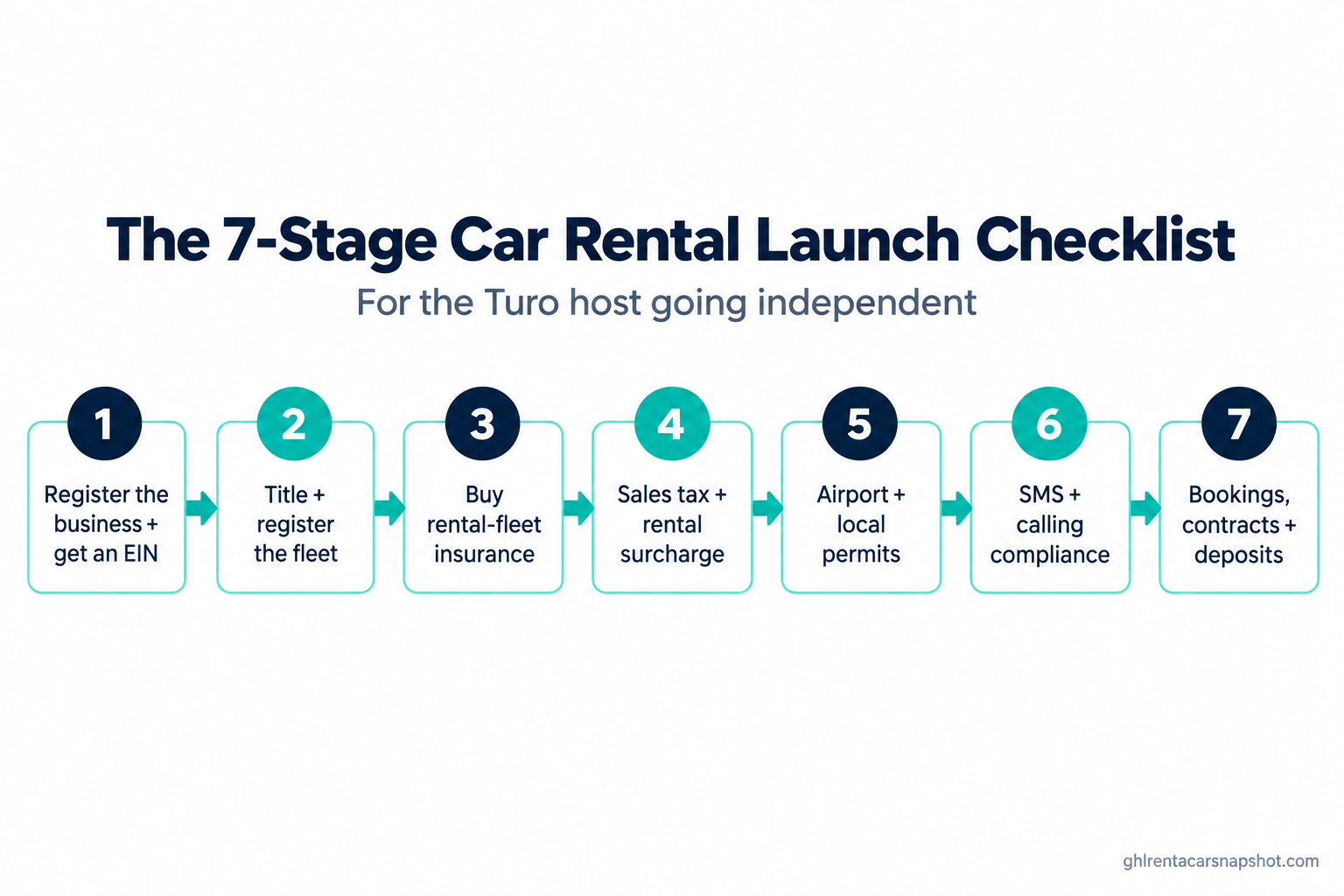
Table of contents
- What skipping this actually costs you
- Stage 1: Register the business and get an EIN
- Stage 2: Title and register the fleet
- Stage 3: Buy real rental-fleet insurance
- Stage 4: Sales tax and the rental surcharge
- Stage 5: Airport and local permits
- Stage 6: Clear SMS and calling compliance
- Stage 7: Wire up bookings, contracts, and deposits
- Three operators, three versions of the launch
- Steal these: the consent line, the permit tracker, the tax email
- Common objections, answered
- Frequently asked questions
What skipping this actually costs you
Start with insurance, because it can end the business in an afternoon. In most of the country the rental company itself is on the hook for the state financial-responsibility minimum on every car it rents. A widely used 50-state survey from the law firm Matthiesen, Wickert and Lehrer shows 45 states require rental companies to carry at least the state-minimum liability coverage, and only five (California, Missouri, New York, Texas, and Utah) do not put that duty on the rental firm (MWL Law 50-state chart). Rent on a personal policy, have a claim, and you have likely voided the policy on top of the loss.
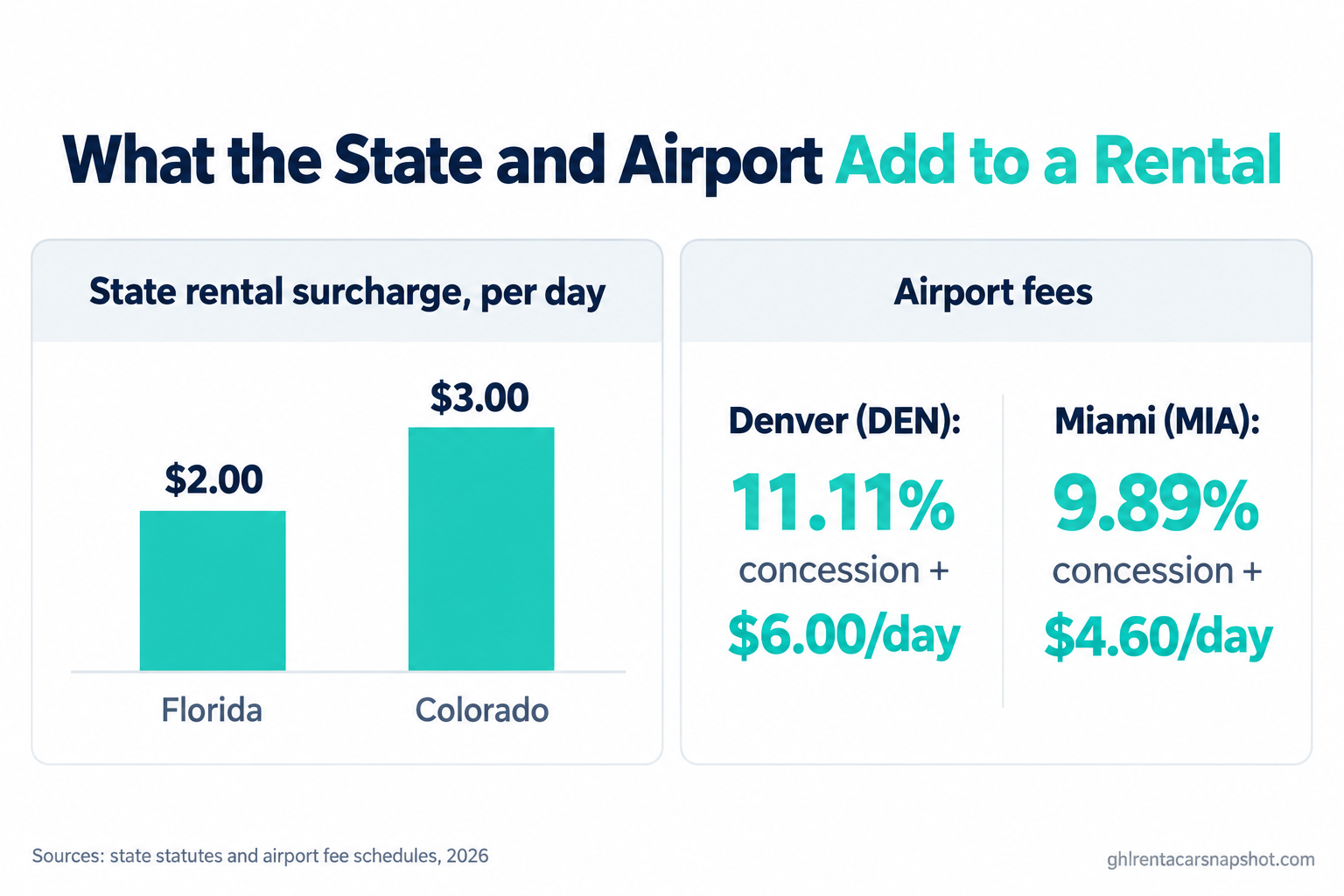
Then there is the tax you never collected. An unregistered rental surcharge does not vanish; it grows with interest. Florida’s surcharge is $2.00 per day for the first 30 days (Fla. Stat. 212.0606), and Colorado charges $3.00 per day, a fee the Tenth Circuit upheld on July 27, 2026 (Auto Rental News). And the marketing rules bite hardest, because they carry a private right of action: the Florida Telephone Solicitation Act lets a consumer sue for $500 per violating text, trebled to $1,500 for a willful one (The Florida Bar Journal).
Stage 1: Register the business and get an EIN
Order matters, because each stage depends on the one before it, so start here. Form a legal entity, almost always an LLC for a small rental operation, with your Secretary of State. That gives you a business name, liability separation between the cars and your house, and the standing to open a business bank account and title vehicles in the company’s name.
Then get a federal Employer Identification Number from the IRS. It is free, takes minutes online, and you need it for corporations, multi-member LLCs, and any business with employees (IRS). You use it to open the bank account, register for state taxes, and set up insurance and processing; the SBA has a clean walkthrough of the full sequence (SBA). Last piece: the local business license or tax receipt, which most cities and counties require separate from the state entity.
Stage 2: Title and register the fleet
Every vehicle you rent needs to be titled and registered, and rental registration is not the same as a personal car. Many states classify rental vehicles as for-hire or commercial, which changes the registration class and the plate.
New York is the clearest example: vehicles rented to non-owners fall under for-hire rules and require an FH-1 insurance certificate for the registration (NY DMV). California adds a Rental Car Agent license from the Department of Insurance for operators who sell coverage to renters, and a Vehicle Lessor-Retailer license for lessors that sell cars (CA DMV). Check your own state’s DMV, and in some states its Department of Insurance, before assuming a normal passenger registration is enough.
One thing you do not have to worry about: NMVTIS, the federal title-history database, is a reporting duty for junk yards, salvage yards, and insurers, not a rental-operation license (DOJ NMVTIS). It is useful only as a buyer checking a used car before you add it to the fleet.
Stage 3: Buy real rental-fleet insurance
This trips up almost every host coming off a platform: the protection plan felt like insurance and was not yours. Now you need your own commercial policy that meets your state’s financial-responsibility minimum on every car.
The minimums vary a lot. Florida requires rental companies to provide at least $100,000 per person and $300,000 per accident in bodily injury, plus $50,000 property damage. California’s is far lower at $30,000, $60,000, and $15,000 (Triple-I). What you are shopping for is a commercial auto or garage policy written for a rental fleet, not a personal policy with more cars on it. Get the limits right for your state, add physical damage coverage, and ask how the policy treats a renter who declines your damage waiver.
Stage 4: Sales tax and the rental surcharge
Short-term rentals are almost always taxable, and many states add a rental-specific surcharge on top of sales tax. You register once, then collect and remit on schedule.
First, get a sales and use tax permit from your state’s revenue department. Then check for the rental surcharge, the separate line most people miss. Texas runs a dedicated motor vehicle rental tax with its own permit (Texas Comptroller). Florida’s $2.00 per day surcharge applies to the first 30 days, on top of sales tax (Fla. Stat. 212.0606). Colorado’s $3.00 per day fee applies to rentals of 30 days or less and, after the Tenth Circuit’s July 2026 ruling, is here to stay (Auto Rental News); it is inflation-indexed, so confirm the current rate each year. These are pass-through charges: the renter pays, you collect, you remit. Set them up from day one, or you owe the state out of your own margin later.
Stage 5: Airport and local permits
If any part of your business touches an airport, the airport adds its own fees and often a permit or concession agreement. These are the biggest and most city-specific numbers you deal with, and they are why a national brand still prices city by city.
Denver International Airport charges an 11.11% concession recovery fee plus a $6.00 per day facility charge, raised from $2.15 in 2023 (Denver International Airport). Miami International Airport runs a lower fee, commonly itemized around 9.89% plus roughly $4.60 per day (itemized on major-agency receipts at MIA, not one public schedule, and fees change, so confirm before quoting). Add state and local tax, and the same $50 per day car costs very different totals in Denver versus Miami.
Airport concession recovery fee, percent of the rental. Denver adds a $6.00/day facility charge on top; Miami roughly $4.60/day. Sources: Denver International Airport and fees itemized on major-agency receipts at MIA.
These fees come with a schedule you have to read, and even off-airport operators near a hub sometimes owe them for a pickup or drop-off on airport property. Some cities also require a specific rental or for-hire permit beyond the general business license, so a call to your city clerk is worth it.
Stage 6: Clear SMS and calling compliance
The moment you text renters a booking confirmation or a pickup reminder, you are a business sender under federal and carrier rules the platform used to shield you from.
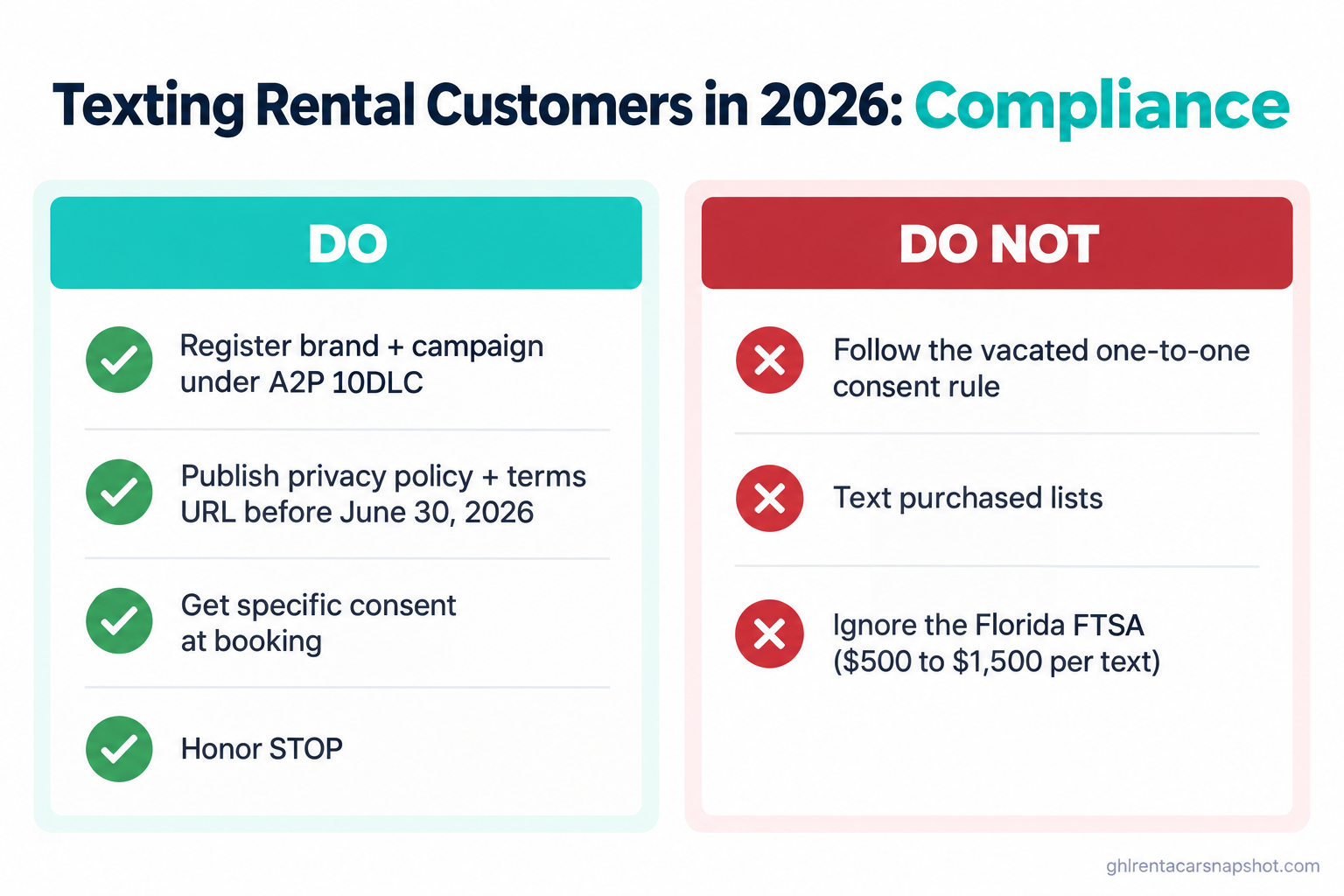
Two things must be true before your first automated text. First, register under A2P 10DLC: your business as a Brand and each messaging use as a Campaign with The Campaign Registry, because carriers filter traffic that is not registered (GoHighLevel guidance). Second, and this is new, from June 30, 2026 a campaign submitted without a valid, publicly reachable privacy policy URL and terms of service URL is rejected outright (Twilio). So both pages need to be live before you register.
Then the state laws, and Florida’s is the one to respect. The FTSA gives consumers a private right of action worth $500 per violation, or $1,500 for a willful one (The Florida Bar Journal), and Florida is a top rental market. One trap: you may still see advice about a strict one-to-one consent rule. Ignore it. The Eleventh Circuit vacated that FCC rule on January 24, 2025, before it took effect, so it is not the law (Wiley). Get clean, specific consent at booking, keep the record, and honor opt-outs. The full mechanics are in our guide to texting rental reminders without a TCPA or 10DLC disaster. We build the automation, not the legal advice, so confirm current rules with counsel.
Stage 7: Wire up bookings, contracts, and deposits
Now the legal and tax foundation is set, and you build the machine that takes money. This is where ex-platform operators underinvest, because Turo gave them a booking engine, a contract, and a deposit hold for free. Off-platform, you own all three, and they protect the revenue you went independent to keep.
You need four things: direct bookings, a signed rental agreement before the keys leave, a card-on-file deposit hold, and documentation of the car out and back. The digital rental agreement and e-sign flow gives you a timestamped contract tied to the reservation, your first defense in any dispute. The damage-photo record out and back turns “it was already like that” into a losing argument. And direct booking is the whole reason to leave the platform, since it stops the commission on every rental (the full Turo math). This is the layer the Car Rental Snapshot is built to be: instead of stitching a booking form, an e-sign tool, a deposit workflow, and reminders together yourself, it ships them wired for rental on day one.
Three operators, three versions of the launch
The seven stages are the same for everyone. Where you spend your energy is not.
Solo ex-Turo host, 8 to 15 cars. Your weak points are insurance and tax, the two jobs the platform silently did for you. Find a broker who has written rental-fleet coverage before you buy the first car, and register for sales tax and any surcharge before your first direct booking. Your advantage is speed, so start Stage 7 with the direct-booking funnel.
The 30-car lot with staff. You have cleared the legal basics, so your risk is drift. More than one person now touches registration renewals, insurance certificates, and tax filings, and a lapsed filing or expired permit slips when nobody owns it. Assign each recurring item an owner and a renewal date, and standardize the SMS consent language so no employee improvises an opt-in that fails A2P review.
The multi-location operator. Every stage is now multiplied by jurisdictions: different insurance minimums, surcharges, registration classes, and airport schedules. You need one compliance calendar tracking every location’s permits and renewals, and a monthly review so a lapse in one city does not become a fine you find a year later. The software you run it on has to handle multiple locations without a rebuild per site.
Steal these: the consent line, the permit tracker, the tax email
Copy and structure you can lift and adapt.
SMS consent line for your booking form (get this specific opt-in at booking):
By entering your mobile number and booking, you agree to receive booking, pickup, return, and account text messages from {business} at the number provided, including messages sent by automated means. Consent is not a condition of rental. Message and data rates may apply. Reply STOP to opt out, HELP for help. See our Privacy Policy and Terms.
Pre-launch permit and filing tracker (build as a sheet with a renewal date and owner per row):
- Business entity registration (Secretary of State): annual
- Local business license or tax receipt (city or county): annual
- Sales and use tax permit (state revenue): on schedule
- Rental surcharge registration, if your state has one: with sales tax
- Fleet registration and plates (state DMV): per vehicle
- Commercial or rental-fleet insurance and any filing (for example NY FH-1): per policy term
- Airport concession or permit, if applicable: per airport schedule
- A2P 10DLC Brand and Campaign, with privacy policy and terms live: one-time, keep current
Tax-setup email to your accountant:
Subject: Rental business tax setup, confirm before launch
Hi {name}, I am launching an independent car rental business ({entity}, EIN on file). Before the first booking, can you confirm: (1) the right sales and use tax account for short-term vehicle rentals, (2) whether my state levies a separate rental surcharge or excise, and at what rate, (3) my filing frequency, and (4) anything city or county specific I owe? I would rather over-register now than owe back taxes later.
Common objections, answered
“This is a lot. Turo handled it, so is going independent worth it?” It is a lot the first time, then it is a renewal calendar. And the reason is the commission. Turo reported roughly 170,000 active hosts and about 360,000 active vehicle listings as of December 31, 2023 (SEC S-1/A, covered by TechCrunch), and every one of them pays a cut of every booking. Do the legal work once and you keep that cut for good.
“I only text my own customers, so do the SMS rules apply?” Yes. A2P 10DLC covers business-initiated messaging to any US number, including transactional texts to your own renters. Registration also keeps your confirmations and reminders from being filtered as spam.
“Can I skip airport fees if I meet renters off-site?” Be careful. Some airports charge fees or require permits for any pickup or drop-off on airport property, even by an off-airport company. Read the rules first.
Frequently asked questions
What licenses do I need to start a car rental business in the US?
At minimum: a registered entity (usually an LLC) with a federal EIN, a local business license, a state sales and use tax permit, fleet titling and registration (a for-hire or commercial class in many states), and commercial rental-fleet insurance meeting your state's minimum. States like California and New York add rental-specific licensing or for-hire filings, so check your state DMV and Department of Insurance.
How much insurance does a rental car company need?
It depends on your state's financial-responsibility minimum, which the rental company must meet in 45 states. Florida requires at least $100,000 per person, $300,000 per accident, and $50,000 property damage; California's minimum is $30,000, $60,000, and $15,000. Buy a commercial or rental-fleet policy, not a personal one, and add physical damage coverage.
Do I have to charge a rental surcharge?
If your state has one, yes: you collect it from the renter and remit it. Florida adds $2.00 per day for the first 30 days, and Colorado adds $3.00 per day on rentals of 30 days or less. These are separate from sales tax, so register for them when you set up your tax account.
What are airport concession recovery fees?
Fees an airport charges rental companies to do business on or near airport property, usually passed to the renter. Denver charges 11.11% plus $6.00 per day; Miami is commonly itemized around 9.89% plus roughly $4.60 per day. They vary by airport and change over time, so confirm the current schedule before quoting a total.
What do I need before texting rental customers?
Register your business and each campaign under A2P 10DLC, and from June 30, 2026 have a public privacy policy and terms URL ready, because registration is rejected without them. Get specific consent at booking, honor opt-outs, and respect state laws like Florida's FTSA, which allows $500 to $1,500 per violating text. Ignore old one-to-one consent advice; that FCC rule was vacated in January 2025.
It is six weeks later. The LLC is registered, the EIN is on file, and your dozen cars are titled and insured under a real rental-fleet policy. Sales tax and the surcharge collect themselves on every booking. Your privacy policy and terms are live, your A2P campaign is approved, and the direct-booking site takes reservations while you sleep, with a signed agreement and a deposit hold before any keys move. The waitlist that used to live on a platform now lives in your own system, and every dollar of it is yours. That is what going independent looks like: not a leap of faith, just seven stages in order.