

It is 6:15pm on a Sunday and a Camry rolls back with a dent in the rear quarter panel that was not there Friday. The renter swears it was already there. You have a card on file, a signed agreement somewhere in your email, and a handful of blurry pickup photos someone may or may not have taken. You file a claim. Three weeks later it comes back denied, and you are eating a $4,000 repair on a car that should have been earning while it sat in the shop.
Here is the short answer. Rental damage claims almost never get denied because the damage was fake. They get denied because the paperwork is thin: no timestamped proof of condition at pickup, notice given too late, a coverage gap nobody checked, or a rental agreement missing the clause that lets you go after the renter. Fix the documentation and the timing and most claims stop bouncing. This is the system that does it, stage by stage.
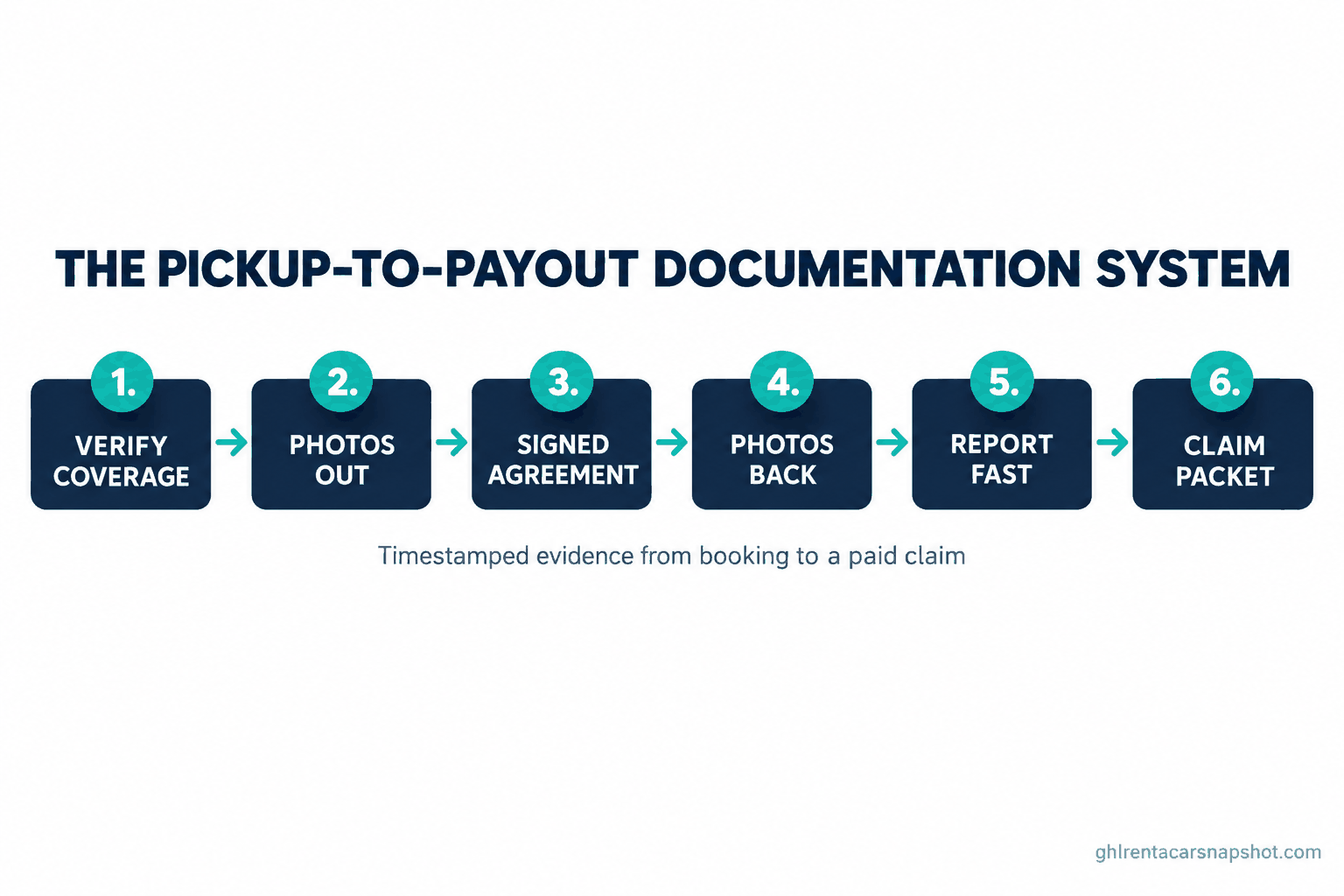
Table of contents
- What a denied claim actually costs you
- Why rental damage claims get denied: the five gaps
- Stage 1: Verify coverage before the keys leave
- Stage 2: Photograph the car out, every time, the same way
- Stage 3: Get the rental agreement clauses right
- Stage 4: Photograph the car back before the renter drives off
- Stage 5: Report the loss fast, because late notice kills claims
- Stage 6: Build a claim packet an adjuster cannot wave off
- Three operators, three versions of the same system
- Steal these: the coverage check, the incident text, the claim email
- Common objections, answered
- Frequently asked questions
What a denied claim actually costs you
Every denied claim is two losses stacked together. You pay for the repair, and the car earns nothing while it sits, often the bigger number. The repair alone is not small: the average collision claim was about $5,489 in 2024, per the Insurance Information Institute, and the CCC Intelligent Solutions Crash Course report put the average repairable-vehicle repair cost above $4,730 in 2024, still climbing in 2025. Fixing a damaged car is a four-figure event, and eating one over a paperwork gap is a bad trade.
What fixing a damaged car costs, in US dollars, across three independent measures. Sources: Insurance Information Institute (average collision claim severity) and CCC Intelligent Solutions Crash Course (average total cost of repair, repairable vehicles).
Why the Turo numbers in that grid? As of year-end 2023, Turo reported roughly 170,000 active hosts and 360,000 active vehicles (TechCrunch, March 2024, citing Turo’s IPO filing). Many of your renters host on platforms and assume that protection follows them onto your lot. It does not, and their own personal coverage is the one most likely to have a hole in it.
Why rental damage claims get denied: the five gaps
Denials cluster around five failure points. Learn them and you can predict which claims will bounce before you file them:
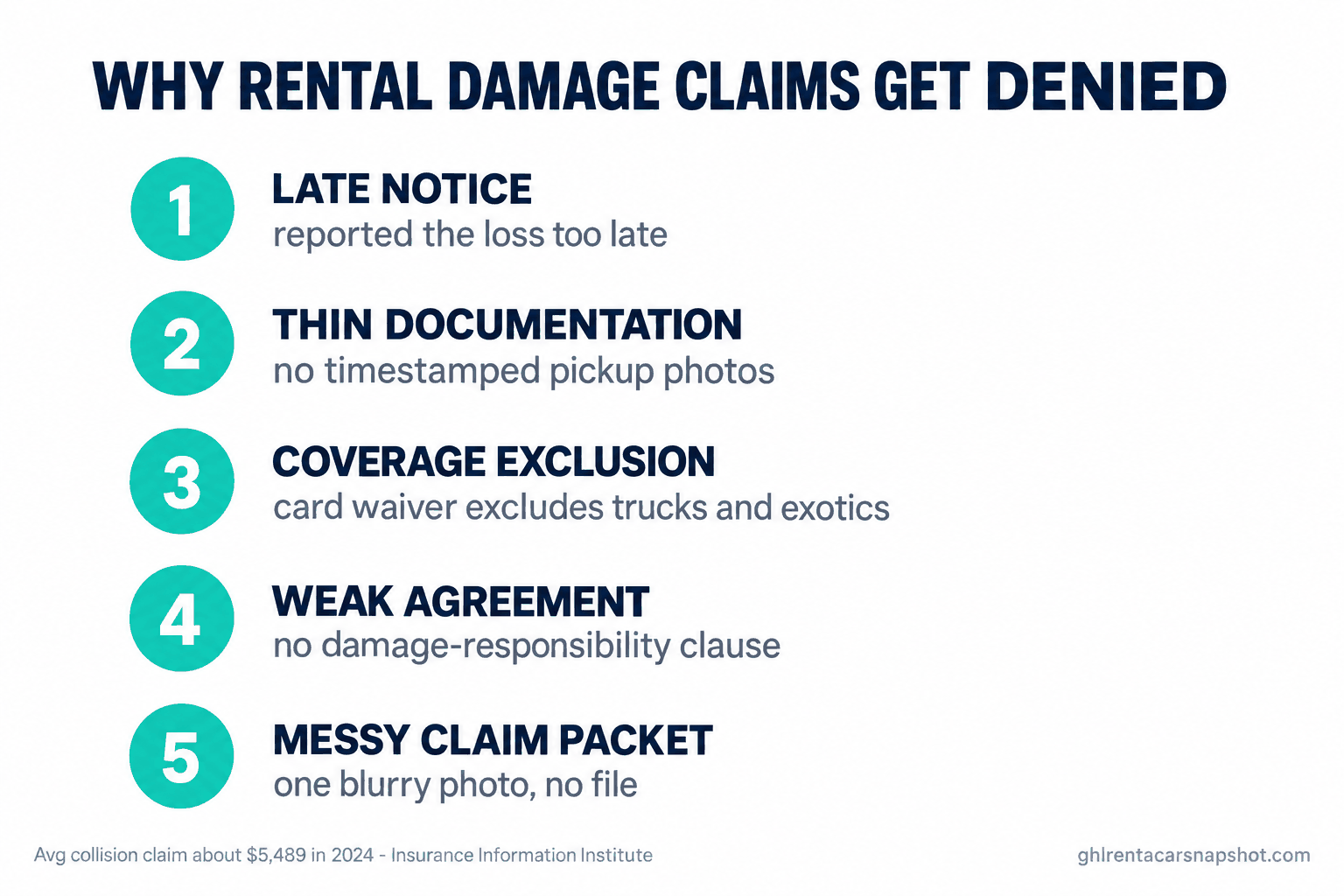
- Late notice. Report a loss a week late and you hand the insurer a clean reason to push back.
- Thin documentation. No timestamped record at pickup means you cannot prove the dent is new, and “new or pre-existing” is the whole fight.
- A coverage exclusion nobody checked. The renter’s personal policy or card waiver may not apply to a car rented for a fee, or to your trucks and exotics at all.
- A rental agreement that does not protect you. Miss the clauses that assign damage responsibility and preserve your right to recover, and your paper is decoration.
- A messy claim packet. A one-line email and a phone photo is easy to deny; a complete packet is harder to wave off.
The rest of this guide is one stage per gap, plus the return inspection that ties it together. None of it needs new software, just a repeatable order.
Stage 1: Verify coverage before the keys leave
The most expensive mistake happens before the rental starts: handing over keys without knowing what covers the car if it comes back broken. There are three backstops, and every one has a gap.
The renter’s personal auto insurance may not apply at all. Personal policies commonly exclude using a vehicle as a “public or livery conveyance,” meaning carrying people or property for a fee (IRMI), and the Insurance Information Institute is clear that business use often requires a commercial policy the renter does not carry.
The renter’s credit-card damage waiver is weaker than most renters think. For a personal rental, card coverage is usually secondary, kicking in after the renter’s own insurance, and it flatly excludes whole categories of vehicle: expensive and exotic cars, most trucks, large passenger vans, and antiques (Chase, Visa Guide to Benefits). If your lot is SUVs, vans, or anything premium, that waiver may cover none of your fleet.
The third backstop is your own commercial physical damage coverage plus the deposit hold, and it is the one you control. So Stage 1 is simple: capture the renter’s coverage details at booking, hold a real deposit before keys leave, and never assume a card waiver covers a vehicle you have not confirmed.
Stage 2: Photograph the car out, every time, the same way
This habit is free and the highest-return in the system. A subrogation practice that recovers rental fleet damage for a living puts it plainly: strong check-in and check-out photos, a signed rental agreement, and documented deductible responsibility all improve your recovery position (Matthiesen, Wickert & Lehrer). Photos turn “he said, she said” into evidence.
Do it the same way every rental so nobody can argue the record is selective: all four corners, both bumpers, the roof, wheels, windshield, interior, and the dash showing the odometer. The images need a timestamp, which a phone camera adds automatically. The fight is almost always about timing, and a complete pickup set answers it in your favor while a missing set answers it in theirs.
Stage 3: Get the rental agreement clauses right
Your rental agreement is the contract that lets you charge the renter for damage and preserves your right to recover: weak agreement, weak claim. It needs to assign damage responsibility clearly, spell out the deductible the renter owes, and confirm who was authorized to drive. That last one matters more than operators expect: if an unlisted driver was behind the wheel, both your coverage and any recovery against the renter can wobble.
Get the agreement signed digitally so it is timestamped, stored, and impossible to “lose.” A signed PDF in a shared inbox is not the same as a signed agreement tied to the reservation. When you subrogate against a renter, the agreement is the document that says you are allowed to. One trap to know: corporate and fleet customers sometimes ask for a waiver of subrogation, which blocks your insurer from recovering from them after a loss.
Stage 4: Photograph the car back before the renter drives off
The return inspection is where most disputes are settled. The rule is simple: photograph the car on return, the same complete way you did at pickup, before the renter leaves the lot. Once they drive off, any new damage becomes arguable and you have lost your case.
Walk the car with the renter present when you can, and match the return photos against the pickup set. New damage now has two timestamped sets bracketing the rental, exactly the evidence an insurer wants. No new damage, and you have proof of a clean return that shields you from a bogus dispute. Note fuel, mileage, and anything mechanical while you are there.
Stage 5: Report the loss fast, because late notice kills claims
Insurance policies contain notice and cooperation clauses that require you to report a loss promptly, and reporting late gives the insurer an opening. In many states, late notice alone does not void coverage unless the insurer was actually prejudiced by the delay, the notice-prejudice rule (Squire Patton Boggs, Saxe Doernberger & Vita). But the rules vary by state and policy type, and some policies do not require proof of prejudice at all. You do not want your claim testing where that line is.
So build reporting into the return process. The moment new damage is confirmed, an incident record should start: what happened, when, the renter, the vehicle, the bracketing photos, the estimate. Notify your carrier inside their window, often days, not weeks. The failure mode is the claim you sat on: the damage was minor, you were slammed, “next week” became a month, and now the timeline has gaps. Make loss reporting a triggered step off the return inspection, not a task that waits for a quiet afternoon that never comes.
Stage 6: Build a claim packet an adjuster cannot wave off
An adjuster’s job includes finding reasons to deny, so make it hard: a one-line email with a blurry photo is easy to reject, a complete and organized packet is not.
The packet is the same every time: the signed rental agreement, the driver’s license and authorized-driver record, the timestamped pickup and return photos, the repair estimate, the incident report with date and time, the renter’s coverage details from booking, and proof of the deposit hold. Attached to one reservation record, it takes minutes to assemble instead of a hunt across three inboxes.
It also powers recovery. If your policy pays, your insurer may subrogate on the same packet; if you pursue the renter directly through the deposit and the agreement’s damage clause, the packet is your case. As the Claims Journal notes on rental recovery, the operators who recover are the ones whose documentation was built before they needed it.
Three operators, three versions of the same system
The framework is the same at every size; only where it breaks changes.
Solo ex-Turo host, 8 to 15 cars. You do everything yourself, so consistency is your risk: on a busy Saturday the walkaround gets skipped. Build the system so it is faster than skipping it, with a booking form that captures coverage, a phone that dumps photos onto the reservation, and a digital agreement signed before pickup. Your biggest upgrade is confirming coverage and holding a real deposit, because your own physical damage coverage is thin and the deposit is your fastest recovery path. Still weighing platform versus direct? The Turo versus your own booking system math is the companion read.
The 30-car lot with staff. More than one person touches the car, and the weak link is the new hire who does not know the photo standard. Standardize it: one checklist, one photo sequence, one place everything lands, and a rule that the deposit is not released until the return inspection is logged. Your risk is drift, the same discipline behind your late-return policy.
The multi-location operator. Several lots, several teams, claims you never personally see. You need one system every location runs the same way, so a claim from your third lot is as clean as one you handled yourself. Centralize the records, standardize the packet, and review denied claims monthly to find which location is skipping a stage. At your scale, the denial rate is a line item that almost always traces to one gap at one location.
Steal these: the coverage check, the incident text, the claim email
Here is the copy; adjust the details to your business.
Coverage confirmation at booking (form field and confirmation text):
To finish your booking we confirm how the vehicle is covered. Please have ready your personal auto insurer and policy number, or the credit card you will use at pickup. Note that some cards do not cover trucks, vans, or premium vehicles, and card coverage is often secondary. A refundable deposit hold applies.
Incident intake text to the renter (sent the moment new damage is found on return):
Hi {first name}, this is {business}. During the return inspection of {vehicle} we found damage that was not there at pickup, and we have photos from both pickup and return. Please reply with what happened so we can document it and move quickly on any claim. Your deposit hold stays in place until this is resolved.
Loss report email to your carrier (within 24 to 48 hours):
Subject: Damage claim, {policy number}, {vehicle}, loss date {date}
Reporting a physical damage loss on a rental vehicle. Attached: signed rental agreement, driver license and authorized-driver record, timestamped pickup and return photos, repair estimate, incident report, and the renter’s coverage details. Please confirm receipt and the next steps.
None of these are hostile. They are factual, they reference the record, and they make clear the documentation already exists. That tone alone settles a lot of disputes.
Common objections, answered
“I have never had a claim denied, so why change anything?” Either you have not had one denied yet, or you absorbed the losses quietly as “cost of doing business” without ever tracking your denial rate. The system costs an afternoon to set up and a minute per rental to run, and one recovered claim pays for years of that minute.
“Won’t all these photos and forms slow down pickup?” Done right it is faster, because it is the same sequence every time and the tools do the filing. A phone walkaround is ninety seconds, and a digital agreement signed before arrival removes the counter scramble.
“I already carry commercial insurance. Isn’t that enough?” Insurance is the backstop, not the system. The policy only pays if you can prove the loss, reported it in time, and did not trip an exclusion. Your documentation is what makes the policy pay, and what lets you recover the deductible from the renter instead of eating it, the same discipline behind a solid deposit-dispute shield.
Frequently asked questions
Why do car rental insurance claims get denied so often?
The common reasons are late notice to the insurer, insufficient documentation of the vehicle's condition before and after the rental, a coverage exclusion nobody checked before the keys left, and a rental agreement that does not clearly assign damage responsibility. Fake damage is rarely the reason, so fixing the timing and the documentation resolves most denials.
Does a renter's personal auto insurance cover damage to my rental car?
Often not fully. Personal auto policies are written for personal use and commonly exclude using a vehicle to carry people or property for a fee. Business use frequently requires a commercial policy the renter does not carry. Never assume the renter's personal policy covers your vehicle without confirming it, and hold a deposit that can absorb a deductible.
How fast do I have to report a rental damage claim?
As fast as possible. Insurance policies require prompt notice of a loss, often measured in days. In many states, late notice alone does not void coverage unless the insurer was prejudiced by the delay, but the rules vary by state and policy type and some policies do not require proof of prejudice. Report within 24 to 48 hours with a complete file to stay out of that gray zone.
What documents do I need to make a rental damage claim stick?
A complete packet: the signed rental agreement, the driver license and authorized-driver record, timestamped pickup photos, timestamped return photos, the repair estimate, an incident report with date and time, the renter's coverage details captured at booking, and proof of the deposit hold. Attach it all to one reservation record so assembling it takes minutes.
Can I recover the damage from the renter instead of my insurer?
Yes, if your paperwork supports it. A signed rental agreement with a clear damage-responsibility clause, a documented deductible, and timestamped photos let you charge the deposit and pursue the renter directly, or let your insurer subrogate against the renter after paying you. The same documentation packet supports both paths.
It is Sunday evening again, and another car comes back with a mark that was not there at pickup. This time the timestamped pickup set is on the reservation, the return photos go up before the renter leaves, the incident record starts on the spot, and the carrier hears from you Monday with a packet they cannot argue with. That is the whole difference between a denied claim and a paid one: not luck, and not better insurance, just a system that documents the truth before anyone needs it to.