

It is 9:40am on a Saturday. Your 10am renter is standing in the lot for a car that is not there, because the guy who took it Friday said he would “have it back by nine, no problem.” He is not answering his phone. Now you either hand the 10am a downgrade you will hear about in a review, or you eat a refund and a re-book. Either way your turnaround plan for the day just fell apart before your second coffee.
Here is the short version so you can fix this today. A late return is almost never a discipline problem. It is a systems problem, and you solve it with four things you can set up in an afternoon: a return time the renter agreed to in writing, a grace period you chose on purpose, a reminder that lands before the car is due, and a late-fee ladder fair enough to enforce every time. Get those right and most late returns disappear, the ones that still happen cost the renter and not you, and your 10am is never left standing in the lot again.
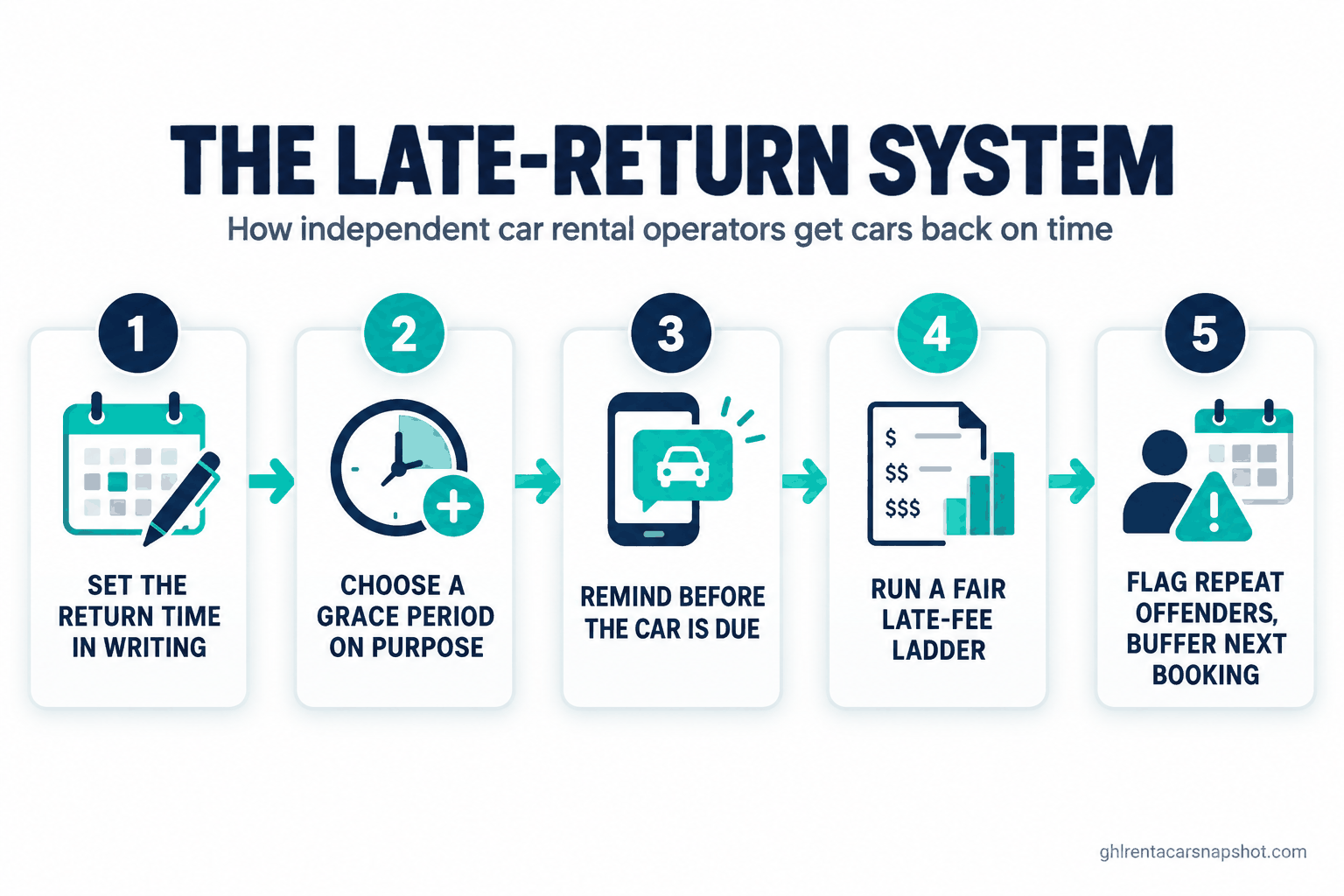
Key Takeaways
- Late returns are a turnaround tax, not bad luck. One car back three hours late can cost you the next rental, staff time, and a bad review at once.
- A grace period is a decision, not a default. The big players land between 29 and 59 minutes; pick a number, write it down, apply it the same way every time.
- The reminder before the car is due beats the fee after. A text a few hours ahead prevents the late return; the fee only pays for it.
- Make your late-fee ladder fair enough to charge without an argument. Hourly up to a cap, then a full day, mirrors Turo, Enterprise, and Hertz, so renters accept it, and the extension turns a would-be late return into paid time.
Table of contents
- What a late return actually costs you
- Stage 1: Set the return time in writing
- Stage 2: Choose a grace period on purpose
- Stage 3: Send the reminder before the car is due
- Stage 4: Build a late-fee ladder you can enforce
- Stage 5: Turn the late return into an extension
- Stage 6: Flag repeat offenders, buffer the next booking
- Three scenarios: solo, 25-car lot, multi-location
- Steal these: the late-return scripts
- Texting these reminders legally
- Common objections, answered
- Frequently asked questions
What a late return actually costs you
The fee you charge is the smallest number in this story. The real cost is the next rental you could not fulfill.
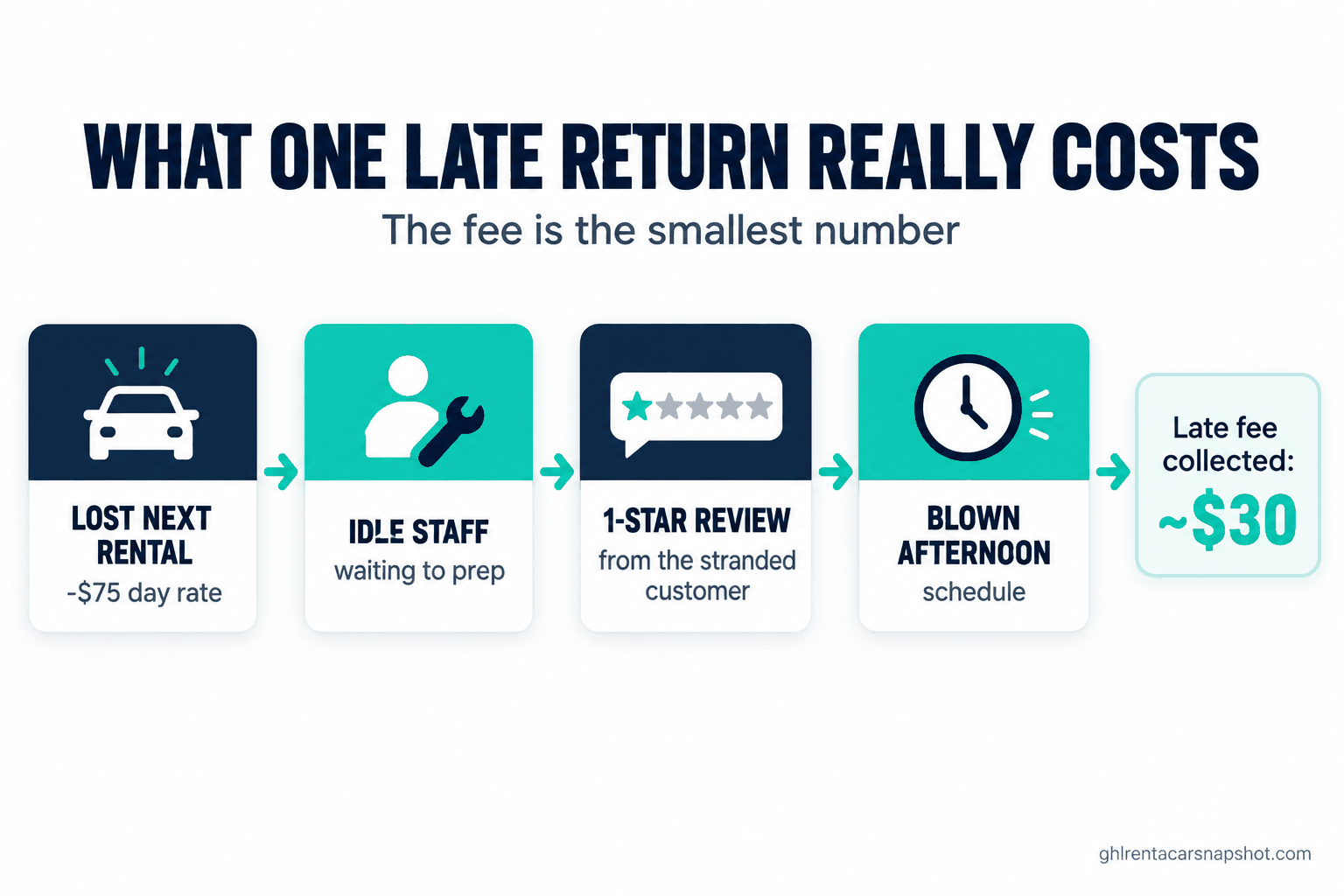
Run the math on one late car. Say your day rate is $75 and turnaround cleaning takes 45 minutes. A car due back at 9am for a 10am pickup has just enough slack if everything runs on time. Now it comes back at noon. You lost the 10am rental, that $75 is gone plus maybe a refund, and your staff is idle instead of prepping other cars. One late car did not cost you a $30 fee. It cost you a day rate, a review, and your afternoon.
That cascade hits small fleets hardest. When you run 12 cars and three are booked back-to-back on a Saturday, you have no spare to swap in. This is the margin math behind your fleet utilization rate: a car that is not on the lot when the next renter arrives earns nothing while making you look bad. If you came from Turo, this followed you. Turo reported more than 175,000 active hosts and around 360,000 vehicles as of 2023 (TechCrunch, 2024), and every one has felt a guest treat the return time as a suggestion. The difference now is the fix is yours to build.
Stage 1: Set the return time in writing
You cannot charge a late fee for a time the renter never agreed to. So the return date, the return time, and the fee for blowing past it all belong in the rental agreement, in plain language, e-signed before the keys leave your hand.
This is where most disputes start. The renter says “I thought I had it until end of day.” Your booking said 9am. If your agreement spells out “Return by 9:00am Saturday. After a 30-minute grace period, a late fee of $15 per hour applies, up to the daily rate,” there is nothing to argue about. Put the return time in three places: the booking confirmation, the signed agreement, and the pickup-day text. The same discipline that protects your deposit with timestamped damage photos protects your schedule.
Stage 2: Choose a grace period on purpose
Every renter is a few minutes late sometimes: traffic, a slow gas station, a kid who will not get in the car. A grace period exists so you and your staff are not fighting over eight minutes. The mistake is not deciding what it is, so every late return becomes a judgment call applied differently to different people.
Look at how the companies your renters have used handle it. Matching that range makes your policy feel normal rather than harsh.
| Company | Grace period | After grace | Full extra day when |
|---|---|---|---|
| Turo | 29 minutes | $10 per hour late | After 2 hours, full daily rate plus a fee |
| Enterprise (US) | ~29 minutes | Hourly charges apply | 2.5 hours or more past the time |
| Hertz | ~59 minutes | Hourly at 1/5 of the daily rate | After 5 hours late |
| Recommended lot policy | 30 minutes | Your hourly rate | Once hourly hits one day rate |
Grace period (minutes) before a late fee starts. Sources: Turo, Enterprise, Hertz.
For most independent lots, 30 minutes is the sweet spot. It covers the honest “traffic was bad” without giving away the free half-day a 59-minute window can become on a tight Saturday. Whatever you pick, hold your team to it: a grace period applied inconsistently is worse than none, because now you look like you play favorites.
Stage 3: Send the reminder before the car is due
This is the stage that actually prevents late returns, and the one most operators skip. A fee punishes after the fact. A reminder prevents. Renters lose track of time; a text a few hours before the car is due pulls them back while they can still act.
Texting works because renters read it. SMS open rates sit around 98%, far above email (Sender), which is why a return reminder cuts late returns the way a pickup reminder cuts no-shows. Send two: one the evening before or morning of, and one a few hours before the deadline. The second is the workhorse, giving the renter time to head back or ask for more time. The trigger is simple: when a booking’s return time is set, schedule a text to fire a few hours before it, using the same reservation automation logic behind a no-show recovery workflow. Make it say “bring it back, or reply if you need more time,” so it converts a would-be late return into an extension request.
Stage 4: Build a late-fee ladder you can enforce
A fee you are afraid to charge is a bluff, and renters can smell it. Build a ladder so obviously fair that charging never feels like a fight.
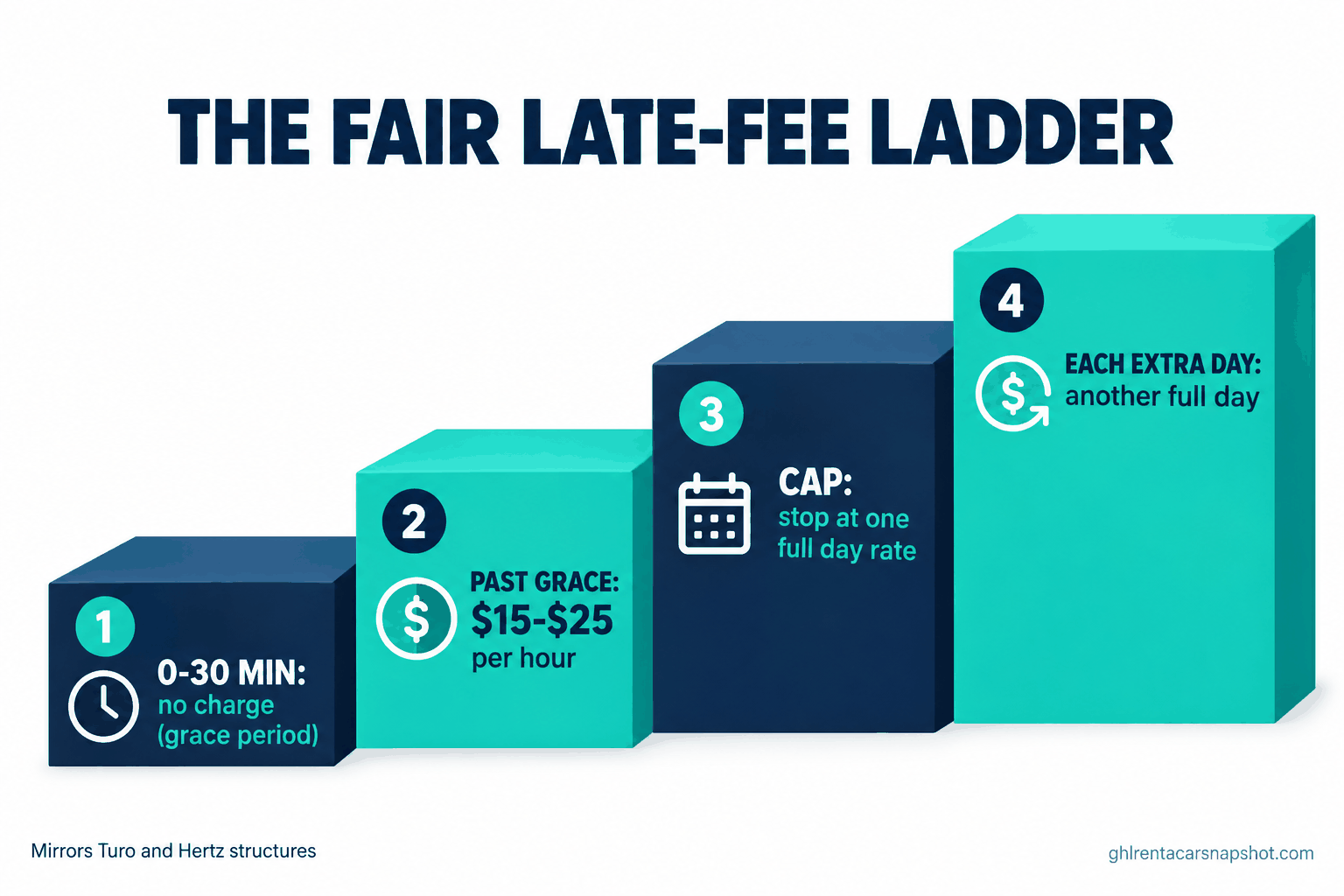
- Inside the grace period (0 to 30 minutes late): no charge. The honest-traffic buffer.
- Hourly, past grace: a flat per-hour fee, say $15 to $25 by car class.
- Cap at one day rate: once the hourly total reaches a full day rate, stop the meter and charge one day. Never let hourly run to $200 on a $75 car, or you lose the chargeback.
- A new day for every extra day: past the next return window is another full day, like a fresh rental.
This is almost exactly Turo’s structure ($10 an hour, then a full day after two hours) and Hertz’s. You are not inventing anything, just writing down what renters already expect.
Stage 5: Turn the late return into an extension
The best outcome for a renter running late is not a fee. It is an extension. A renter who pays for two extra hours is happy and feels taken care of. The same renter who just keeps the car and eats the fee is plotting a chargeback. Same two hours, different relationship, decided by whether you made asking easy.
Build the extension path into the reminder and return flow. When a renter replies “can I keep it longer,” your team or automation checks the calendar, confirms the car is not booked next, quotes the extra time at your normal rate, charges the card on file, and updates the return time in one motion. If the next renter is at noon, the answer is “I can give you until 10:30.” If nothing is booked until Monday, be generous. When you own the calendar, you own the extension, and the extension is pure margin. The full case is in Turo versus your own booking system.
Stage 6: Flag repeat offenders, buffer the next booking
Most renters are late once and never again. A small number are late every time, and those are worth tracking. Tag a contact the first time they return a car more than an hour late. The second time, your booking flow can quietly require a larger card-on-file hold and stop booking anyone tight behind them.
That second move is the quiet hero. If you know a renter runs two hours over, do not schedule a pickup 45 minutes after their return. Losing 90 minutes of availability on one car is far cheaper than blowing up a confirmed booking. The goal is not to punish the repeat offender, it is to stop arranging your schedule so their habit becomes your problem.
Three scenarios: solo, 25-car lot, multi-location
The six stages are the same for everyone. What changes is how much you automate and how tight your buffers need to be.
The solo host, 8 to 15 cars. Probably a former Turo host building a direct book. Your whole risk is the back-to-back booking, because you have no spare to swap in. Priorities: put the return time and fee in the agreement, set a 30-minute grace, automate the pre-deadline reminder text, and never book two rentals on one car without a real gap. You will remember repeat offenders by name for now.
The 25-car lot with staff. Now the failure is inconsistency, because more than one person works the counter, and the verbal “no problem” is your enemy. Priorities: one written policy everyone follows, the reminder cadence running automatically so it does not depend on who is on shift, the fee ladder charged the same way every time, and a hard rule that extensions get logged. Start tagging repeat offenders here.
The multi-location operator, 50-plus cars. Your problem is scale and handoffs; a car late at one location can strand a booking at another. Priorities: everything above, plus a system-enforced booking buffer, repeat-offender flags that follow the renter across locations, and reporting on which lot and car classes run late most. At this size, a 2% dent in late returns is real money.
Steal these: the late-return scripts
Here is the copy. Each names your business, stays about the booking, and stays friendly until it cannot.
Return reminder (a few hours before due, the workhorse):
Hi {first name}, it’s Sunrise Rentals. Reminder your {car} is due back by {time} today at {location}. Need more time? Reply here and we’ll check the calendar before any late fee starts. Thanks!
Extension offer (when they ask and the car is free):
Done! I’ve extended your {car} until {new time}. The extra time is {amount}, charged to the card on file. New return: {new time} at {location}. Drive safe.
Late-fee notice (past grace, no reply, fee now applies):
Hi {first name}, your {car} was due at {time} and we haven’t heard from you. A late fee of {rate}/hour is now running per your rental agreement. Return it or reply to extend so we can stop the fee. Call us at {phone}.
Counter phone script (when a renter calls to say they’ll be late):
“No problem, thanks for calling ahead. Let me extend your booking now so it’s official and you’re not hit with a late fee. What time works? Let me check the calendar. Great, you’re set until [time], and I’ll put the extra [amount] on your card on file.”
None of these lead with the fee. They lead with the reminder and the extension, and only mention the fee once the friendly path has been ignored. That order keeps it enforceable and the renter calm.
Texting these reminders legally
Since these reminders go out by text, a quick guardrail. Operational messages about a booking the renter made are the safest kind of text you can send, but you still need to be registered for A2P 10DLC, hold a consent record from the booking, and honor opt-outs. If you rent to Floridians, the state’s mini-TCPA carries a private right of action, so run the strict version. The full walk-through is in our guide to texting pickup and return reminders without a TCPA problem and the step-by-step TCPA-compliant messaging guide.
Common objections, answered
“Won’t the reminders and fees annoy renters?” The reminder does the opposite. A renter running late is grateful for the heads-up that saves them a fee. The fee only annoys the renter who ignored the reminder and never asked to extend, and that renter was going to be annoyed anyway.
“I already have a late clause in my agreement. Isn’t that enough?” The clause is necessary but not sufficient. It makes the fee enforceable; it does nothing to prevent the late return. A PDF does not text the renter three hours before the car is due. You can start manual today, a written policy and two reminders on your own calendar, and automate once that gets painful. The clause is your backstop, not your system.
“What if the renter disputes the fee?” This is why Stage 1 exists. A signed agreement with the return time and fee spelled out, plus a text log showing you reminded them and offered an extension they ignored, is a nearly airtight record. The operators who lose these charged a fee that was never written down, or one so large it looks punitive. Write it down, cap it at a day rate, keep the log.
Frequently asked questions
What is a fair grace period for a car rental late return?
Thirty minutes is the sweet spot for most independent operators. It covers honest delays without giving away a free half-day. For reference, Turo and Enterprise use about 29 minutes and Hertz about 59, so 30 feels normal. The key is to pick a number, put it in your agreement, and apply it the same way to everyone.
How much can I charge for a late rental car return?
A fair structure is an hourly fee past the grace period, capped at one full daily rate, then a new full day for each additional day. A common range is $15 to $25 an hour by car class. Turo charges $10 an hour then a full day after two hours. Avoid an uncapped hourly fee, which tends to lose a chargeback dispute.
Can I charge a late fee if it is not in the rental agreement?
You should not. A late fee is only enforceable if the return time and fee were disclosed and agreed to before the rental, ideally in a signed agreement. Charging one the renter never agreed to is the fastest route to a lost chargeback and a bad review. Put the terms in the confirmation, the agreement, and the pickup-day text.
How do I prevent late returns instead of just charging for them?
Send a reminder text a few hours before the car is due, with an easy way to ask for more time. It pulls a distracted renter back while they can still act, and the extension option turns a would-be late return into paid time. The reminder does the prevention; the fee is only your backstop.
How do I handle a renter who is late every time?
Tag them after the first return more than an hour late. On their next booking, apply a larger card-on-file hold and stop scheduling other rentals tight behind them on the same car. A turnaround buffer around a known repeat offender saves you from a blown, refunded booking.
Back to that Saturday. Run this system and it ends differently. Friday’s renter got a text at 6pm reminding him the car was due at 9. He replied that he needed until 10, you saw the 10am pickup on the calendar, and told him 9 sharp or you would extend and charge him. He brought it back at 8:55. Your 10am pulled in to a clean, ready car, and you never touched a fee. That is the point: a good late-return policy is not about collecting fees. It is about making sure the car is on the lot when the next renter walks up.