
A flight lands at 4:50pm. By 5:10 the traveler is standing at the rental counter in a line twelve deep, watching the big brands quote a weekend rate that doubled with fees they did not expect. Half of them pull out a phone while they wait and search “car rental near [airport].” That search is the whole opportunity, and you do not need a counter inside the terminal to win it.
Here is the short version. You can rent to airport-bound travelers as an independent without an on-airport concession, and in most cases you should. The counter carries a concession recovery fee of roughly 10% to 11% of the rental, a customer facility charge of about 5 to 6 dollars a day, and a bidding war for space you cannot win. The off-airport operator skips most of that stack and competes on price, service, and a car waiting where the customer wants it. The catch: “off-airport” is not a magic fee dodge, and the system that captures this demand is booking, delivery, and follow-up, not a building. This is how to build it.
Table of contents
- Why the airport counter is a trap for independents
- What the concession stack really costs
- The off-airport system, stage by stage
- Three fleets: 8, 30, and 80 cars
- Texting out-of-state travelers without a compliance mess
- Common objections, answered
- Frequently asked questions
Why the airport counter is a trap for independents
Airport demand is the best demand in this business. The traveler has no car, a reservation made before they flew, and little price sensitivity in the moment. That is why the national brands pay so much to stand in the terminal, and why a 12-to-100 car independent should not try to join them at the counter.
On-airport rental is a concession: you bid for the space, sign a multi-year agreement with the airport authority, pay a percentage of every dollar you earn there, and pay consolidated facility costs on top. The brands amortize that across thousands of cars. You cannot. The counter is a cost structure built for Hertz, not for a lot with 30 vehicles.
But the customer does not care where the counter is. They care that the car is clean, the price is honest, and it is waiting when they land. An independent who delivers to the hotel, or meets the traveler a short ride away, beats a line twelve deep and keeps the margin the airport would have taken. Same logic as the Turo versus your own booking system math: own the relationship, keep the money.
What the concession stack really costs
The stack is bigger than most operators think, and it varies by city. Start with the concession recovery fee. At Miami International, the airport applies about 10% on rentals that originate at the airport (Miami International Airport). Denver is a 10% share of gross revenue paid to the City and County of Denver, grossed up to roughly 11.1% on the customer’s bill (AutoSlash). One line on the receipt, a tenth of your revenue gone.
Then the customer facility charge, a flat daily fee for the shared garage: Miami’s sits at $5.35 per rental day in 2026 (DWU Consulting), Denver’s in the same 6-dollar range. On a seven-day rental that is another 37 to 42 dollars before tax.
States add their own surcharges on top. Florida charges a statutory $2 per day on rentals of vehicles seating fewer than nine (Fla. Stat. 212.0606). Colorado added a $3 per day congestion impact fee on rentals of 30 days or less, and in July 2026 the Tenth Circuit upheld it 2-1, so it is firmly in effect and indexed to inflation (Auto Rental News; Reuters via U.S. News).
Concession recovery fee as a percent of the rental, by pickup location (figures approximate). Sources: Miami International Airport; AutoSlash.
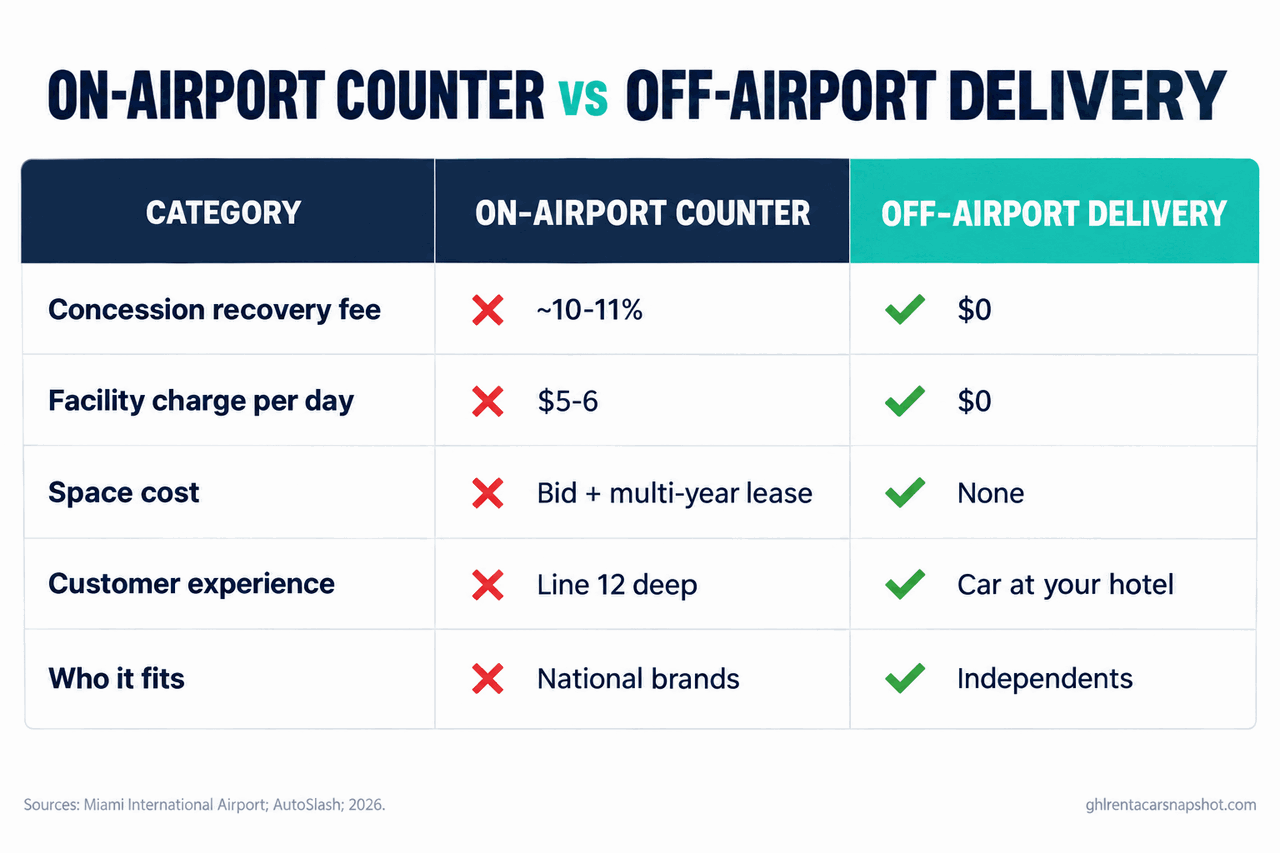
On a Miami weekend rental with a 350-dollar base, that is roughly 35 dollars in concession plus about 37 dollars in facility charges across the week, close to 80 dollars of airport-specific cost that makes the car no better. Pure overhead an off-airport operator does not carry.
The off-airport system, stage by stage
The money off the airport is not in a building. It is in a system that gets found, answers fast, books direct, puts the car where the traveler is, and turns one trip into the next. Six stages, each with how to set it up, the copy you can use, and how it breaks.
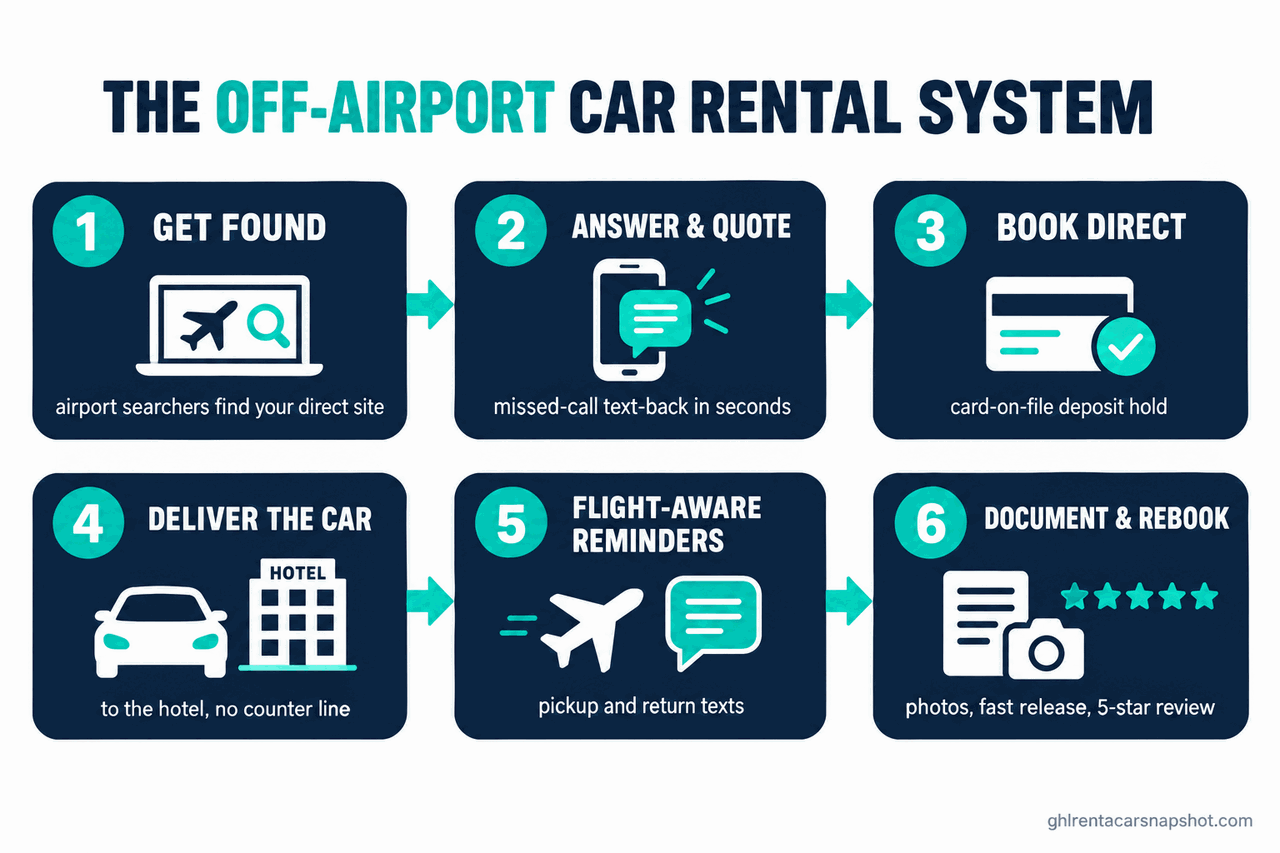
Stage 1: Get found by airport searchers
The traveler searching “car rental near [airport]” from baggage claim is your highest-intent lead of the day. You win that search with a direct-booking site that names the airport, a Google Business Profile with a rating and real photos, and content that answers what travelers actually ask: do you deliver to the terminal, what is the deposit, can I get the car at my hotel.
Name the airport code and the hotels and neighborhoods you cover. A page titled for your city plus “airport car rental” with honest pricing beats a brand’s generic listing on the one thing travelers care about: total price with no surprise at the counter. And show the price. Travelers bounce from any rental site that makes them call for a quote, because vagueness reads as the same trap they just hit at the counter. The full ranking build is in the local SEO playbook for car rental businesses.
Stage 2: Answer and quote before they book the brand
An airport lead is perishable in minutes. The traveler is in line comparing you to the counter in front of them, and whoever answers first with a car and a real price wins. If your phone goes to voicemail, you lose to the line.
The fix is a missed-call text-back on your main line and your Google number, so the second a call goes unanswered a text fires asking the two things you need: dates and vehicle. It moves the conversation to the channel a traveler in a loud terminal will actually use, and recovers more airport bookings than anything else (missed-call text-back playbook).
Hi, this is {business}, sorry we missed you. We deliver to the terminal and nearby hotels, no counter line. What dates and vehicle are you after, and which airport or hotel? I’ll send a price right now.
The first reply has to carry a quote, not a “we will get back to you.” The traveler will not wait.
Thanks {first name}. We have a {vehicle type} for {dates} at {rate}/day, with a refundable {hold} deposit hold. We can meet you curbside or drop it at your hotel. Want me to lock it in?
Stage 3: Book direct and lock the deposit
Direct booking is the point of the off-airport model. No marketplace commission, no concession, and you keep the customer’s details so you can rent to them again. But a direct booking is only real when the deposit hold is on a card before the keys move.
Put a card-on-file authorization hold in the booking flow, not a request you chase later. It protects you against damage, tolls, and no-shows, and filters out the people who will not commit. Sizing and placing the hold without scaring off good renters is in the security deposit hold guide, and the contract should be a digital rental agreement with e-sign the traveler signs from their phone before they land.
Stage 4: The handoff, delivery or lot-and-shuttle
This is the stage that separates a real off-airport business from a hobby, and the one with a legal wrinkle you must get right.
You have two honest models. Delivery means you bring the car to the traveler’s hotel or a meeting point. Lot-and-shuttle means they take a short rideshare or your van to your nearby lot. Delivery wins on experience and justifies a premium; lot-and-shuttle is cheaper to staff at volume.
Now the wrinkle: “off-airport” does not automatically mean “no airport fee.” Some airports assess one on off-airport companies that serve customers who flew in. Orlando charges a 10% gross-receipts fee within a seven-mile radius when the customer arrived by air within 24 hours, though they can sign a statement that they did not. Salt Lake City assesses its concession fee on off-airport companies that pick up or drop off at the airport itself (Christopher Elliott). Meeting a traveler curbside can pull you into the fee you were avoiding, while delivering to their hotel usually does not. Call your airport authority, learn your rule in writing, and design the handoff around it.
Your {vehicle} is confirmed for {date}. Reply with your hotel or where you’d like to meet, and your flight number so we time it to your landing. We’ll text you the exact spot and a photo of the car and the driver 30 minutes before.
Stage 5: Flight-aware pickup and return reminders
Travelers are the easiest renters to remind and the easiest to lose track of, because their plans move with their flights. Set three touches: a confirmation at booking, a pickup reminder the day before with the meeting details, and a return reminder the morning the car is due with the drop-off location and time. For a traveler flying out, tie the return reminder to a buffer before their flight so you are not chasing a car in a parking garage while the renter is at the gate. The timing templates, and the rules that keep them legal, are in the pickup and return reminder playbook.
Reminder: your {vehicle} is due back {date} by {time} at {location}. Flying out? Leave time to return it and clear security. Need to extend? Reply here and we’ll sort it out.
Stage 6: Return, document, re-rent, and rebook
The return is where deposits are won or lost and where your next rental happens or does not. For an airport fleet, turnaround is everything: the car back clean at noon goes out again that afternoon to the next arrival.
Document every handoff with timestamped photos, out and back, so a deposit dispute ends with evidence instead of an argument. This matters more with travelers, who are out of state by the time a dispute surfaces and quick to file a chargeback from another time zone. The full workflow is the damage-photo deposit-dispute shield. Then release the hold fast, because a traveler who gets their deposit back the same day is the one who rebooks and refers.
Reviews are the engine of airport demand, because the next traveler choosing between you and the counter reads them first. Ask at peak goodwill, right after a smooth return and a fast release, with a direct link, and route anything unhappy to you privately before it goes public (five-star review pipeline). Then tag the renter with their trip reason and vehicle so a business traveler who comes through quarterly gets a “welcome back” with their usual car pre-offered, not a cold quote.
Hope the trip went well, {first name}. A quick review would mean a lot: {link}. Next time you’re in {city}, text this number and we’ll have your {vehicle} ready, no counter line.
Three fleets: 8, 30, and 80 cars
The model scales, but it looks different at each size. The honest version for three fleets:
| Solo, 8 cars | Mid, 30 cars | Large, 80 cars | |
|---|---|---|---|
| Handoff model | Delivery only, owner drives | Delivery plus a small lot | Lot-and-shuttle plus delivery premium |
| Who meets the renter | You | 1-2 part-time drivers | A dispatch-scheduled team |
| Booking | Direct site plus phone | Direct site, automated quotes | Direct site plus corporate accounts |
| Biggest risk | Your own time at the curb | Handoff timing across drivers | Fleet sync across pickup points |
| First automation to add | Missed-call text-back | Flight-aware reminders | Delivery dispatch and routing |
Solo, 8 cars. You are the delivery driver, so your time is the bottleneck, not your fleet. Automate the inbox so you are not quoting at midnight, batch deliveries to nearby hotels, and charge a delivery premium that makes a trip worth leaving the lot.
Mid, 30 cars. The risk moves from your time to coordination. Two drivers handing off cars at different hotels need one calendar and one set of reminders, or you double-book and strand a traveler. This is the size where a system pays for itself.
Large, 80 cars. You are running a distributed counter with no building. Keep the fleet in sync across every pickup point so the same car is never promised twice, the way the double-booking fix lays out, and add corporate accounts for the travelers who come through monthly.
State rental surcharges you still collect off-airport, per rental day, in dollars. Sources: Auto Rental News; Fla. Stat. 212.0606.
Texting out-of-state travelers without a compliance mess
Most operators skip this until it bites them. Your airport renters are disproportionately out-of-state, and every confirmation, reminder, and review text is a regulated message.
You are texting under the TCPA and the carrier 10DLC rules, so your business sending number must be registered through brand and campaign registration, and from June 30, 2026 that campaign has to carry a privacy policy URL and a terms-and-conditions URL (CTIA messaging principles). Register the number, collect real consent at booking, and honor STOP automatically.
State laws stack on top, and Florida matters most because it is a top rental market and its mini-TCPA, the Florida Telephone Solicitation Act, carries a private right of action that plaintiffs’ lawyers use aggressively. One point that trips people up: do not rely on any “one-to-one consent” rule, because that FCC rule was vacated in January 2025 before it took effect and is not law. Consent at booking for service messages about the rental, documented and tied to the reservation, is what you need. Keep your texts to service messages, confirmations, reminders, and a single review request about a rental the customer actually booked, and you stay transactional and far lower risk than marketing blasts. The full current rulebook with sample consent language is in the TCPA and 10DLC guide for rental texting.
Common objections, answered
“Won’t I lose all the walk-up airport traffic?” You never had it. Walk-ups go to the counters inside the terminal, and you were never going to get a concession to stand there. The demand you can win is the traveler who booked ahead from their phone, which is exactly where your system meets them. You are capturing bookings the brands take for granted.
“Delivery sounds like it eats my whole day.” It does, if you run it like a favor instead of a product. Charge a delivery fee that covers the trip, batch deliveries to nearby hotels in one run, and automate everything around the handoff so the only thing you do by hand is drive and hand over keys. The delivery is a premium the counter cannot match, not a cost.
“The national brands will always outrank me, so why bother?” They outrank you for their brand names, not for honest local pricing and “deliver to my hotel.” Travelers are sick of the counter line and the fee surprise, and a local operator who shows a real price and brings the car to them wins on the exact things the brands are bad at. You compete on experience and price, not ad budget, and there you win.
“I already list on Turo, isn’t that easier?” Turo brings volume and takes a cut of every trip, and you never own the customer, so you pay again every time that traveler comes back. The direct model is more work to start and keeps far more of each booking, plus the relationship. Most operators run both and shift weight to direct as their own bookings grow, the hybrid path in the Turo math breakdown.
Frequently asked questions
Do off-airport rental companies have to charge the airport concession fee?
It depends on your local airport's rules. Many off-airport operators pay no airport fee, but some airports assess one on off-airport companies that serve fliers. Orlando charges a 10% gross-receipts fee within a seven-mile radius when the customer arrived by air within 24 hours, and Salt Lake City applies its concession fee to off-airport companies that pick up or drop off at the airport. Delivering to a hotel instead of meeting at the terminal usually avoids it. Confirm your rule with your airport authority in writing.
Is off-airport car rental actually cheaper for the customer?
Usually. Industry pricing analyses put airport rentals roughly 15% to 30% higher than nearby off-airport locations, averaging around 18%, driven mainly by the 10% to 11% concession recovery fee and the daily facility charge. Operators who skip that stack can quote a lower total.
Does Florida's $2-per-day rental surcharge apply to my off-airport lot?
Yes. The surcharge under Fla. Stat. 212.0606 applies to rentals of vehicles seating fewer than nine. It does not apply to rentals from an airport-authority location, because those already pay the airport's own fees, so an off-airport lot collects the $2 while on-airport brands do not. The concession and facility charges are far larger than that line.
Does Colorado's $3-per-day congestion fee apply off-airport?
Yes. It is a statewide fee on rentals of 30 days or less, not an airport fee, so it applies off-airport too. The Tenth Circuit upheld it in July 2026 and it rises with inflation. Collect it on every qualifying rental and show it as its own line.
How do I text out-of-state travelers without breaking the TCPA?
Register your sending number through 10DLC brand and campaign registration, and from June 30, 2026 that campaign must include a privacy policy URL and a terms-and-conditions URL. Collect consent at booking, keep texts tied to the reservation, and honor STOP automatically. Florida's FTSA adds a private right of action, so document consent carefully.
Do I need software to run delivery and meet-and-greet?
At a handful of cars you can run it on a phone and a spreadsheet, but it breaks the moment two drivers and two handoffs happen on the same morning. A connected system for booking, deposit holds, flight-aware reminders, damage photos, and reviews keeps cars from being double-promised and travelers from being stranded, and it lets the model scale past the owner's own time.
The traveler who landed at 4:50 and searched from baggage claim did not want a counter. They wanted a clean car, an honest price, and someone to bring it to them. An independent does that better than any brand in the terminal, and the fees you skip pay for the service that wins the review that brings the next one. Build the system once, and airport demand stops being the brands’ to keep.
About the author. Derek Okafor is a rental reputation and revenue strategist in Orlando, Florida. He came up through hospitality and airport-area rental desks and focuses on turning smooth returns into public five-star reviews and repeat bookings for independent operators.
Fees, surcharges, and airport rules change and vary by location. Verify current rates with your airport authority and state revenue department, and treat tax and legal questions as ones for your own advisor. Outcomes described here are illustrative.