

A Dallas car rental owner outgrows their software the same way they outgrow a parking lot: quietly, then all at once. The booking tool that was fine at 15 cars can’t handle three locations, won’t talk to QuickBooks, and charges per-seat for features nobody uses. So the question lands: do you buy off-the-shelf rental software, or build something custom? The short answer for most Dallas lots in 2026 is neither extreme — buy a configurable automation system (a GoHighLevel-based build) for the 90% of your operation that looks like everyone else’s, and commission custom software only for the specific workflow that is genuinely yours and worth defending. Off-the-shelf wins on speed and price; custom wins on fit and ownership; the expensive mistake is picking the wrong one for the wrong job.
This guide lays out the real 2026 build-vs-buy math for a Dallas fleet — what each path actually costs, where each one leaks money, and a simple framework for deciding which of the three routes fits your lot.
Key Takeaways
- Dallas is one of the strongest rental markets in the country: DFW handled a record 87.8 million passengers in 2024 — up 7.4% over 2023 and the world’s third-busiest airport (DFW International Airport), while Dallas drew 27.7 million visitors and $10.9 billion in economic impact (Visit Dallas). Software that can’t keep up leaks bookings on the busiest days.
- Off-the-shelf software makes you pay for bloat you don’t use: 80% of a typical software product’s features are rarely or never touched (Pendo, 2019 Feature Adoption Report), and the average company actively uses only 49% of the software it pays for (Zylo, 2024 SaaS Management Index).
- Building from scratch is powerful but risky: large IT projects run 45% over budget and deliver 56% less value than predicted, and 17% go so badly they threaten the company’s existence (McKinsey & University of Oxford).
- The pragmatic middle — a configurable GoHighLevel automation system — covers reservations, reminders, deposits, and reviews on day one, and only the truly unique workflow gets custom code.
- A decision rule: buy off-the-shelf when your process is standard, build custom when the workflow is your competitive edge (and the volume justifies it), and use a GHL system for everything in between.
Table of contents
- Why Dallas rental operators hit the software wall
- The three ways to run your rental software
- Off-the-shelf rental software: fast, cheap, and rigid
- Custom-built software: perfect fit, real risk
- Off-the-shelf vs custom: the side-by-side
- The middle path most Dallas lots actually need
- When custom software is the right call
- A simple build-vs-buy decision framework
- Frequently asked questions
Why Dallas rental operators hit the software wall
Dallas-Fort Worth is a rental pressure cooker in the best way. DFW International moved a record 87.8 million passengers in 2024 — a 7.4% jump over 2023, keeping it the world’s third-busiest airport (DFW International Airport). Off the runway, Dallas welcomed 27.7 million visitors in 2024, generating $10.9 billion in economic impact (Visit Dallas), and with FIFA World Cup matches coming to the metroplex, that curve is bending up, not flattening. Nationally, the U.S. car-rental market is projected to grow from $38.9 billion in 2025 to $49.1 billion by 2030 (Mordor Intelligence).
U.S. car rental market size, USD billions. Source: Mordor Intelligence, United States Car Rental Market.
That growth is exactly what exposes a software wall. Most independent Dallas lots didn’t choose a software strategy — they accumulated one. A booking widget here, a spreadsheet for the return checklist, Twilio for texts, QuickBooks for the books, a separate tool for reviews. It held together at one location. At two or three lots chasing airport turnaround and weekend demand, the seams split on the days you can least afford it, because workers toggle between applications roughly 1,200 times a day and lose nearly four hours a week just reorienting after each switch (Harvard Business Review, 2022).
When the wall hits, owners reach for one of two big levers — replace it all with a bigger off-the-shelf platform, or build something custom. Both can be right. Both are frequently wrong. The difference is knowing what each one is actually good at.
The three ways to run your rental software
There aren’t two options here, there are three — and collapsing them into “buy vs. build” is where lots overspend.
- Off-the-shelf rental SaaS — a packaged product like a dedicated reservation platform or a marketplace. You rent it monthly, configure a few settings, and go. Fast and cheap to start; you live inside someone else’s roadmap.
- A configurable automation system — a GoHighLevel-based build (like our Car Rental Snapshot) that ships the standard rental workflows pre-built but lets you shape pipelines, messaging, and integrations to your lot. The middle path: most of the fit of custom, most of the speed of off-the-shelf.
- Fully custom software — a reservation CRM, customer booking portal, fleet dashboard, or AI agent built specifically for your operation. Maximum fit and ownership; maximum cost, time, and risk.
The rest of this guide compares the two extremes head-to-head, then shows where the middle path fits — because for most Dallas operators, the right answer is a blend, not a binary.
Off-the-shelf rental software: fast, cheap, and rigid
Off-the-shelf wins the first 30 days. You sign up, import your fleet, and take a booking the same afternoon. There’s no build risk, the monthly fee is predictable, and someone else patches the bugs. For a single-location lot with a standard process, that’s often exactly right — and you should not build what you can buy for $200 a month.
The cost shows up later, in three places.
You pay for bloat you’ll never touch. Packaged software is built for the average of thousands of customers, so it’s stuffed with features for use cases that aren’t yours. Pendo’s analysis found 80% of the features in a typical software product are rarely or never used (Pendo, 2019 Feature Adoption Report) — and you’re paying for all of it while the one thing your lot actually needs sits on a “planned” roadmap you don’t control. Zoom out across your whole stack and the waste compounds: the average company actively uses just 49% of the software it pays for and burns roughly $18 million a year on unused SaaS at enterprise scale (Zylo, 2024 SaaS Management Index). Independent lots aren’t spending millions, but the pattern is identical — three overlapping tools, each half-used, each with its own bill.
It bends your operation to its shape. Off-the-shelf software encodes someone else’s assumptions about how a rental works. If your Dallas lot runs a corporate-account approval flow, a luxury deposit-and-ID sequence, or an after-hours airport key handoff that doesn’t match the vendor’s template, you either abandon the workflow that makes you money or bolt on a manual workaround — which is just re-keying by another name.
It doesn’t integrate on your terms. The moment you need the booking tool to talk to your accounting, your telematics, and your review pipeline, you discover the integrations you need aren’t there and can’t be added. That’s when operators start shopping for a replacement — and start looking hard at custom.
Custom-built software: perfect fit, real risk
Custom software solves the fit problem completely. A purpose-built reservation CRM, booking portal, or fleet dashboard does exactly what your lot does — no unused bloat, no forced workarounds, and it’s an asset you own instead of a subscription you rent. Done right, it becomes a genuine competitive moat: the corporate-billing portal or the AI booking agent your competitors can’t buy off a shelf.
But custom is where the honest part of this comparison lives, because building software is genuinely risky. A landmark McKinsey and University of Oxford study of large IT projects found they run 45% over budget, 7% over time, and deliver 56% less value than predicted — and 17% go so badly they threaten the very existence of the company that undertook them (McKinsey & University of Oxford).
Share of large IT projects by outcome (%). Source: McKinsey & University of Oxford, “Delivering large-scale IT projects on time, on budget, and on value.”
Those numbers describe enterprise mega-projects, not a single rental portal — but the failure modes scale down cleanly to a lot that tries to build too much, too broadly, with the wrong partner. The lesson isn’t “never build.” It’s build narrow. Custom software succeeds when it’s scoped to one high-value workflow, shipped in weeks not years, and built by people who already understand rental operations. That’s why modern custom builds using AI-assisted development — where a focused agent like an AI booking-intake bot or a fleet-and-financial analyst ships in three to five weeks instead of three quarters — change the math: the risk of a build is proportional to its scope and timeline, and both are now far smaller than the McKinsey-era projects those statistics describe.
Off-the-shelf vs custom: the side-by-side
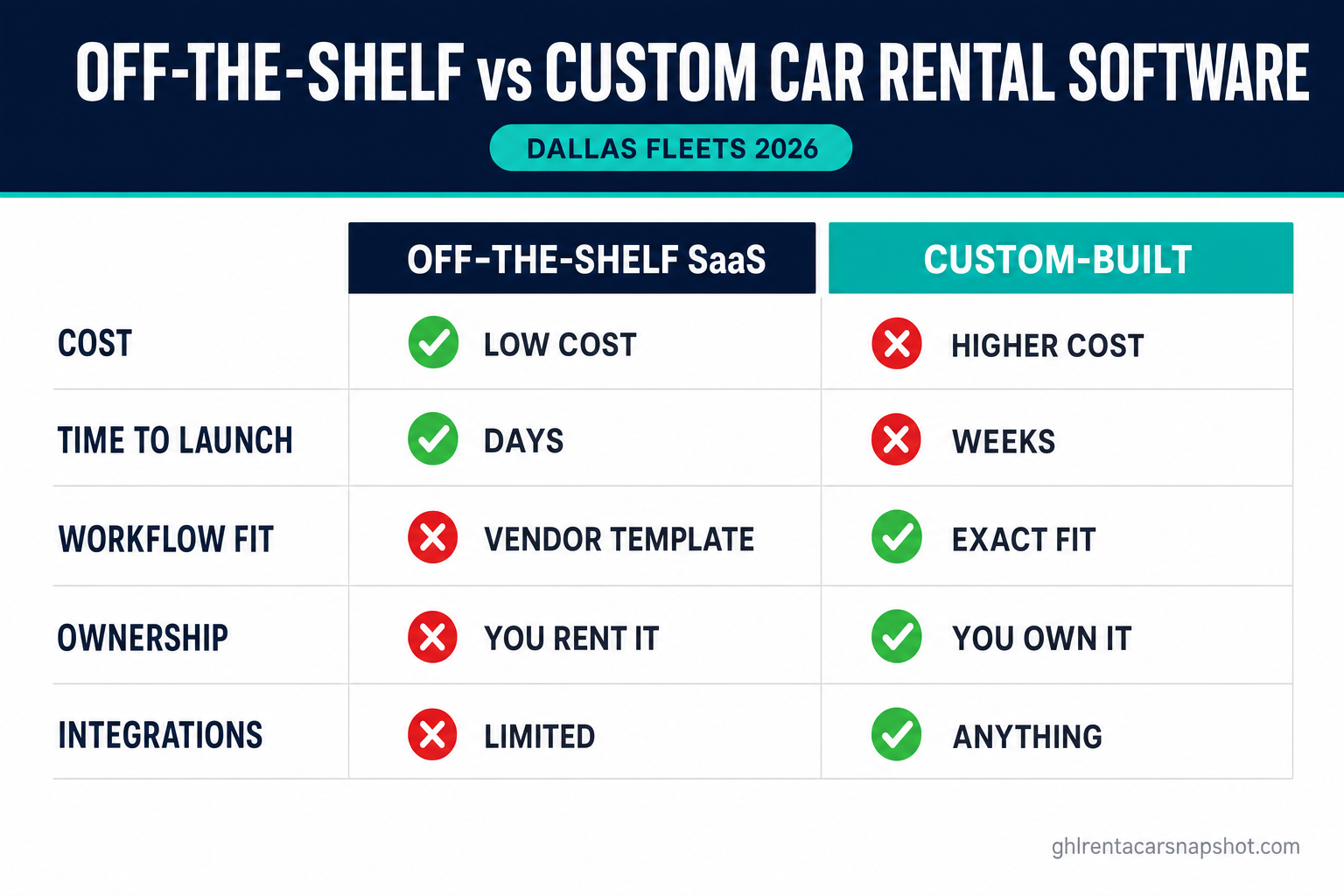
Here’s the head-to-head for a Dallas rental operator weighing the two extremes. (The middle path — a configurable GHL system — borrows the best column from each, which is exactly why most lots land there.)
| Dimension | Off-the-shelf rental SaaS | Custom-built software |
|---|---|---|
| Upfront cost | Low — sign up and go | High — real development investment |
| Time to launch | Days | Weeks to months (narrow scope) |
| Fit to your workflow | Whatever the vendor built | Exactly your operation |
| Unused bloat | High — you pay for 80% you won’t use | None — built for your process only |
| Ownership | You rent it, forever | You own the asset |
| Integrations | Only what the vendor offers | Anything you need — QuickBooks, telematics, GHL |
| Scaling to multi-location | Per-seat fees stack up | Built to your structure |
| Ongoing cost | Monthly subscription that only rises | Maintenance / retainer you control |
| Risk | Low build risk, high lock-in risk | Higher build risk, zero lock-in |
| Best for | Standard, single-location lots | Unique, high-volume, multi-location fleets |
Read the table and the pattern is obvious: neither column wins every row. Off-the-shelf dominates cost and speed; custom dominates fit, ownership, and integrations. The right choice depends entirely on whether your process is standard or genuinely yours — and most lots have both kinds of process at once, which is the whole argument for the middle path.
The middle path most Dallas lots actually need
Here’s what the two-column debate misses: the vast majority of what a rental lot does is standard. Capturing an inquiry, confirming a booking, sending a pickup reminder, holding a deposit, requesting a review, recovering an abandoned reservation — every lot in Dallas does these, and they don’t need to be custom-built. They need to be configured well and never dropped.
That’s the sweet spot a GoHighLevel automation system fills. A rental-specific build like the Car Rental Snapshot ships those standard workflows pre-built — reservation automation, missed-call text-back, pickup/return reminders, deposit prompts, no-show recovery, and review requests — so you get the fit of a tailored system without the build risk of custom code or the bloat of packaged SaaS. You configure pipelines, messaging, and integrations to your lot; you don’t invent them from a blank screen or accept a vendor’s rigid template.
It also closes the most expensive gap in any rental operation — the one between an inquiry and a reply. Contacting a web lead within 5 minutes instead of 30 makes you about 100× more likely to reach them and 21× more likely to qualify the lead (MIT / InsideSales Lead Response Management Study). A configured system answers instantly and automatically; a patchwork of off-the-shelf tools with nobody watching the inbox does not.
This is also the safest on-ramp when you outgrow a single tool. Rather than a risky rip-and-replace, operators typically migrate the whole stack onto one GoHighLevel system first, prove it, then layer custom software on top only where the data says it’s worth it — the same logic that decides whether a lot should outgrow off-the-shelf booking software at all.
When custom software is the right call
Custom is the right investment for a Dallas fleet when at least one of these is true:
- The workflow is your competitive edge. If your corporate-account portal, dynamic pricing, or franchise dashboard is a reason customers choose you, own it — don’t rent a generic version of it.
- Off-the-shelf physically can’t do it. You’ve hit a hard wall the vendor won’t move: a required integration that doesn’t exist, a data model that doesn’t fit, a compliance need the platform ignores.
- The volume justifies it. At three, five, or ten locations, per-seat SaaS fees and manual workarounds cost more every year than a build that pays for itself — and keeps paying.
- You need to own the customer relationship and data. When a marketplace or platform sits between you and your renters’ contact data, a custom booking system or reservation CRM puts that asset back in your hands — the same ownership argument behind running your own booking system instead of Turo.
Modern custom builds for rental operators aren’t the multi-year sagas the risk stats describe. They’re narrow, AI-accelerated agents and tools: an AI booking-intake agent that checks availability by vehicle class and confirms only real openings, an AI voice receptionist that answers your line 24/7 and books directly to your calendar, an AI document-processing agent that reads licenses and rental agreements, or an AI fleet-and-financial analyst that connects QuickBooks and your reservation system and answers utilization questions on demand — each scoped to weeks, not years. Getting a single one of those right is what tips a growing lot’s numbers, the same way disciplined fleet utilization tracking does.
A simple build-vs-buy decision framework
You don’t need a consultant to make this call. Run each software need your lot has through three questions.
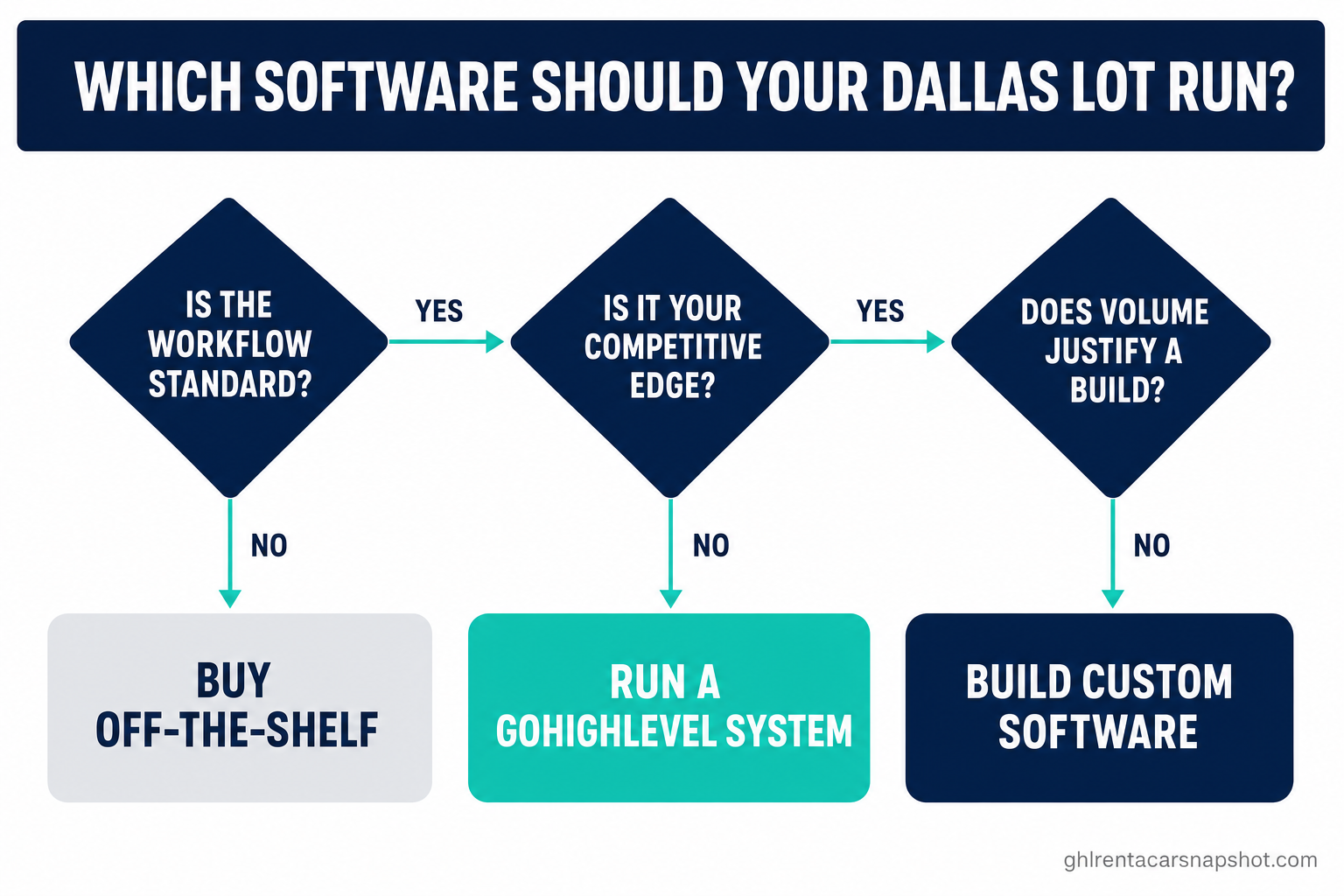
- Is this workflow standard — the same as every other lot’s? If yes, don’t build it. Buy off-the-shelf or, better, run it inside a configurable GHL system that also handles everything around it. Building commodity functions is the most common way rental owners waste money.
- Is this workflow your competitive edge, or a hard integration wall? If yes, this is a candidate for custom software — but only the specific workflow, not your whole operation.
- Does the volume or lock-in cost justify owning it? At meaningful scale, custom pays for itself; below it, keep renting. Let the numbers decide, not the fear of missing out on “having your own system.”
Most Dallas operators who run this framework end up in the same place: a GoHighLevel system as the operational backbone, off-the-shelf tools for a few commodity edges, and one or two custom pieces where their lot is genuinely different. That’s not a compromise — it’s the portfolio that costs the least and fits the best.
The lots that overspend on software almost always made the same mistake — they treated “buy vs. build” as one big decision instead of a dozen small ones. Decide it workflow by workflow and the answer gets cheap and obvious.
The bottom line for Dallas operators
Dallas rental demand has rarely been stronger, and that’s exactly why the software you run matters more, not less — a record-setting airport and a $10.9-billion visitor economy punish any tool that drops a booking on a busy Friday. Off-the-shelf software is the right call for standard, single-location processes; you should never build what you can buy for a couple hundred dollars a month. Custom software is the right call when a workflow is your competitive edge, hits a wall packaged tools can’t clear, or reaches the volume where owning it beats renting it. And for the wide middle — which is most of what your lot does — a configurable GoHighLevel system gives you the fit of custom and the speed of off-the-shelf without the risk of either.
Decide it one workflow at a time. Buy the standard, build the special, and let a rental-savvy team run the platform so you can run the lot. Want to see which pieces of your operation are worth building versus buying? Book a quick walkthrough and we’ll map it against your numbers.
Frequently asked questions
Should a Dallas car rental company buy off-the-shelf software or build custom?
For most Dallas lots, the answer is a blend. Buy off-the-shelf (or run a configurable GoHighLevel system) for standard workflows like reservations, reminders, deposits, and reviews — you should never build what you can buy cheaply. Build custom software only for the specific workflow that's your competitive edge, hits a hard integration wall, or reaches the volume where owning it beats renting it. Decide it workflow by workflow, not as one big buy-vs-build vote.
Why is off-the-shelf rental software cheaper but often a bad long-term fit?
Packaged software is built for the average of thousands of customers, so you pay for bloat you'll never use — Pendo found 80% of a typical product's features are rarely or never touched — while the one workflow your lot actually needs sits on a roadmap you don't control. It's a subscription you rent forever, not an asset you own, and it bends your operation to its template instead of the other way around. That's fine for commodity functions and a real problem when the rented tool controls a workflow that differentiates you.
Is building custom car rental software too risky for an independent operator?
It's risky only when it's scoped too broadly. McKinsey and Oxford found large IT projects run 45% over budget and 17% threaten the company's existence — but those are sprawling enterprise mega-projects. A narrow, well-scoped build — a single booking portal, fleet dashboard, or AI agent shipped in weeks with AI-assisted development — carries a fraction of that risk. The rule is build narrow: one high-value workflow at a time, with a partner who already understands rental operations.
What is the middle path between off-the-shelf and custom software?
A configurable automation system — a GoHighLevel-based build like the Car Rental Snapshot. It ships the standard rental workflows pre-built (reservation automation, missed-call text-back, reminders, deposit prompts, no-show recovery, review requests) so you get the fit of a tailored system without the build risk of custom code or the unused bloat of packaged SaaS. You configure pipelines, messaging, and integrations to your lot, and add custom software only where your operation is genuinely unique.
When does custom software actually pay for itself for a car rental fleet?
When at least one of three things is true: the workflow is a competitive edge customers choose you for; off-the-shelf physically can't do it (a missing integration, an unfit data model, an ignored compliance need); or you've reached the volume — typically multiple locations — where per-seat SaaS fees and manual workarounds cost more every year than a build that pays for itself. Below that threshold, keep renting; let the numbers decide, not the appeal of 'having your own system.'
About the author: Julian Cardoza spent eleven years running the counter and the back lot at independent rental locations across the Southwest before going solo as an operations advisor. He learned the hard way that a full lot on paper still loses money when the software can’t keep up on a Friday turnaround. Today he helps small and mid-size rental companies decide what to build, what to buy, and what to automate — so no booking inquiry, deposit hold, or return reminder ever falls through the cracks.
Related reading:
- Turo vs. Your Own Booking System: The 2026 Math for Car Rental Operators
- How to Migrate Your Car Rental Business to GoHighLevel (Step-by-Step)
- When to Outgrow Off-the-Shelf Car Rental Booking Software
- Fleet Utilization Rate: The Metric That Decides Whether Your Lot Makes Money
- AI for Car Rental Businesses: The 2026 Automation Playbook
Editorial note: figures cited are drawn from the third-party research linked inline and reflect those sources as of publication. Market-size, airport, and tourism figures come from Mordor Intelligence, DFW International Airport, and Visit Dallas; software-project and feature-usage statistics come from McKinsey/University of Oxford, Pendo, and Zylo. GHL Car Rental Snapshot builds GoHighLevel automation systems and custom software for car rental operators — it is not a car rental company, insurer, or payment processor. Costs, market data, and platform features change; confirm current sources before making decisions.