

It is a Tuesday in early February and your lot is full the bad way: eleven of your fourteen cars sit in their spots, washed, fueled, and earning nothing. The phone has rung twice all day, both wrong numbers. Five weeks ago, over the holidays, you were turning people away. Same fleet, same lot. The only thing that changed was the calendar.
Here is the short version so you can act on it today. Car rental demand is deeply seasonal, and the money you lose in the slow months usually cancels out a big chunk of what the surge made you. The fix is not to pray for summer. It is to run four playbooks across the year: prep hard before the peak, squeeze every dollar out of the surge, defend utilization through the grind, and attack the trough with reactivation offers instead of waiting it out. The operators who smooth the year keep cars earning when their competitors’ lots go quiet.
Key Takeaways
- Seasonality is a utilization problem. The average US operator runs about 66.2% fleet utilization; a healthy target is 75-85% and peak can hit 90%+ (Auto Rental News; Nomora). The slow season drags that average down.
- An idle car is a loss, not a break. A $30,000 sedan sheds roughly $27 a day in depreciation before insurance and financing (LendControl). Every empty February slot bills you anyway.
- The surge is real and predictable. AAA projected about 72.2 million travelers over the 2025 Independence Day period, 61.6 million by car, a record (AAA). Summer and holidays are when you make the year.
- Your own channel carries you through the trough. With 71%+ of rental revenue booked online and a renter list you own, you fill slow weeks with an offer instead of waiting for the phone (Grand View Research).
Table of contents
- What the slow season actually costs you
- Why your demand swings so hard
- The operator’s year: four seasons, four jobs
- Season 1: Pre-season prep, the ramp
- Season 2: The surge, where you make the year
- Season 3: The mid-season grind
- Season 4: The slowdown, and how to attack it
- Three fleets, three versions of the year
- Steal these: the off-season and surge messages
- A word on texting your list without a compliance mess
- Common objections, answered
- Frequently asked questions
What the slow season actually costs you
Most operators treat the slow season as a break, and that framing kills your year. A car on the lot is not resting; it is a fixed cost with the meter running. Depreciation, financing, insurance, registration, and your lot lease bill you whether the key is in a renter’s hand or on the board.
Put a number on it. A $30,000 sedan sheds about $27 a day in depreciation alone (LendControl), and roughly thirty cents of every rental dollar goes to depreciation (Umbrex). A car idle for a 30-day February hands back around $800 in depreciation for nothing, and ten idle cars is real money out the door.
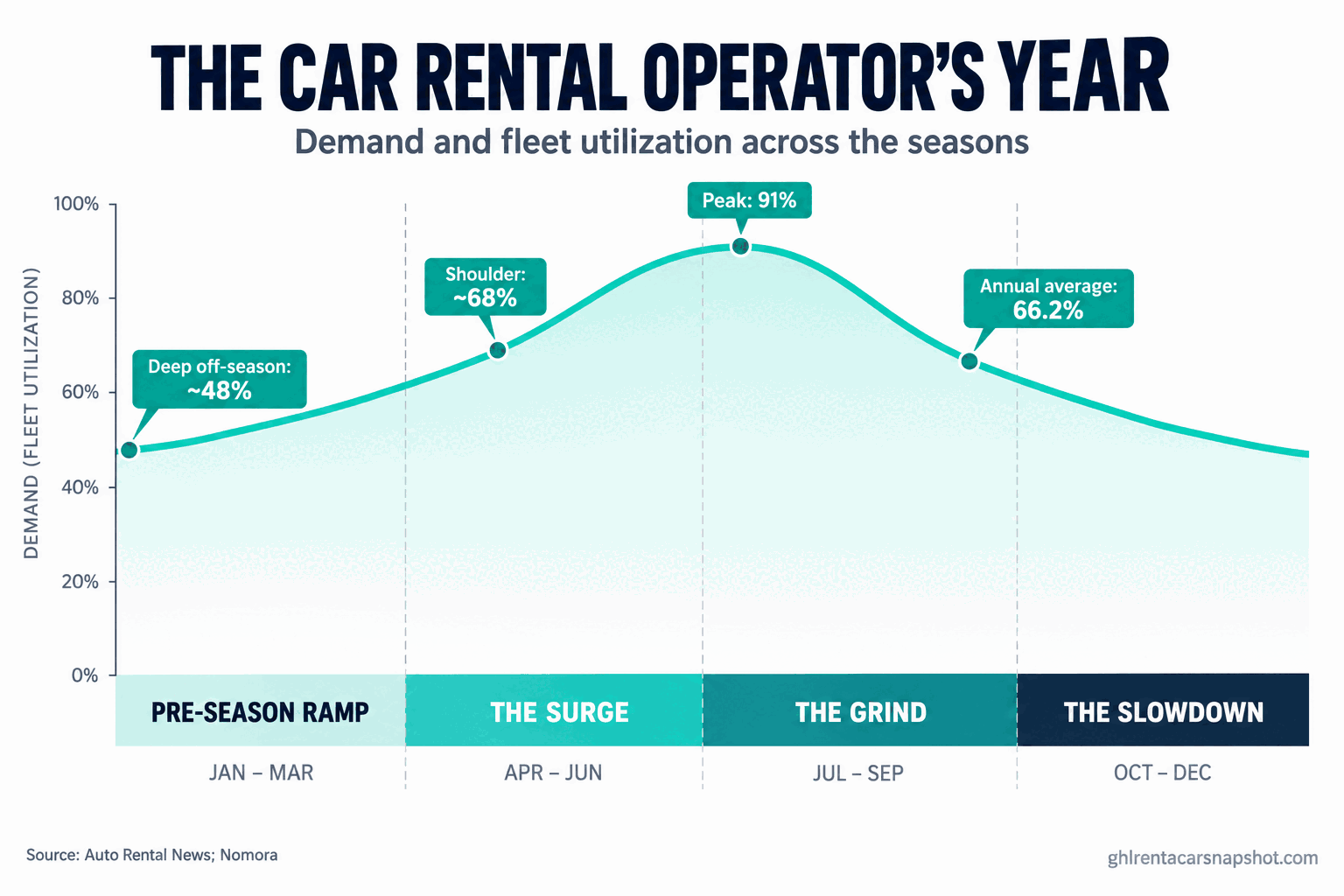
This is why the trough decides your year more than the peak. The surge is loud, so everyone works it; the slow season is quiet, so most operators coast, and that is where the profit the surge earned gets refunded to the bank and the insurer. The national average fleet utilization sits at 66.2% (Auto Rental News), a blend of 90%-plus in July and something ugly in January, broken out in the fleet utilization rate guide.
Illustrative fleet utilization across an operator’s year, anchored to the 66.2% US annual average and a 90%+ peak. Your exact curve depends on your market. Sources: Auto Rental News, Nomora.
Why your demand swings so hard
Your demand swings because your renters’ lives swing. Leisure travel bunches into summers, holidays, and school breaks, and most of your bookings ride that calendar. AAA projected about 72.2 million people would travel over the 2025 Independence Day stretch, 61.6 million by car, the highest on record (AAA). That is your surge in one statistic, and the flip side is the week after New Year’s. Three forces stack to make the swing worse than you expect.
The travel calendar. Summer, Thanksgiving, December holidays, and spring break are when people rent. They sit on a calendar you already own, so you can plan every one.
Weather and geography. No two markets are alike, which is why a generic plan fails. A Miami operator’s worst months are hurricane season, June through November, when a storm can kill a weekend with two days’ notice. A Denver operator’s shape is the opposite: ski-season demand in winter and a mud-season lull in spring. Florida even layers a statutory $2-per-day rental surcharge onto every day a car is out (Fla. Stat. 212.0606), while Colorado charges a $3-per-day congestion impact fee a federal appeals court upheld in 2026 (Auto Rental News). Same business, completely different year.
Local events. A convention, a festival, a big game, or a graduation weekend creates a mini-surge in a dead month, so track your city’s event calendar. And before you run any playbook below, pull your last two years of bookings into a spreadsheet by month: your seasonality, with dates attached, is a plan.
The operator’s year: four seasons, four jobs
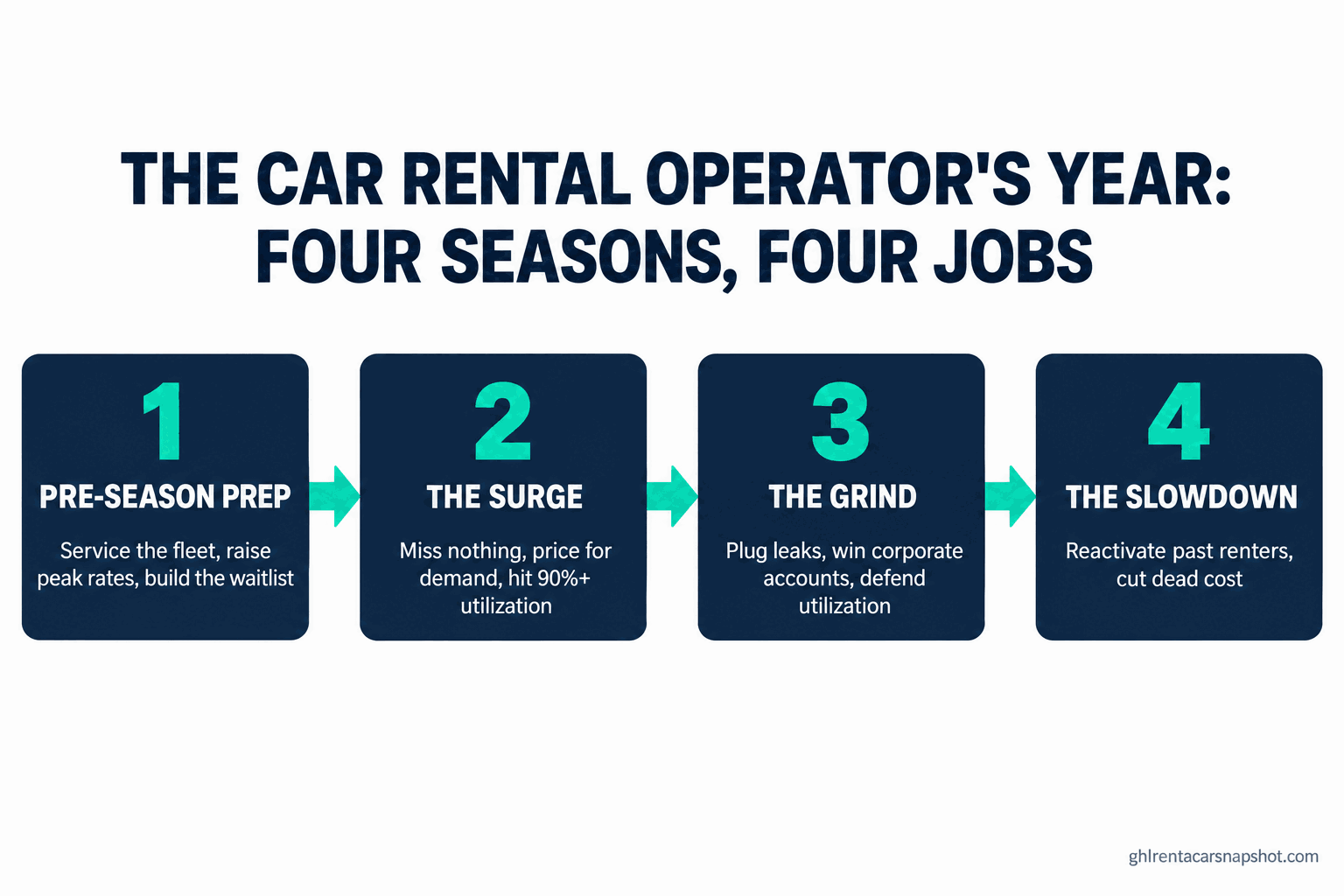
Forget the calendar on the wall. Your business has four seasons defined by demand, each with a different job: pre-season prepares the fleet and funnel, the surge maximizes every dollar, the grind defends utilization, and the slowdown goes on offense while cutting dead cost. Here is each one, with the setup, the timing, and how it breaks.
Season 1: Pre-season prep, the ramp
The ramp is the four to six weeks before your peak. The job: be ready before demand arrives, not during it. Operators who prep during the surge turn away bookings because a car is in the shop or a listing is half-built.
Get every car inspected and serviced now, while the bays are quiet, and refresh your photos and listings. Raise your peak rates in advance so you are not repricing on the busiest day, and read the pricing strategy guide first. Most important, build the waitlist: capture every inquiry now, even for dates you cannot fill yet, so you have warm renters to call the minute a car opens. When someone asks about a peak weekend that is already booked, do not say no. Say “that weekend is full, want me to text you first if a car opens up?” and tag them. That tag is a surge-season gold mine.
Season 2: The surge, where you make the year
The surge is your summer, your holidays, your event weeks. Utilization can run 90% or higher (Nomora), and the only real limits are how many cars you have and how many bookings you let slip. The job is to miss nothing and price right.
Missing nothing is a speed problem: a renter who cannot reach you calls the next lot, and there is always a next lot in July. The research is brutal: firms that respond within an hour are seven times more likely to qualify a lead, yet the average first response takes 42 hours and 23% of leads never get a reply at all (Harvard Business Review). In July, a missed-call text-back and an instant booking confirmation are the difference between 85% and 95% utilization.
Pricing right means charging what the surge is worth. Demand is inelastic on a sold-out weekend, so peak rates should sit meaningfully above your base, set before the week starts. If you are turning cars away, the price is too low.
The surge is also when you capture renters for the slow season: tag every July renter, note their trip type, and set them up for the reactivation sequence. The renter who loves you in July is the one you text in February, which is the whole logic of the repeat renter loyalty flywheel.
Season 3: The mid-season grind
The grind is the shoulder: spring and fall, the stretches between the big peaks where demand is fine but not frantic. Utilization sits in the national-average zone, where the gap between a good operator and an average one shows up. The job is to defend and lift utilization by plugging leaks. The four big ones are slow lead response, no-shows, poor turnaround buffers, and renters you never ask back. A no-show is as idle as a car nobody booked, and the fix is deposits and confirmation sequences, in the no-show and cancellation recovery playbook.
The grind is also when you court the one customer who does not care about your season: corporate accounts. A company that needs a car for traveling staff books in March the same as in July, so a handful of steady corporate accounts flattens your whole year. Chase them in the grind, not in the trough, when it is already too late.
Season 4: The slowdown, and how to attack it
The trough is the deep off-season: January and February for most markets, mud season in the mountains, the dead weeks wherever yours fall. Utilization can crater well below your average. The instinct is to wait it out, and that is the most expensive habit in this business, because every idle day is still billing you. The job is to play offense on demand and defense on cost at the same time.
On offense, you attack with the asset the surge built: your renter list. With a list you own and most rental revenue now booked online (Grand View Research), a slow week is not a sentence, it is a prompt to send an offer: a midweek discount, a snowbird weekly rate, a free upgrade for a past renter. You are converting a car that would earn zero into one that earns something, which beats depreciation-only.
On defense, cut the costs that no longer earn. The trough is the right time to sell or pause the cars that drag your utilization down all year; a car running at 30% even in your peak is a wrong-car problem, and this is when you face it. Platforms will not help: a marketplace can disappear and take your bookings with it, the whole argument for a channel you control, in the Turo versus your own booking system breakdown.
Three fleets, three versions of the year
The same four seasons play out differently depending on your size. Run the version that matches your fleet.
The solo operator, 3 to 5 cars. Your swing is the most violent, because one dead car is 20-25% of your fleet, and your edge is speed: in the trough you can text every past renter by name in an afternoon and fill a week off one offer. Keep the fleet small enough to run near-full in the shoulder, and resist buying a sixth car to chase peak days you only get twelve of a year. That car sits idle the other 353.
The mid-size team, around 20 cars. You have enough fleet and demand that systems pay off most here: utilization tracking by car, automated reactivation to a segmented list, dynamic peak pricing, and a corporate book deep enough to flatten the trough. A 20-car fleet running at 60% instead of 75% is three cars’ worth of revenue evaporating all year.
The large operator, 50 to 100 cars. Your problem is not finding demand in the surge, it is capital efficiency across the whole year. The winners rotate fleet in and out seasonally, lean on corporate and repeat demand to set a high floor, and treat the trough as a disposal-and-planning window. A one-point utilization gain across 80 cars is real money.
Steal these: the off-season and surge messages
Here is the copy that does the work. Send only to renters who agreed to hear from you, and read the compliance note that follows.
The surge waitlist capture (a peak date is already booked):
“Hi [Name], that July 4 weekend is fully booked right now, but cars free up as plans change. Want me to text you the moment one opens? Reply YES and I’ll keep you first in line.”
The off-season reactivation text (a past renter in the trough):
“Hi [Name], it’s [Your Name] at [Company]. The lot’s quiet this month so I can do [X]% off any weekday rental through [date], just for past renters. Need a car for anything coming up? Reply and I’ll set it aside.”
The snowbird or long-term trough offer:
“Hi [Name], slow-season special: [vehicle] at a weekly rate of [rate], the best price we run all year. Perfect if you need wheels for a few weeks this winter. Want the details?”
The post-rental review request (every season, compounding in the trough):
“Thanks for renting with us, [Name]. If everything went well, a quick Google review would mean a lot and helps other folks find us: [link]. If anything was off, reply here first and I’ll make it right.”
The reviews you collect all year are what make strangers pick you when demand returns.
A word on texting your list without a compliance mess
Everything in that steal-these section involves texting people, and in 2026 you cannot just blast a list. Business texting in the US runs through A2P 10DLC: your brand and each campaign must be registered with the carriers, or messages get filtered and never arrive.
Two things to get right. First, as of June 30, 2026, campaign registration requires a working PrivacyPolicyUrl and TermsAndConditionsUrl, so your site needs both live and linked before you register. Second, state mini-TCPA laws matter, and the Florida FTSA matters most because Florida is a giant rental market and the law carries a private right of action, meaning a renter can sue you directly over an unwanted text (Fla. Stat. 501.059). Get prior express consent, honor opt-outs instantly, and keep records.
One thing you may have read is no longer true: the FCC’s “one-to-one consent” rule was vacated by the 11th Circuit in January 2025 and then formally repealed (Womble Bond Dickinson), so do not design your consent flow around it. The full build, with the real consent language, is in the TCPA and 10DLC compliance guide for rental texting.
Common objections, answered
“The slow season is slow for everyone. Nothing I can do.” Demand is lower, true. But your utilization in the trough is a choice, not a fixed number. You can sit at 40% waiting for the phone, or send an offer to a list you own and pull it to 55%. The weather is out of your control; whether an idle car gets an offer attached to it is not.
“Discounting off-season just trains people to wait for deals.” It can, if you discount sloppily. Make off-season offers a reward for past renters and for midweek flexibility, not a public fire sale. A targeted “past renters only, this month only” text fills idle cars from people who were not going to pay peak anyway, without touching your public rate.
“I already pay for rental software. Doesn’t it handle this?” Most rental software manages your fleet and bookings. Very little of it runs the marketing: waitlist capture, segmented reactivation texts, review harvesting, consent tracking. That is the layer that turns a quiet month into booked cars.
“I’m a one-person shop. No time for four playbooks.” You run them one at a time, each taking over as the last winds down. Automating the capture and reactivation means the busy seasons run themselves while you work the lot, and the slow season gives you time to set up the next one.
Frequently asked questions
When is the slow season for car rental?
For most US markets the deep trough is January and February, but it is highly local: ski-town operators peak in winter, and Florida operators deal with hurricane season from June through November. Pull your own last two years of bookings by month to find your real slow season.
How do I keep cars rented during the off-season?
Send targeted offers to a renter list you own: a midweek discount, a weekly snowbird rate, a free upgrade. An idle car earns zero against roughly $27 a day in depreciation, so any booking that beats the car's daily cost is worth taking.
Should I lower prices in the slow season?
Selectively. Convert cars that would otherwise earn nothing with a targeted, conditional discount to past renters or for midweek dates. Avoid slashing your public rate, which trains everyone to wait for deals; keep offers private and time-boxed.
How much does an idle car actually cost me?
Depreciation alone runs about $27 a day on a $30,000 sedan. Add insurance, financing, registration, and lot cost, and a car idle for a 30-day month hands back well over $800 for nothing.
Can texting past renters with off-season offers get me in legal trouble?
It can if you do it wrong. Business texting runs through A2P 10DLC registration, and as of June 30, 2026 campaign registration requires a live privacy policy and terms URL. The Florida FTSA carries a private right of action, so get prior express consent, honor opt-outs instantly, and keep records. The FCC's one-to-one consent rule was vacated in January 2025 and never took effect.
It is a Tuesday in early February again, a year later, and your lot is not full. Nine of your fourteen cars are out: three to past renters who got a text about a midweek rate, one to a corporate account that books every month, one long-term to a snowbird who saw your weekly deal. The phone rang four times today and you answered all four, because the system caught them. Same fleet, same February. The only thing that changed is that you stopped waiting for the season to turn and started working it.