
It is 6:15am on a Friday in January and your phone is already going. A couple flew into Denver International last night, they want an AWD SUV for a Breckenridge weekend, and they need it in ninety minutes because snow is coming over the pass. You have the car. You also have three voicemails you never heard, two of them the same kind of booking. Up on I-70, CDOT just put the Traction Law in effect. This is your surge, and it is also the week you either catch every call or hand it to the lot down the road.
Here is the short version. Denver is not a generic rental market. Your year runs on a ski-season surge, a brutal mud-season trough, and a summer plateau, and three Colorado-specific fees skim your margin on every airport rental. Plan the calendar you already have, winterize before the snow, capture every ski-weekend inquiry, and attack the spring dead zone with offers instead of waiting it out, and you keep cars earning when competitors’ lots go quiet. This is the season-by-season build, the failure points, and the Denver copy you can paste in today.
Key Takeaways
- Denver’s surge is winter, not summer. Colorado ski areas logged about 13.8 million skier visits in 2024-25, the state’s third highest season on record (SAM). That I-70 traffic is your December-to-March demand.
- Three fees skim every airport rental. DEN passes through a roughly 11.1% concession recovery fee (AutoSlash), Colorado adds a $3-per-day congestion fee a federal appeals court upheld in July 2026 (US News), plus a facility charge on top.
- The Traction Law runs Sept 1 to May 31 on I-70, and rental cars get named as a top cause of winter spinouts (KOAA). Winterize or your car becomes the $50 ticket and the closed lane.
- Mud season, not January, is your real trough. April and May are the dead weeks between ski and summer, and an idle car still sheds about $27 a day in depreciation (LendControl).
Table of contents
- What Denver’s calendar does to your fleet
- The three fees that quietly set your Denver margin
- The Denver operator’s year: four seasons, four jobs
- Season 1: The fall ramp (October to November)
- Season 2: The ski-season surge (December to March)
- Season 3: Mud season, your real trough (April to May)
- Season 4: The summer plateau (June to September)
- Three Denver fleets, three versions of the year
- Steal these: the Denver operator messages
- Texting your Denver list without a compliance mess
- Common objections, answered
- Frequently asked questions
What Denver’s calendar does to your fleet
Most operators run Denver like it is Phoenix or Orlando, and the math punishes them. Your demand does not follow the national summer-leisure curve. It follows snow. Colorado ski areas pulled about 13.8 million skier visits in 2024-25, the state’s third best season on record (SAM). Those people land at DEN, drive west, and a big share need all-wheel drive for the weekend. That is your surge, and it peaks when most of the country’s rental demand is flat.
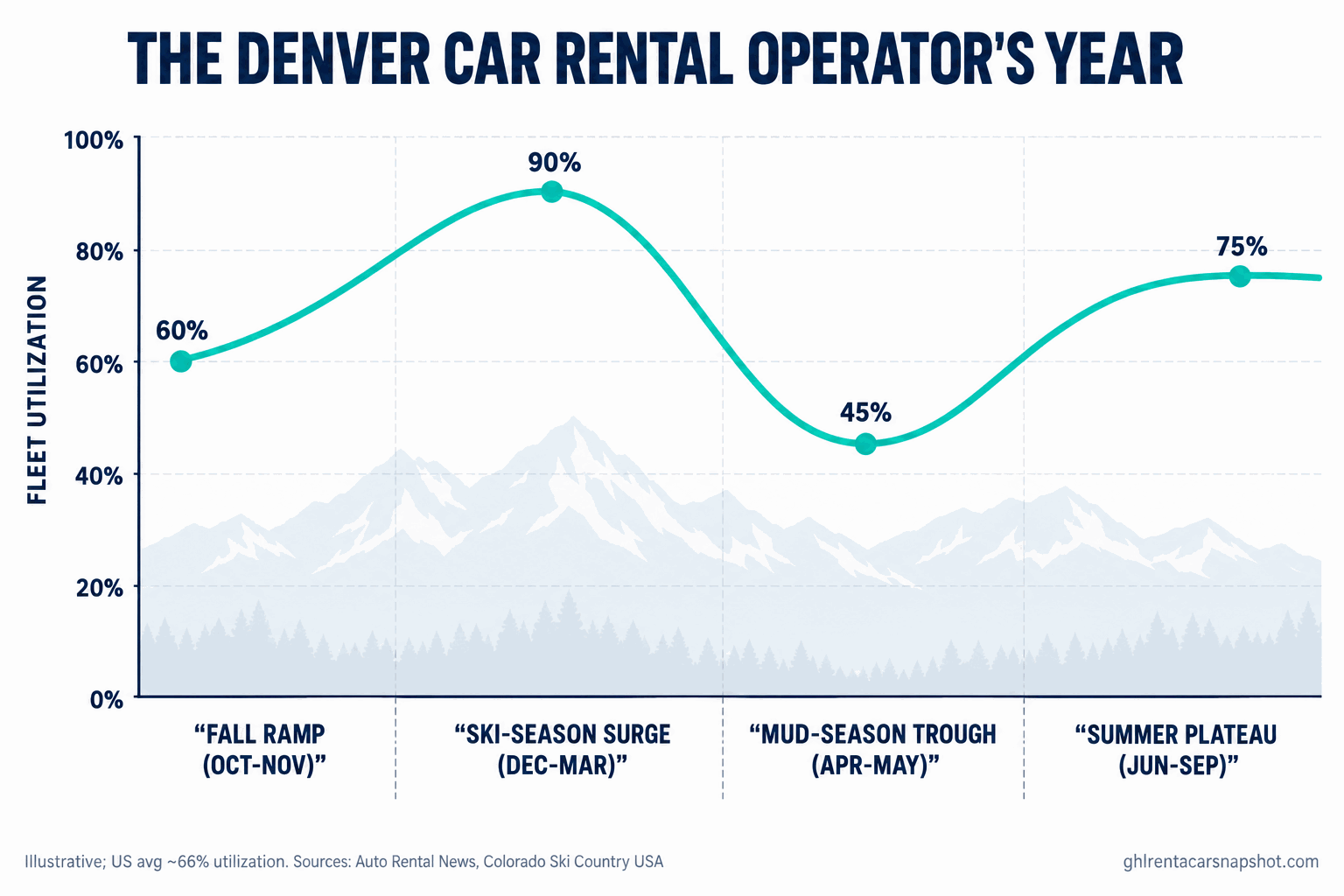
The flip side is spring. Before the hikers arrive you hit a trough January never touches: mud season, roughly April into May. A $30,000 SUV sheds about $27 a day in depreciation before insurance, financing, and lot lease (LendControl), so a car parked for a 30-day month hands back roughly $800 for nothing. The national average fleet utilization sits around 66% (Auto Rental News), but Denver hides a violent swing inside that: near 90% on a powder weekend, well under 50% in a dead mud-season week. The job is to pull the whole curve up, and that starts with knowing where the fees go.
The three fees that quietly set your Denver margin
Before any seasonal play, understand what Denver charges you, because these three fees set the floor under your pricing and stack on nearly every airport-origin rental.
The DEN concession recovery fee, about 11.1%. Rental companies at Denver International owe the City and County of Denver 10% of gross revenue and recover it by adding roughly 11.1% to the renter’s bill (AutoSlash). The trap that catches off-airport operators: those airport fees can follow a renter who flew into DEN and picks up within about 20 miles and 24 hours of landing, so “off-airport” is not automatically fee-free. If you run an off-airport lot, know exactly where that line falls.
The Colorado $3-per-day congestion impact fee. Approved in 2024 on rentals of 30 days or less, and in July 2026 the 10th Circuit upheld it against a challenge from the American Car Rental Association, which represents Avis, Hertz, and Enterprise (US News). It is indexed to inflation and applies whether you are a national brand or a three-car independent.
The airport customer facility charge. DEN adds a per-day facility charge on cars rented by arriving flyers. It is smaller than the concession fee, but it stacks on top of it and of sales tax.
Illustrative dollars added to a single day of a $70 Denver-airport rental, before state and local sales tax. Percentages and per-day amounts vary by location and year. Sources: AutoSlash, US News.
Do not memorize the percentages. Just know the renter sees a quote noticeably higher than your sticker day rate, so your direct-booking channel, where you control the disclosure, is worth more in Denver than almost anywhere. Spell the fees out before checkout and you dodge the chargebacks that come from a surprise line item.
The Denver operator’s year: four seasons, four jobs
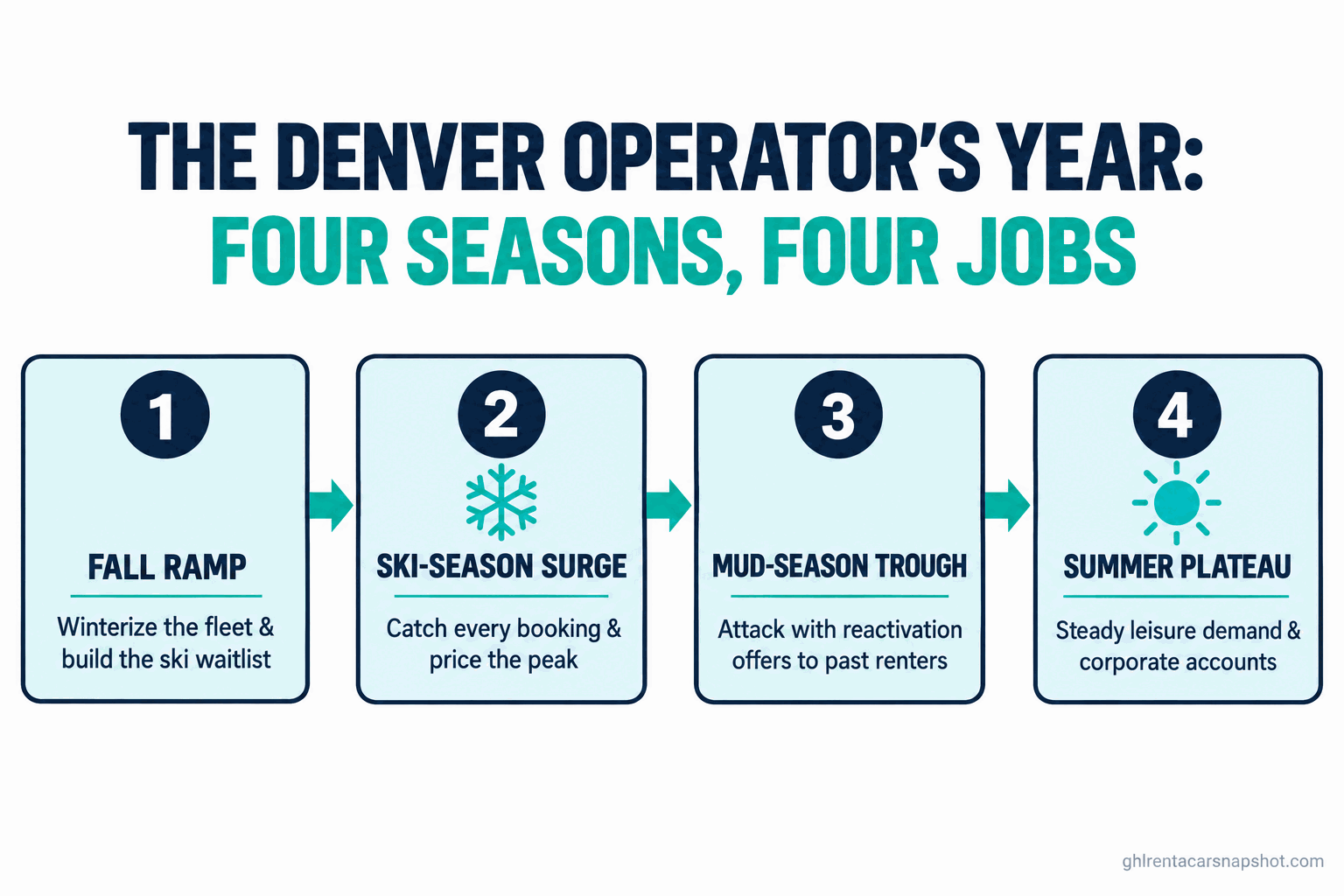
Your Denver business has four seasons defined by snow and travel, each with a different job: fall gets the fleet and funnel ready, winter maximizes every ski-weekend booking, spring goes on offense against the trough, and summer runs a steady leisure plateau.
Season 1: The fall ramp (October to November)
The ramp is the four to six weeks before the first real snow. The job is to be ready before demand arrives. In Denver that means one thing no other market forces on you: winterize the fleet, because your cars are about to drive mountain passes in storms.
Get every vehicle on all-weather or mud-and-snow tires with legal tread before the Traction Law goes live. CDOT runs the Passenger Vehicle Traction Law on I-70 from Dotsero to Morrison every year from September 1 to May 31, and as of 2026 it applies to all vehicles, including two-wheel-drive, or your renter eats a $50 fine plus a $17 surcharge (CDOT). Rental cars get named as a top cause of winter spinouts that shut the interstate down (KOAA / Denver7), so winterization is also your liability shield.
While the bays are quiet, raise your ski-weekend rates in advance so you are not repricing on the busiest Friday of January (pricing strategy guide). Then build the waitlist: capture every early inquiry for peak dates, even ones you cannot fill yet, and tag them. When someone asks about a Presidents’ Day weekend that is already booked, do not say no. Say “that weekend is full, want me to text you first if an AWD opens up?” That tag is a surge-season gold mine, and the same capture logic lifts your fleet utilization rate.
Season 2: The ski-season surge (December to March)
This is where you make the Denver year. Powder weekends can run utilization to 90% or higher, and the only real limits are how many AWD cars you have and how many bookings you let slip. The job is to miss nothing and price right.
Missing nothing is a speed problem, and Denver’s surge makes it worse because the demand is weather-triggered and impatient. A couple who just landed and sees snow in the forecast books the first lot that answers. Firms that respond within an hour are far likelier to win the lead, yet the average first response drags on for hours and many leads never get a reply (Harvard Business Review). In January, a missed-call text-back and an instant confirmation are the gap between 85% and 95% utilization, the argument behind running every lead through one inbox.
Pricing right means charging what a powder weekend is worth. Demand is inelastic when every lot in the metro is sold out, so your AWD and SUV rates should sit well above base while sedans stay cheaper, since nobody wants a rear-drive coupe for Vail. Set those rates before the week starts, and tag every ski-season renter for the mud-season reactivation sequence: the renter who loved you in January is the one you text in April, the logic of the repeat renter loyalty flywheel.
Affiliate disclosure: if you start a GoHighLevel account through our link, we may earn a commission at no extra cost to you.
Season 3: Mud season, your real trough (April to May)
Mud season is the stretch most out-of-state owners never price for. The snow turns to slush, the resorts wind down, and the summer hikers have not arrived. For a lot of the metro this is deader than January, and the instinct is to wait it out. That is the most expensive habit in the Denver business, because every idle day still bills you depreciation, insurance, and lot cost. The job is offense on demand and defense on cost at the same time.
Illustrative Denver fleet utilization across the year, anchored to the ~66% US annual average. Your exact curve depends on your lot and mix. Sources: Auto Rental News, Colorado Ski Country USA.
On offense, attack with the asset the ski season built: your renter list. A spring week that looks dead is a prompt to send an offer. Text past ski renters a midweek discount, a weekly rate for a snowbird heading home, or a free upgrade for a repeat renter. You convert a car that would earn zero into one that earns something, which always beats depreciation-only. This is the same reactivation engine the general slow season playbook runs nationally, tuned to Denver’s April-May dead zone.
On defense, cut cost that no longer earns. Mud season is the right time to sell or pause the cars that drag utilization down all year, and to catch up on the maintenance you skipped during the surge. A car running at 30% even in your peak is a wrong-car problem, and spring is when you face it.
Season 4: The summer plateau (June to September)
Summer in Denver is a steady leisure plateau, not a spike. The mountains fill with hikers and national-park traffic. Rocky Mountain National Park draws over four million visitors a year and now runs a timed-entry reservation system from late May through mid-October (National Park Service). A guest with a timed RMNP entry has a fixed pickup window, so your confirmation and reminder texts matter more, not less.
The summer job is to hold a high floor with demand that does not care about snow: corporate accounts. A company that flies staff into Denver books in June the same as January, so a handful of steady corporate accounts flattens your whole curve and carries you across the fall ramp and the mud-season trough. Chase them in summer when you have time, not in the spring panic. Summer is also your review-harvesting season, with steady volume and renters in a good mood coming back from the mountains. Every five-star review you bank in July is what makes a January ski renter, comparing three Denver lots at 6am, pick you.
Three Denver fleets, three versions of the year
The same four seasons play out differently depending on your size. Run the version that matches your lot.
The solo operator, 3 to 5 cars. Your swing is the most violent, because one idle car is a fifth of your fleet, and your edge is speed and specialization. Lean hard into AWD and SUVs, what the ski surge pays a premium for, and skip the sedans that sit all winter. In mud season you can text every past renter by name in an afternoon. Resist buying a sixth car to chase the dozen powder weekends you get a year, because it sits idle the other 353 days and still owes you insurance.
The mid-size team, around 20 cars. Systems pay off most here: utilization tracking by car, automated reactivation to a segmented list, dynamic ski-weekend pricing, and a corporate book deep enough to flatten the trough. A 20-car fleet running at 60% instead of 75% is three cars’ worth of revenue evaporating, most of it in the spring you never planned for. This is where a missed-call text-back pays for itself in a single January weekend.
The large operator, 50 to 100 cars. Your problem is capital efficiency across the whole year and surviving the fee load on every airport rental. The winners rotate fleet seasonally, add AWD for winter and shed it before mud season, lean on corporate and repeat demand for a high floor, and treat spring as a disposal-and-planning window. A one-point utilization gain across 80 cars is real money, and so is every chargeback you prevent by disclosing the fees up front.
Steal these: the Denver operator messages
Here is the copy that does the work. Send only to renters who agreed to hear from you, and read the compliance note that follows.
The fall winterization and rate-change notice (to past renters, October):
“Hi [Name], it’s [Your Name] at [Company]. Our AWD and SUV fleet is winterized and ready for ski season, and peak dates book up fast. Planning a mountain trip this winter? Reply with your dates and I’ll hold a car before the calendar fills.”
The ski-weekend waitlist capture (a peak date is already booked):
“Hi [Name], that [holiday] weekend is fully booked right now, but AWD cars free up as plans change. Want me to text you the moment one opens? Reply YES and I’ll keep you first in line.”
The pickup text that covers the Traction Law (surge season):
“Your [vehicle] is ready for [time] pickup at [location]. Heads up: I-70 is under the Traction Law through spring, so your car is on winter-rated tires and good to go. Drive the passes slow, and text us if conditions get rough.”
The mud-season reactivation text (a past renter in April or May):
“Hi [Name], it’s [Your Name] at [Company]. The lot’s quiet between ski and summer, so I can do [X]% off any weekday rental through [date], just for past renters. Need wheels for anything coming up? Reply and I’ll set one aside.”
The summer confirmation that respects a timed park entry:
“You’re confirmed for [vehicle], [date] at [time]. If you’ve got a Rocky Mountain National Park timed-entry window, give yourself an extra 30 minutes for pickup. Anything you need before the trip?”
The post-rental review request (every season, compounding before the surge):
“Thanks for renting with us, [Name]. If everything went smooth, a quick Google review would mean a lot and helps other folks find us: [link]. If anything was off, reply here first and I’ll make it right.”
The reviews you collect all summer are what make a stranger pick you when the snow flies.
Texting your Denver list without a compliance mess
Every message above involves texting people, and in 2026 you cannot just blast a list. Business texting runs through A2P 10DLC: your brand and each campaign have to be registered with the carriers, or messages get filtered and silently never arrive. The nastiest version is the one you do not see, where your ski-weekend confirmation shows as sent but the carrier dropped it and your renter no-shows swearing nobody told them.
Two things to get right. First, as of June 30, 2026, campaign registration requires a live Privacy Policy URL and a Terms and Conditions URL, so both pages need to be live and linked before you register (Twilio). Second, federal TCPA rules govern consent, quiet hours, and opt-outs, and some states add stricter mini-TCPA laws with a private right of action, so if you text a renter whose number sits in one of those states you inherit that risk. Get prior express consent at booking, honor STOP instantly, and keep records.
One thing you may have read is no longer true: the FCC’s “one-to-one consent” rule was vacated in January 2025 and then formally repealed (Womble Bond Dickinson), so do not design your consent flow around it. The full build is in the TCPA and 10DLC guide for rental texting.
Common objections, answered
“Denver demand is seasonal for everyone. Nothing I can do about spring.” Demand is lower in mud season, true. But your April utilization is a choice. You can sit at 40% waiting for June, or send an offer to a list you own and pull it to 55%. The weather is out of your control; whether an idle car gets an offer attached to it is not.
“The airport fees are the airport’s fault, not mine.” The renter does not see it that way. They see a quote 20% above the sticker and feel ambushed, which is how you earn a one-star review or a chargeback. You cannot remove the concession or congestion fee, but you can disclose it clearly on your own booking page, one more reason your direct channel beats a marketplace here.
“I already pay for rental software. Doesn’t it handle the marketing?” Most rental software manages your fleet and bookings well and your marketing barely at all. Waitlist capture, segmented mud-season reactivation, review harvesting, missed-call text-back: that is the layer that turns a quiet spring into booked cars, and it usually is not in the box.
“I’m a one-person shop. No time for four seasonal playbooks.” You run them one at a time, each handing off to the next. Automating the capture and reactivation means the ski surge runs itself while you are out handing keys, and mud season gives you slow hours to set up the next winter. The system works the calendar so you do not have to remember to.
Frequently asked questions
When is the busy season for car rental in Denver?
Denver's peak is winter ski season, roughly December through March, driven by I-70 mountain traffic. Colorado ski areas logged about 13.8 million skier visits in 2024-25. Summer is a steady leisure plateau, and the real slow stretch is mud season in April and May, between ski and summer.
What fees do Denver airport rentals have to charge?
Rentals originating at Denver International carry roughly an 11.1% concession recovery fee passed to the renter, Colorado's $3-per-day congestion impact fee (upheld by the 10th Circuit in July 2026), and a per-day customer facility charge, all before sales tax. Airport fees can also follow a renter who flew in and picks up within about 20 miles and 24 hours.
Does the Colorado Traction Law affect my rental fleet?
Yes. CDOT's Passenger Vehicle Traction Law runs on I-70 from September 1 to May 31 and, as of 2026, applies to all vehicles including two-wheel-drive. Cars need all-weather or snow tires with legal tread, or the driver faces a $50 fine plus a $17 surcharge. Rental cars are named as a top cause of winter spinouts, so winterizing is both a service and a liability shield.
How do I keep cars rented during Denver's mud season?
Send targeted offers to a renter list you own: a midweek discount, a weekly snowbird rate, or a free upgrade for repeat renters, aimed at April and May. An idle car earns zero against about $27 a day in depreciation, so any booking that beats the car's daily cost is worth taking.
Should I stock my Denver fleet with AWD or sedans?
Weight toward all-wheel drive and SUVs. That is what the ski surge pays a premium for, what handles the passes under the Traction Law, and what summer mountain travelers want. Sedans sit idle through winter here. Solo operators especially should specialize in AWD rather than spread thin across body styles.
Can texting past renters with seasonal offers get me in legal trouble?
It can if you do it wrong. Business texting runs through A2P 10DLC registration, and as of June 30, 2026 campaign registration requires a live privacy policy and terms URL. Federal TCPA rules govern consent and opt-outs, and some states add stricter mini-TCPA laws, so get prior express consent, honor STOP instantly, and keep records. The FCC's one-to-one consent rule was vacated in January 2025 and never took effect.
It is 6:15am on a Friday in January, a year later. The couple who just landed books online in four minutes because your rate and fees were right there on the page, no surprises. The three overnight voicemails already got a text back and two of them turned into bookings before you finished your coffee. Your AWD fleet went on winter tires back in October, so every car is legal for the pass and nothing is in the shop. Same lot, same storm on I-70. The only thing that changed is that you stopped running Denver like it was somewhere else and started working the year you actually have.