
It is Saturday, 10:52am, and you are at the curb with a customer who wants the Tahoe. You are photographing his license, scrolling for the agreement, fumbling the card reader for the deposit hold, and walking the car for scratches, all while two more renters text asking where to meet you and your phone rings with a Sunday booking you will never call back. One pickup, twenty-five minutes gone, and the return is at noon.
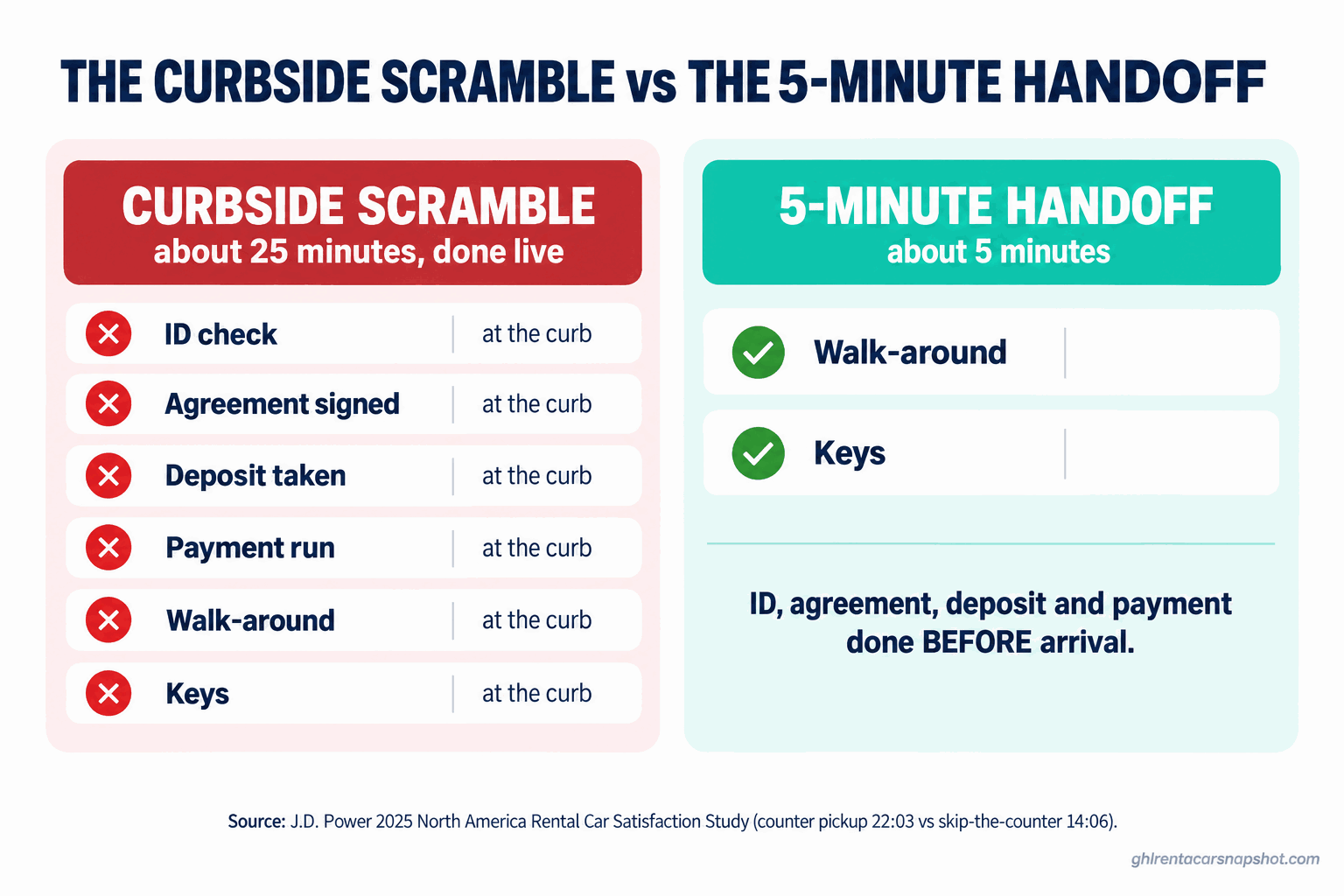
Here is the short answer. Pickups and drop-offs do not have to eat your day. They eat it because you run every step live, in front of the customer: ID check, agreement, deposit, payment, walk-around, all at once, every time. Move everything that does not need the car physically present to before the customer arrives, and all that is left at the curb is the keys and a two-minute walk-around. That turns a 25-minute scramble into a 5-minute handoff.
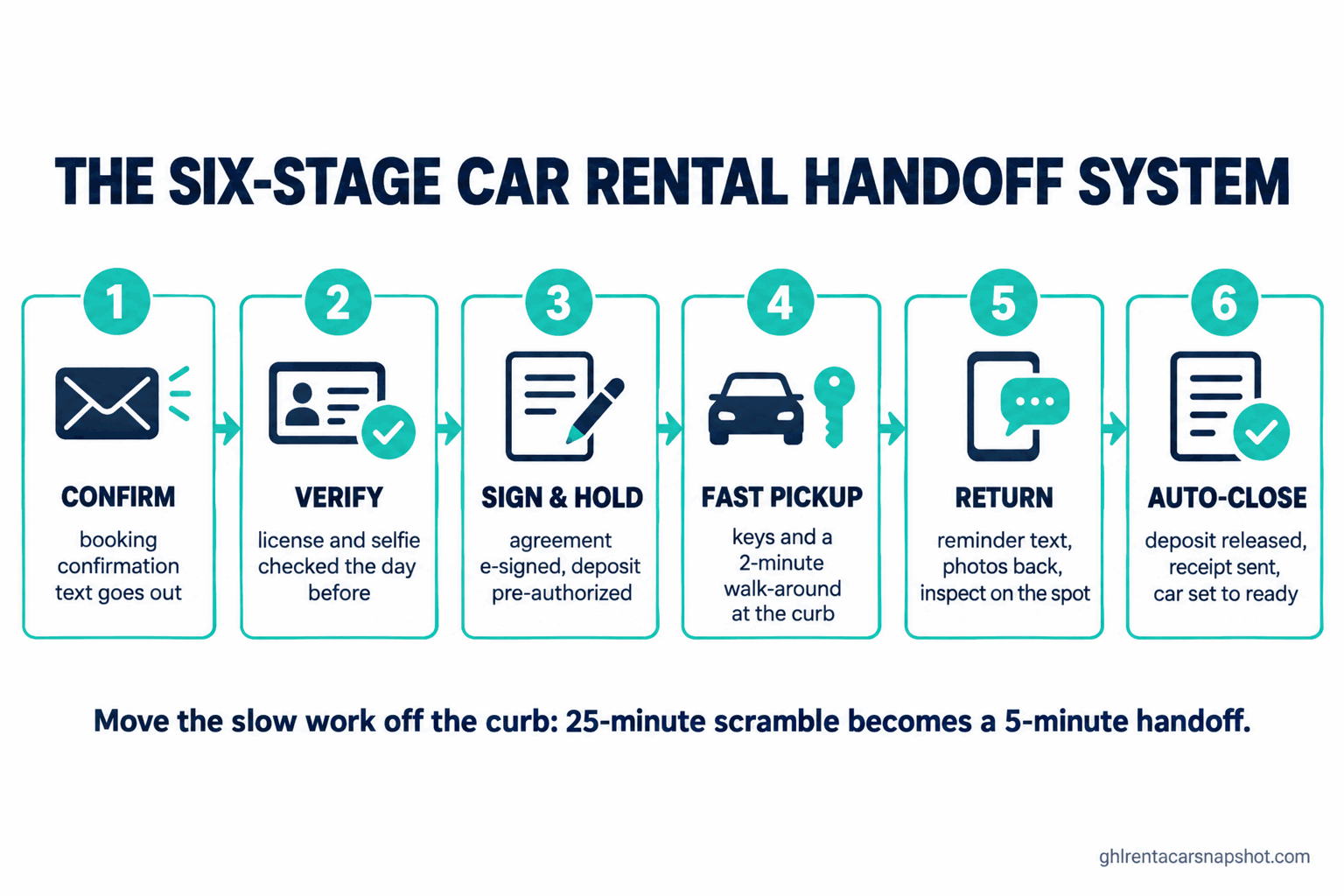
Table of contents
- What the curbside scramble actually costs you
- The core idea: move everything off the curb
- Stage 1: Confirm the booking and start the clock
- Stage 2: Verify the driver before they ever show up
- Stage 3: Sign the agreement and hold the deposit ahead of time
- Stage 4: The five-minute pickup at the curb
- Stage 5: The return, done in two minutes
- Stage 6: Auto-close, release the deposit, ask for the review
- Three operators, three versions of the same system
- Keeping the reminder texts legal
- Steal these: the five messages that run the handoff
- Common objections, answered
- Frequently asked questions
What the curbside scramble actually costs you
Start with a number that is not a guess. J.D. Power’s 2025 North America Rental Car Satisfaction Study, built on 8,263 travelers who rented at an airport, found that customers who skipped the live counter completed pickup in 14 minutes 6 seconds, while those who went through the counter took 22 minutes 3 seconds (Auto Rental News, citing J.D. Power). Nearly eight minutes a rental, and it shows in the scores: bypass customers rated the experience 704 on a 1,000-point scale versus 662 at the counter.
Those are airport numbers, but the lesson transfers: every minute a renter watches you do paperwork is a minute you are not re-renting, answering the phone, or turning the car that just came back.
Average time to complete a rental pickup, in minutes. Source: Auto Rental News reporting the J.D. Power 2025 North America Rental Car Satisfaction Study.
Now put a dollar figure on it. Counter and rental clerks earn a median of $17.98 an hour nationally, per the U.S. Bureau of Labor Statistics (OEWS, SOC 41-2021, May 2023). Run 30 pickups and 30 returns in a busy week, 60 handoffs, and trim each from 25 minutes to 8: that is about 17 hours a week back, roughly $15,000 a year in labor value. If you do the handoffs yourself, those are the hours you would spend calling back leads, so the real cost is the bookings you never close.
The core idea: move everything off the curb
During a pickup you verify the driver, sign the agreement, hold the deposit, run payment, photograph the car, and hand over keys. Of those six, only two need the car and the customer in the same place: the photos and the keys. Everything else can happen hours earlier. You are not buying robots or a kiosk, you are resequencing: push verification, signing, the deposit hold, and payment to the booking stage, and leave the curb for the two things that require it. Six stages do this, and the rest of this piece walks each one with its failure mode and the text that drives it.
Stage 1: Confirm the booking and start the clock
The moment a reservation lands, an automated confirmation goes out by text and email. This is where the pre-arrival work begins, so the message is not a receipt, it is the first instruction. Keep it short: name the car, the date, the pickup window, and the single next step, tap the link to verify and sign.
How it breaks. The confirmation asks for nothing, so the customer does nothing until they are in front of you. Make the next action unmistakable with a soft deadline (verify 24 hours before pickup or the slot may be released), and automate it off the booking trigger, because a message you copy and paste is the one you skip on the busy Saturday.
Stage 2: Verify the driver before they ever show up
License, age, and authorized-driver checks are the slowest part of a curbside pickup and the easiest to move. The customer uploads a license photo and a selfie through a link the day before. You review it on your own time, and the renter who should not get the car never makes it to the curb. This is also your fraud screen, and the deeper version is in our guide on how to verify renters and prevent car rental fraud.
How it breaks. You collect the documents but never look until pickup, so you moved the delay, not removed it. Build a real review step: the reservation does not go to “ready” until a human clears the ID. And always ask for the selfie too, so you can tell the person holding the card is the person on it.
Stage 3: Sign the agreement and hold the deposit ahead of time
These are the two things most operators still do live, and moving them pays off most. A digital agreement goes out as a signing link after verification clears: the customer initials the clauses that matter and signs on their phone, and you get a timestamped, stored copy instead of a photo of a clipboard lost in your email. We cover the full flow in how to build a digital rental agreement and e-sign process.
The deposit hold runs the same way. A card-on-file pre-authorization places a hold before the car moves, so the money is reserved without being charged and you are not tapping a reader at the curb. Our walkthrough on automating security deposit holds has the mechanics, and pairing it with timestamped photos is what makes a damage and deposit dispute survivable.
How it breaks. The agreement is a wall of text with no clear places to initial, so people sign without reading and dispute later: break it into clauses with initials on the ones that matter (fuel, mileage, late return, smoking, deposit). And watch the hold window, because placed too early it can expire before a multi-day rental ends, so re-authorize long rentals.
Stage 4: The five-minute pickup at the curb
By the time the customer arrives, verification is cleared, the agreement is signed, and the deposit is held. The car is pulled, fueled, and clean, and all that is left is the walk-around and the keys.
The walk-around is not optional and not slow. Walk the car with the customer, shoot the same photos every time (four corners, roof, interior, dash with odometer and fuel gauge), and timestamp them to the reservation. Two minutes, done the same way on every car, and you have the proof that settles a dispute before it starts. Pickup windows matter too: let everyone arrive “around 10” and you recreate the line you just killed, so offer 15-minute slots. If you also list on Turo, syncing those calendars stops the double-book that turns a clean pickup into an argument, which we cover in how to stop double-booking across Turo and your own site.
How it breaks. The car is not actually ready when the customer shows, so your “five-minute” pickup becomes a wait: a car is not “ready” in your system until it is cleaned, fueled, and photographed from the last return. The other trap is inconsistent walk-around photos, so standardize the shot list on every car.
Stage 5: The return, done in two minutes
The return is a pickup in reverse, with its own trap: the renter who drifts back late, or drops the car and vanishes before you can inspect it. A return reminder text goes out the morning the car is due, with the time, drop location, and fuel expectation. When the car comes back, shoot the same photo set you took at pickup, compare on the spot, and note any new damage before the renter leaves. If it is clean, say so out loud and in a text, which kills the “you charged me for nothing” dispute. Late returns are their own fight, covered in the late-return policy that gets cars back on time.
How it breaks. No return reminder, so the customer forgets the time and you lose the car for the next booking: automate it off the due date. And never inspect after the renter has gone, because a new scratch becomes your word against theirs, so inspect while they are there, with a staffed window or a photo protocol for after-hours drops.
Stage 6: Auto-close, release the deposit, ask for the review
A rental is not finished when the keys come back, but when the deposit is released, the receipt is sent, and the car is flipped back to ready. Automate the close: once the return photos confirm no damage, release the hold, send a receipt, and move the car to ready status so it can be re-rented without you touching anything.
Then, and only then, ask for the review. A happy customer who just got their deposit back fast is your best shot at five stars. Route anyone who had a problem to you privately first, so you fix it instead of reading about it on Google.
How it breaks. A manual deposit release gets forgotten, and three days later an angry call sours a perfect rental, so automate the release the moment the return clears. And gate the public review ask on a clean return, or it reaches the renter who brought the car back on E with a new dent.
Three operators, three versions of the same system
The six stages are the same for everyone. What changes is how much you automate and who touches the car at the curb.
The solo operator, 10 to 20 cars. You are the counter, the cleaner, and the phone. Your win is lockbox or keypad pickup for verified, signed, paid renters, so you are not driving to every handoff. The system confirms, verifies, signs, and holds; you check remotely that it cleared, release the code, and keep your Saturday.
The mid-size lot, 20 to 50 cars and two or three staff. You have hands at the curb, so your win is throughput, not contactless. Pickup slots and a real ready-state let two staff run twice the turns, handing over keys and doing walk-arounds instead of keying in license numbers.
The large or airport-adjacent operator, 50-plus cars. You are closest to the J.D. Power scenario, where the counter itself is the problem. Your win is a genuine skip-the-counter path for repeat, verified renters, because that eight-minute gap across hundreds of rentals a week is real staffing. Keep the counter for walk-ups, but make it the exception, which is where the satisfaction gap (704 versus 662) turns into repeat bookings.
Keeping the reminder texts legal
The handoff runs on texts, which put you under the TCPA, the A2P 10DLC rules your carrier enforces, and your state’s own law. The full compliance playbook is in texting rental reminders without a TCPA or 10DLC disaster; here is the short version.
Register your brand and campaign through The Campaign Registry before you send business texts, and make sure the registration carries a Privacy Policy URL and a Terms and Conditions URL, which it now requires. Collect express consent at booking with a clear checkbox, keep the record, and honor every opt-out automatically. Reminders tied to an active reservation sit on firmer ground than promotional blasts, but that does not cover a marketing text.
Two things to be clear about. One, ignore anyone who says a federal “one-to-one consent” rule governs your lead texts: the FCC’s version was struck down by the Eleventh Circuit on January 24, 2025 in Insurance Marketing Coalition v. FCC (Akerman), so it is not the standard. Two, in Florida the Florida Telephone Solicitation Act (Fla. Stat. 501.059) carries a private right of action with statutory damages, so a sloppy marketing text to a Florida number can become a class claim fast. None of this blocks the handoff; it just means the texts are built with consent from day one.
Steal these: the five messages that run the handoff
Five automated messages carry the whole thing. Lift them, swap your details, and keep them plain.
That is the whole conversation: confirm, nudge, ready, remind, close. None of it needs you at a desk or the customer waiting at the curb.
Common objections, answered
“Won’t contactless pickup feel impersonal?” It feels faster. The J.D. Power data is blunt: people who skipped the counter were more satisfied, by 42 points. You still greet every renter and walk the car with them; you are only removing the wait.
“My customers aren’t tech-savvy enough for this.” The flow is a text with one link, the same thing they use to confirm a dentist appointment or track a package. For the rare renter who genuinely cannot, you keep the manual path, which is what the curb is still for. The fast path is the default, the manual path the rare exception.
“I already pay for HQ Rental Software or Fleetwire. Isn’t this built in?” Rental software manages the fleet and the booking. It is usually thin on the automated messaging, consent handling, review routing, and missed-call follow-up that actually drive the handoff and fill the calendar, so most operators keep the fleet tool for inventory and layer a messaging system on top. We broke down the money side in Fleetwire vs. HQ Rental Software for a 20-car fleet.
“What about walk-ups with no booking?” You still take them. A walk-up runs all six stages compressed into one visit, the slow version you used to run for everyone, except now it is the exception, not your whole Saturday. And you do not have to be technical to run any of this: the stages are triggers and templates, built right once, which is why we package it as a done-for-you system.
Frequently asked questions
How long should a car rental pickup actually take?
If verification, the agreement, and the deposit are done before the customer arrives, pickup is just the walk-around and the keys, roughly five minutes. J.D. Power's 2025 study clocked skip-the-counter pickups at about 14 minutes versus 22 at the counter, so moving the paperwork off the curb is where the time is won.
Can a small independent operator do contactless car rental pickup?
Yes. The customer verifies their license, signs, and has the deposit held through links before arrival, then collects the car from a lockbox, keypad, or staged spot while you confirm remotely that it cleared. Keep a standardized photo set at pickup and return so you still have condition proof.
Is it legal to text booking confirmations and pickup reminders to renters?
Yes, with consent and compliance. Register your brand and campaign for A2P 10DLC, collect clear express consent at booking, honor opt-outs automatically, and include a Privacy Policy and Terms URL in your campaign registration. Reminders tied to an active reservation sit on firmer footing than marketing blasts, and watch state laws, especially Florida's FTSA.
How do I hold a deposit without charging the customer?
Use a card-on-file pre-authorization, which reserves the amount without capturing it, placed before the car moves. Holds expire, so for multi-day rentals re-authorize to keep coverage on the back half, and release the hold automatically the moment a clean return is confirmed.
Will moving pickups off the counter hurt my customer relationships?
The data says the opposite. In J.D. Power's 2025 study, customers who bypassed the counter rated the experience 704 out of 1,000 versus 662 at the counter. Speed builds goodwill. You keep the human touch in the greeting and the walk-around and remove the part nobody enjoys.
It is Saturday again, 10:52am, and the customer who wants the Tahoe pulls up. His license is verified, the agreement is signed, the deposit is held, and the car is pulled, fueled, and clean. You walk it together, shoot the photos, hand him the keys, and he is gone in five minutes. Your phone rings with a Sunday booking, and this time you answer it. That is the whole difference: not working harder, just doing the slow part before anyone shows up.