

You are 18 cars deep, the spreadsheet is one accidental delete from ruin, and you finally decide to price real rental software. HQ Rental Software keeps coming up. It looks like the grown-up option, so you go to its website to find the price. You click the product pages, the features, the “solutions.” No number. There is a “Request a demo” button instead. Now you are choosing between booking a sales call or trusting a half-dozen review sites that all quote slightly different figures.
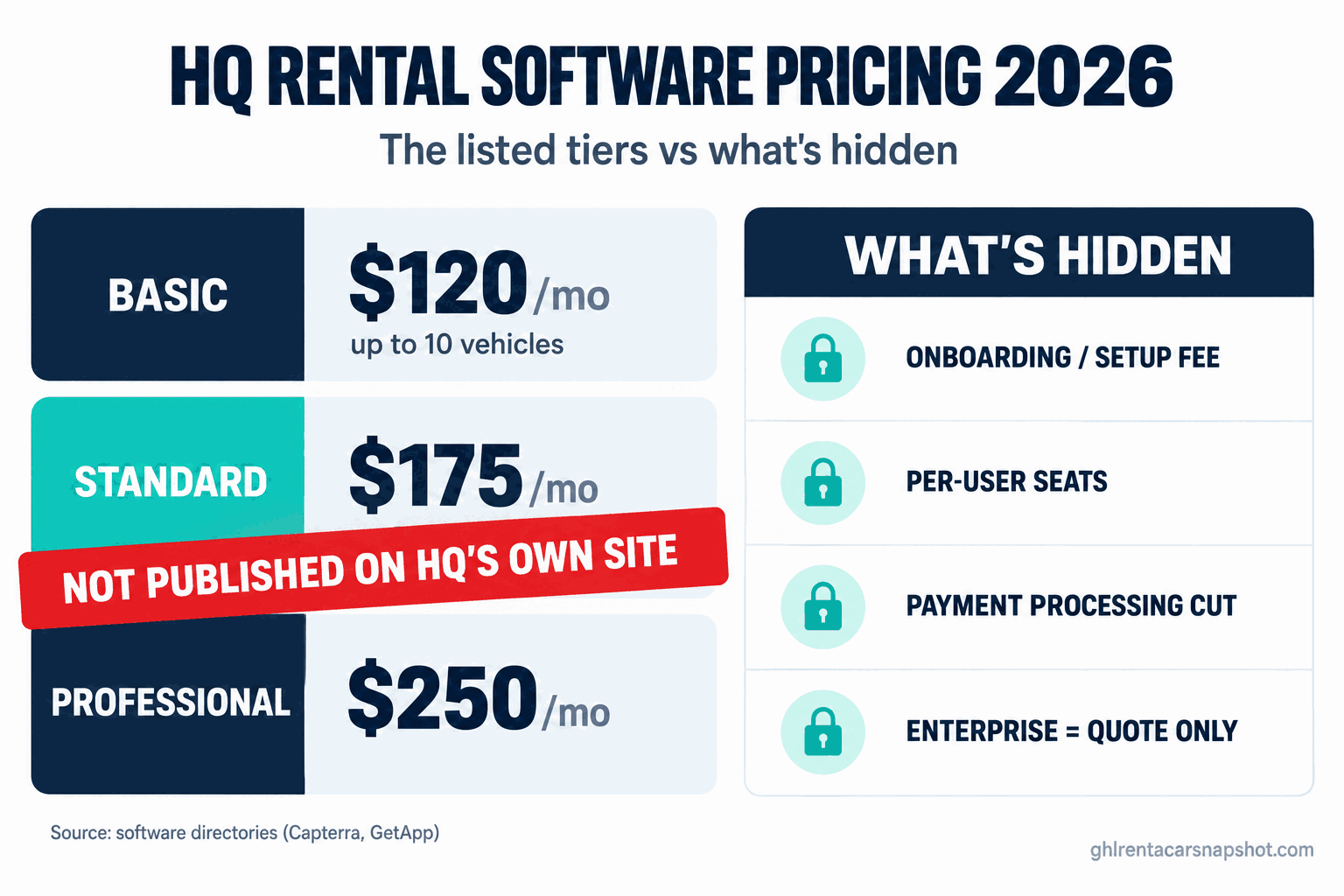
Here is the short version so you can stop clicking. HQ Rental Software does not publish pricing on its own website. The numbers you see everywhere, roughly $120, $175, and $250 a month, come from third-party software directories, not from HQ. Even those only pin down the entry tier, about $120 a month for up to 10 vehicles. Everything above that, plus setup, add-ons, and payment processing, is quote-only. This teardown gives you every number I could verify, the costs that never show up until the invoice, three honest cost scenarios by fleet size, and the exact email that forces a rep to put a real all-in price in writing.
Key Takeaways
- HQ publishes no price on its own site. The public figures come only from directories like Capterra, Software Advice, and GetApp. HQ’s own pages route you to a demo.
- The listed tiers are about $120 / $175 / $250 a month. GetApp pins the entry tier at roughly $120 a month for up to 10 vehicles. The higher tiers and the enterprise plan are quote-only.
- The sticker is not the all-in price. HQ does not disclose setup fees, per-seat charges, add-on costs, payment-processing cuts, or contract length. Budget for all of them and get each in writing.
- Two competitors will just tell you. Fleetwire lists from about $24 a month (up to $89 for 15 vehicles). GoHighLevel starts at $97 a month and runs far more than booking. Price those before you sit through an HQ demo.
Table of contents
- What HQ Rental Software actually is
- What HQ Rental Software actually costs in 2026
- Why you can’t find HQ’s price on HQ’s site
- What the three tiers really get you
- The costs the listing doesn’t show
- Three cost scenarios: solo, mid-size, large fleet
- HQ vs the cheaper field: who should skip it
- The compliance cost no quote includes
- Steal this: the email that forces a real quote
- Common objections, answered
- Frequently asked questions
What HQ Rental Software actually is
Before you price it, know what you are pricing. HQ Rental Software is a dedicated, cloud-based car rental management platform built for real counters: reservations, a fleet calendar, rate and season management, online booking, a customer portal, maintenance tracking, and multi-location support. It is built for operations, not marketing, and the depth is the whole pitch. If you run two or three lots, a mix of daily and weekly terms, and staff who each need a login, HQ is designed for exactly that.
Here is the catch. A platform built for that kind of operation almost always prices like one: tiered by fleet size and seats, with onboarding, and with the real number set by a quote instead of a public plan. That is the opposite of a self-serve app that shows a price and lets you start the same afternoon. The first thing to understand about HQ’s cost is that the cost is deliberately hard to see.
What HQ Rental Software actually costs in 2026
I will be straight about what is verified and what is not, because that honesty is the point of a teardown.
What is solid: three major directories list HQ in the same band. Capterra and Software Advice both show a starting price around $120 a month, flat rate, with a free trial, and a Professional tier near $250 a month. GetApp adds the one vehicle count anyone publishes: the $120 entry tier covers up to 10 vehicles, and annual billing includes a free month. A mid tier around $175 a month shows up across listings too. Above that sits an enterprise plan that is quote-only.
HQ monthly list price by tier, USD, per third-party directories (HQ publishes none on its own site); enterprise tier is quote-only. Sources: Capterra, Software Advice, GetApp.
Now the part to handle carefully. Those directory numbers are the listing, not HQ’s own word, and HQ does not confirm them on its site. The vehicle bands for the Standard and Professional tiers, the per-seat charges, the add-on prices, the setup fee, and the contract length are all things HQ does not publish anywhere public. Competitor comparison sites float specific figures for those. Treat them with suspicion, because a rival vendor has every reason to make HQ look expensive or confusing. The only numbers I stand behind are the ones multiple neutral directories agree on, and those stop at the monthly sticker.
Why you can’t find HQ’s price on HQ’s site
Demo-gated pricing works in the vendor’s favor three ways. With no public number, the rep can size the quote to what your operation looks like it can afford. Competitors can’t undercut a figure they can’t see. And you can’t comparison-shop without first spending an hour on a sales call, so by the time you have a number you are already half-sold.
None of that makes HQ a bad product. Plenty of good software is sold this way, and the depth is real. But a vendor that hides its price is keeping room to move, which means the first number you hear is almost never the best one available. You cannot evaluate HQ on price the way you evaluate Fleetwire, where the whole thing is on one public page. You have to extract HQ’s number yourself, and all of it, not just the monthly figure the rep leads with.
What the three tiers really get you
Since HQ does not publish a feature-by-tier breakdown, the honest version of this table is what the directory listings and the product’s positioning tell us, with the unknowns marked as unknowns. Do not let a rep gloss over the blanks. Each blank is a question you ask before you sign.
HQ Rental Software tiers: what's known vs quote-only (2026)
| Plan | Basic | Standard recommended | Professional |
|---|---|---|---|
| Price | ~$120/mo | ~$175/mo | ~$250/mo |
| Feature 1 | Up to 10 vehicles (GetApp) | Larger fleet (band not disclosed) | Larger fleet + multi-location |
| Feature 2 | Core reservations + online booking | Core reservations + online booking | Full reservations + rate management |
| Feature 3 | Seats / setup / processing: not disclosed | Seats / setup / processing: not disclosed | Seats / setup / processing: not disclosed |
Look at how many rows read “not disclosed.” That is the actual state of HQ’s public pricing. An enterprise tier sits above Professional for larger fleets, quote-only with no listed figure. If you run 40 or 50 cars across two lots, you are almost certainly in that zone, which means the directory numbers tell you nothing about your real cost. They are a starting point for the conversation, not an answer.
The costs the listing doesn’t show
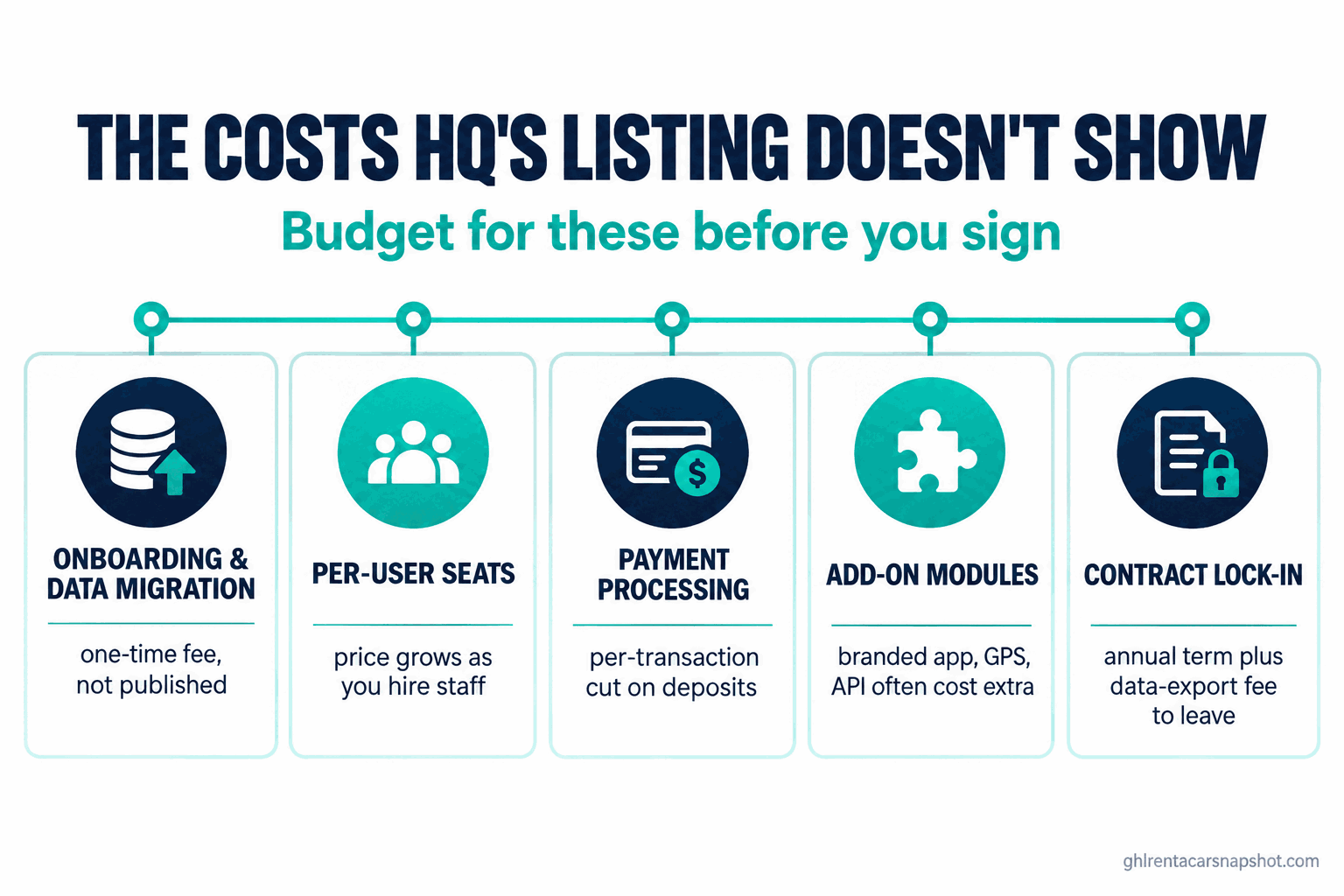
This is the section the demo skips, and it is where the real money hides. Whatever monthly figure you end up quoted, budget for these, and notice how each one breaks a budget built only on the sticker.
- Onboarding and data migration. Moving your reservations, customer records, and vehicle history into a full platform is real work, and mature rental software usually charges a one-time fee for it. HQ does not publish a setup figure, so you cannot assume it is zero. This is the line most often absent from the pitch and present on the first invoice. Ask the exact dollar amount in writing.
- Per-seat creep. Tiered tools commonly price by login. A plan that is fine for you alone climbs as you add a counter clerk, a weekend hire, and an office manager. Ask what the price is at the seat count you will actually run in six months.
- Payment processing. If HQ runs your deposits through an integrated processor, there is a per-transaction cut on top of the subscription. On real volume, that cut can rival the monthly fee. Confirm the percentage and whether you can bring your own processor.
- Add-on modules. Features that feel core in a demo (a branded app, GPS, advanced reporting, an API) are frequently paid add-ons, not base features. Confirm every feature you loved on the call is in the tier you are quoting.
- Contract length and exit cost. Platform tools lean toward annual commitments, which keep a tool that stops fitting on your card for a year, and getting your data back out can carry its own charge. Ask what a clean export costs before you sign, not in month nine.
None of these are hypothetical. They are the standard shape of quote-gated rental software, which is exactly why a public page would have to show them and a demo does not.
Three cost scenarios: solo, mid-size, large fleet
The right answer depends on your fleet size and how much you want one tool to run. Here is the honest math using only HQ’s published monthly list prices, before any setup, add-ons, or processing, which you add on top once you have a quote.
Solo operator, 5 to 8 vehicles
Your real problem is a booking page that works and a deposit that gets held. HQ’s Basic tier at about $120 a month, roughly $1,440 a year in subscription alone, covers up to 10 vehicles. The honest question is whether you need a full platform to rent six cars, or whether a lighter tool solves the leak for a third of the price. Fleetwire’s entry plan starts around $24 a month with no setup fee. At this size, buy the smallest tool that stops the leak.
Growing shop, 20 to 30 vehicles
Now you have staff, repeat renters, and enough volume that a dropped follow-up costs real money. You are above the Basic cap, into the Standard or Professional tier, call it $175 to $250 a month, $2,100 to $3,000 a year before setup and seats. HQ handles the fleet depth you now need. What it does not do is run your marketing: the missed-call text-back, the abandoned-booking recovery, the review requests, the no-show follow-up. The moment you buy a second tool for those, your “one software bill” becomes three. This is the size where a lot of operators quietly pay for a booking platform, a separate marketing stack, and a separate texting tool.
Established operation, 40 to 50+ vehicles, multiple lots
You are in HQ’s quote-only enterprise zone, so the directory numbers tell you nothing. Expect a real sales process, an onboarding fee, and per-seat pricing. At this scale HQ’s depth earns its keep and the setup cost is a smaller share of your spend. This is also the size where the all-in bill (subscription plus seats plus processing plus whatever you bolt on for marketing) is big enough that you should model it over three years, not one month, before you commit.
Annual subscription (12 months at list price), USD. List price only: excludes setup, per-seat, add-on, and payment-processing costs, which HQ does not publish. Sources: HQ via Capterra, Fleetwire, GoHighLevel.
Notice where a general operations platform lands. GoHighLevel’s Starter plan sits at $97 a month, right in the band of the dedicated tools, except it runs your texting, CRM, reservation automation, review pipeline, and no-show recovery in one place. That is why plenty of operators stop buying a booking tool plus a marketing stack and start buying a single operations system.
HQ vs the cheaper field: who should skip it
HQ is not the only dedicated tool, and it is far from the cheapest. Here is the honest buyer’s read.
- Buy HQ if you run a real counter with multiple locations, mixed daily and weekly terms, staff who each need a seat, and you want one deep system of record for the rental side. The depth is the point, and you are willing to go through a quote to get it.
- Skip HQ for Fleetwire if you are a solo or small operator who mostly needs a clean booking page, a calendar, and deposit holds, and you want to see the price before you talk to anyone. Fleetwire’s public pricing starts around $24 a month and tops out near $89 for 15 vehicles (Fleetwire). I walk through that head to head in Fleetwire vs HQ Rental Software for a 20-car fleet.
- Skip HQ for RENTALL or Navotar only if you have already priced them, because both are also quote-gated with the same hidden-cost risk. I broke those down in RENTALL pricing: what the demo won’t tell you and Navotar alternatives for independent operators.
- Skip dedicated rental software entirely if your real bleeding is leads, not fleet management: missed calls, slow follow-up, no-shows, and no review engine. A booking platform fixes none of those. An operations platform does. The full field, side by side, is in car rental software pricing in 2026.
The honest summary: HQ is a strong platform for a shop that has outgrown simple tools and wants depth. It is overkill, and over-priced, for an operator whose main problem is that the phone goes to voicemail on a Friday.
The compliance cost no quote includes
Here is a cost that never appears on any rental software quote, HQ’s included, because it is not the vendor’s job. If you text renters (and you should, it is how you cut no-shows and late returns), you are on the hook for text-messaging compliance yourself. Three things matter now, and one myth needs killing.
- A2P 10DLC registration is mandatory, and it just got stricter. To send business texts in the US you register your brand and campaign through the carrier system. As of June 30, 2026, any new campaign registration must include a PrivacyPolicyUrl and a TermsAndConditionsUrl, or it is rejected in review (Twilio). If your site has no privacy policy and terms pages, your texting does not launch.
- State mini-TCPA laws carry teeth, especially Florida. The Florida Telephone Solicitation Act (Fla. Stat. 501.059) is a mini-TCPA with a private right of action: a consumer can sue for the greater of $500 per violation or actual damages, trebled for willful violations, and it reaches out-of-state businesses (Gunster). Florida is a top rental market, so this is not abstract.
- The myth: a “one-to-one consent” rule. You may have read that you now need separate, one-to-one consent for every sender. You do not. The FCC’s one-to-one consent rule was vacated by the Eleventh Circuit in January 2025, one business day before it was set to take effect, and it never became law (Akerman).
I wrote the full playbook in texting rental reminders without a TCPA or 10DLC disaster. The point here is narrow: when you price HQ, remember the texting layer you need is a separate cost and a separate responsibility, and a booking tool does not carry it for you.
Steal this: the email that forces a real quote
A good HQ demo shows a clean reservation flow and real fleet depth, and most of it works well. What the rep will not volunteer, unless you make them, is the full cost stack. So do not walk in and ask “what does it cost.” Send this the day you book the demo, so the rep arrives with numbers instead of “let me circle back.”
On the call, do not accept a range for any of the six. A range is a placeholder, not a price. If the rep says “onboarding is usually a few hundred,” answer “for my exact setup, is it $300, $500, or $700, and can you put that in the follow-up email.” A number you can hold onto behaves very differently from one said out loud and forgotten.
Common objections, answered
“HQ doesn’t publish pricing, but neither do its competitors. Why single it out?” I don’t single it out as worse. RENTALL and Navotar are also quote-gated, which is why I priced those separately. HQ gets its own teardown because it is the one most small operators reach for when they decide to “get serious,” so it is the one most likely to cost more than you planned. The directory listings give a false sense of a known price. This post exists to show you the floor is not the bill.
“I already run on spreadsheets. Isn’t any real software an upgrade?” Real software is an upgrade for fleet management. It does nothing for the part that is actually losing you money most weeks, which is slow lead follow-up and missed calls. If you are moving off manual tools, decide first whether your bleeding is operations or marketing. I walk through that fork in running a rental on spreadsheets and WhatsApp, where it breaks.
“Isn’t a $120-a-month tool cheap enough that the hidden costs don’t matter?” The $120 tier caps at 10 vehicles. If you are reading a buying guide, you are probably past that, which puts you in the Standard, Professional, or quote-only enterprise zone where setup, seats, and processing stack up fast. The hidden costs matter precisely because they land on the fleet sizes most likely to buy.
Frequently asked questions
How much does HQ Rental Software cost per month in 2026?
HQ does not publish pricing on its own website. Third-party directories (Capterra, Software Advice, GetApp) list it at roughly $120, $175, and $250 a month, with the $120 entry tier covering up to 10 vehicles, and an enterprise tier that is quote-only. Those figures are directory listings, not HQ's confirmed prices, and they exclude setup, per-seat, add-on, and payment-processing costs.
Does HQ Rental Software charge a setup or onboarding fee?
HQ does not publicly disclose a setup fee, so you cannot assume it is zero. Mature rental platforms commonly charge a one-time onboarding and data-migration fee. Ask for the exact dollar amount in writing before you sign, because it is the cost most likely to be absent from the demo and present on the first invoice.
Is HQ Rental Software cheaper than Fleetwire?
No. Fleetwire publishes pricing starting around $24 a month, up to about $89 a month for 15 vehicles, with no setup fee. HQ's listed entry tier is about $120 a month. HQ is a deeper platform built for multi-location counters, so the comparison is depth versus price, not a straight cost match. A solo or small operator who mainly needs a booking page usually does not need HQ's depth.
Why can't I find HQ Rental Software's price on its website?
HQ uses demo-gated pricing, a deliberate sales strategy. Hiding the number lets the rep size a quote to your operation, prevents competitors from undercutting a visible figure, and gets you onto a sales call before you have a price to compare. It does not mean the product is bad, but you have to extract the full cost yourself.
Do I still need separate texting compliance if I use HQ Rental Software?
Yes. Rental software does not carry your text-messaging compliance. You must register your brand and campaign through A2P 10DLC (and, as of June 30, 2026, include privacy-policy and terms URLs), and you remain liable under the TCPA and state mini-TCPA laws like Florida's FTSA. There is currently no one-to-one consent rule in effect, since it was vacated in January 2025.
It is Friday afternoon again. This time, when you price HQ Rental Software, you walk in knowing the $120 you read online is a floor, not a bill, and you have the six questions that turn a demo into a real quote. Whether HQ is right for you comes down to one thing: is your problem fleet depth, or is it the leads slipping through the cracks while you are up a ladder with a customer? Price the tool that fixes your actual bleeding, get every number in writing, and don’t sign against the first figure a rep says out loud.
If your real problem is the leads, not the fleet, the whole follow-up system (missed-call text-back, booking recovery, reminders, reviews, no-show recovery) is already built and installed for a one-time price in the Car Rental Snapshot. Spend thirty minutes on a walkthrough before you commit to another monthly subscription.