

It is 9:15 on a Saturday. A renter texts your business number asking if the gray SUV is free next weekend. You are elbow-deep in a return inspection, so you glance at the booking tab on your phone, see the SUV looks open, and reply “yes, it’s yours.” Two hours later you remember the Google Sheet you updated last night from your laptop, not your phone. The SUV is already booked. Now you are the person who has to un-promise a car, and that renter is gone for good.
If that feels familiar, you are not doing anything wrong. Almost every independent operator starts on spreadsheets and WhatsApp. The problem is that they stop scaling at the exact point your lot starts making real money.
Here is the short version. Spreadsheets and WhatsApp break down once you cross roughly 10 to 15 vehicles or two people touching the calendar, because they cannot prevent a double-booking, prove what a renter agreed to, send a reminder on their own, or show you which cars are losing money. This post walks the six jobs you are quietly asking them to do, shows where each breaks, and names the system piece that replaces it.
Key Takeaways
- The tools are not the problem, the ceiling is. They work for a handful of cars, then break around 10 to 15 vehicles or when a second person touches the calendar.
- Speed is the first thing you lose. Replying to a lead within an hour makes you about 7x more likely to qualify it, yet most businesses take 42 hours (Harvard Business Review, 2011).
- A WhatsApp thread is not a contract. In a damage dispute, a verbal deposit and a photo of a photo are not evidence, and chargebacks cost far more than the amount disputed (Mastercard, 2025).
- Renters want texts you cannot send by hand. About 89% prefer texting a business (EZ Texting, 2024), but manual reminders get forgotten on busy days.
- You do not have to rip and replace. Swap the leakiest job first, keep the rest, move one piece at a time.
Table of contents
- The six jobs you are asking them to do
- Job 1: Taking the booking
- Job 2: The agreement and the deposit
- Job 3: Pickup and return reminders
- Job 4: Documenting the car out and back
- Job 5: Reviews and repeat business
- Job 6: Knowing your numbers
- Three ways to make the jump
- The texting rule you cannot ignore when you switch
- Steal these: the messages that do the work for you
- Common objections, answered
- Frequently asked questions
The six jobs you are asking them to do
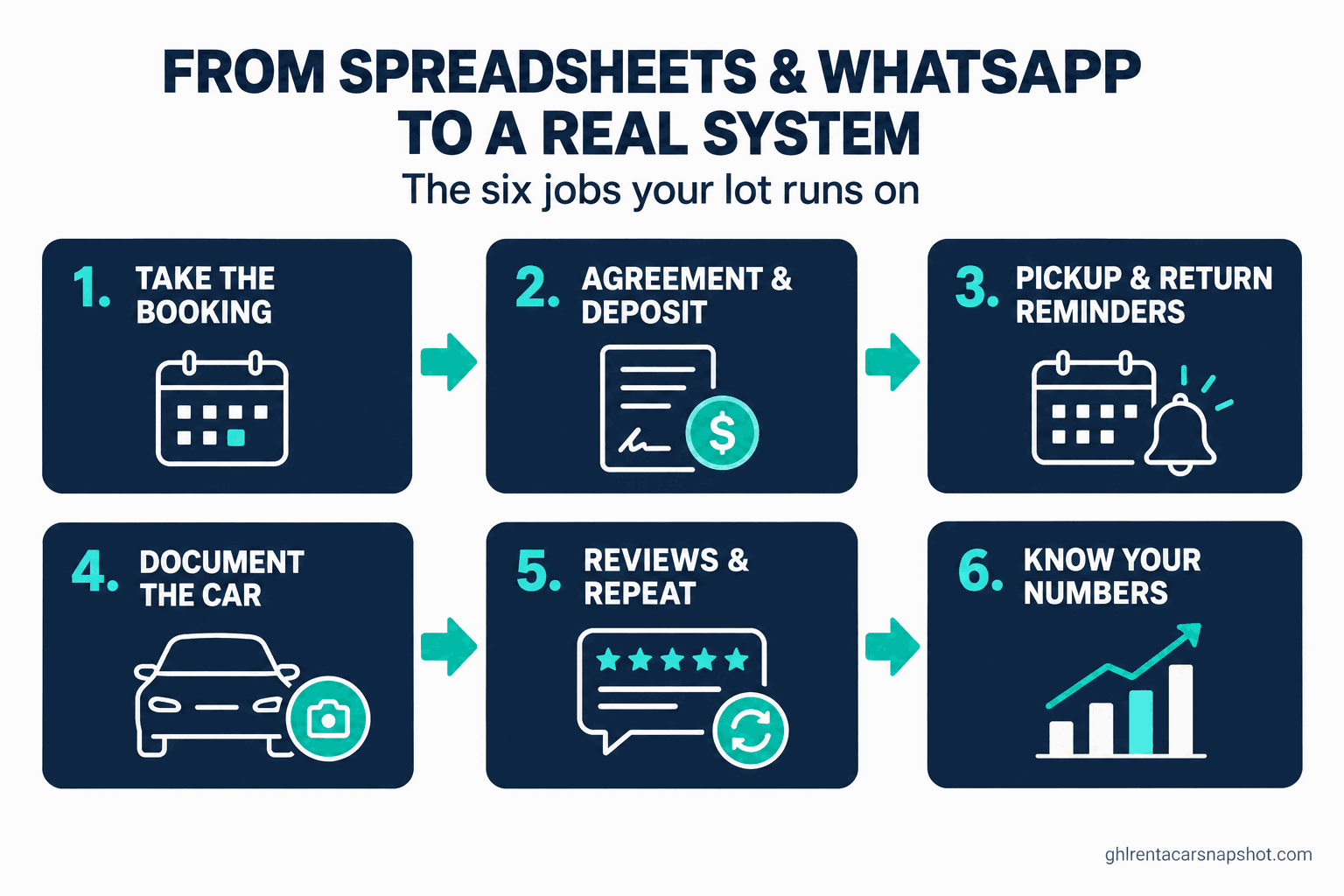
In the beginning you can hold the whole business in your head: five cars, a calendar app, a WhatsApp thread per renter. Then you add cars, a second driver, and ads that bring inquiries while you are on the road, and the free setup starts costing you in ways no invoice shows. Strip away the software talk and a car rental runs on six repeating jobs, each now living in a spreadsheet, a WhatsApp thread, or your head.
- 1Job 1
Take the booking
Capture the inquiry, check availability, hold the car.
- 2Job 2
Agreement and deposit
Signed contract and card-on-file hold before keys move.
- 3Job 3
Reminders
Pickup time, return time, anything overdue.
- 4Job 4
Document the car
Timestamped photos out and back.
- 5Job 5
Reviews and repeat
Ask happy renters, win back old ones.
- 6Job 6
Know your numbers
Utilization, revenue per car, what is idle.
For each: where it breaks, and what replaces it.
Job 1: Taking the booking
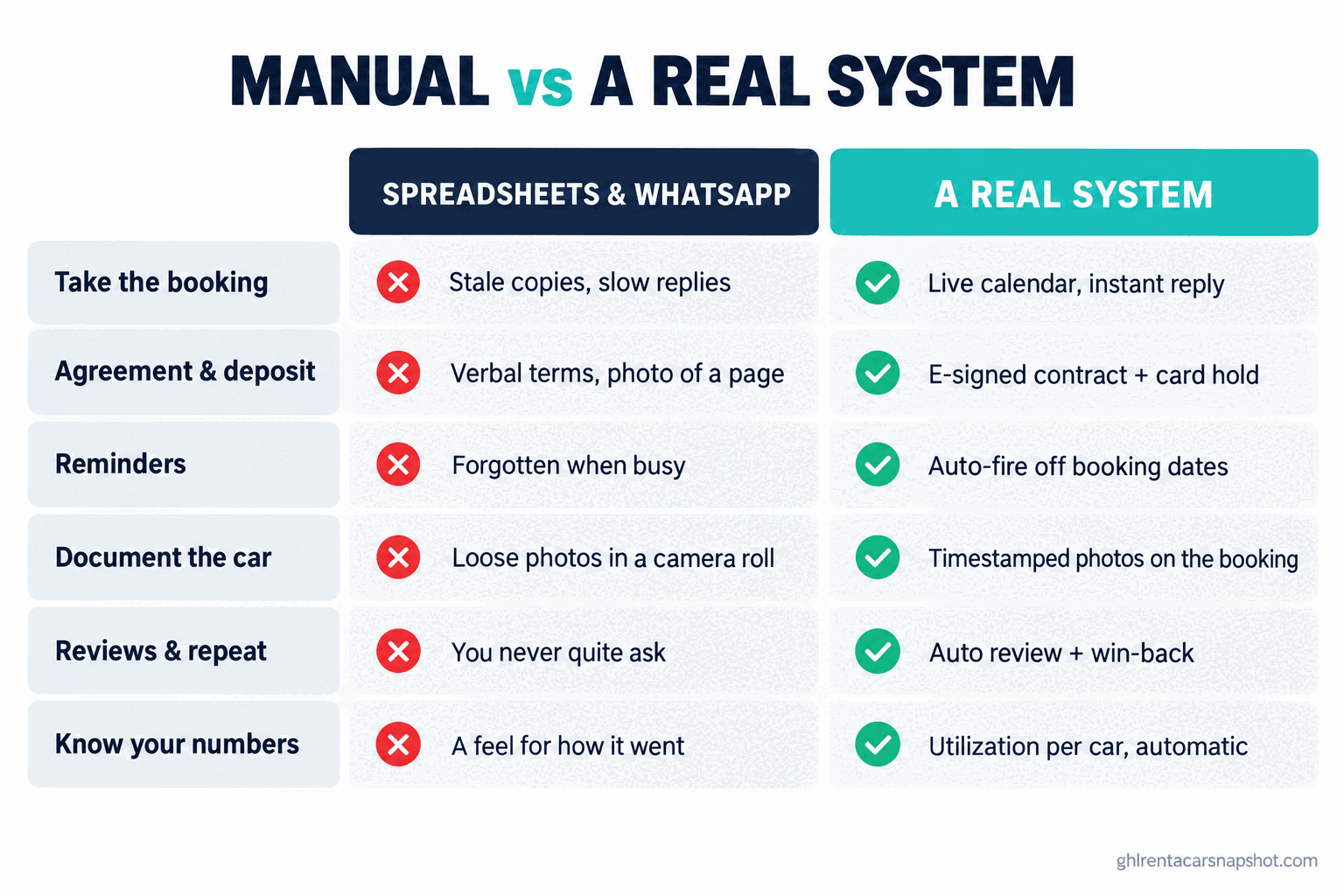
The manual version: an inquiry lands, you check a tab, eyeball the dates, and reply when you get a second. Availability lives in one file one person edits at a time.
Where it breaks. Two things, both expensive. First, the double-booking. The moment more than one person can promise a car, or your laptop and your phone show different versions, you will hand the same vehicle to two renters. One gets an apology and never comes back.
Second, speed. Inquiries arrive on a Friday evening mid-turnaround, and they sit. An audit of 2,241 companies found that replying to a lead within an hour made a business about 7 times more likely to qualify it than waiting one hour longer, yet the average first response took 42 hours (Harvard Business Review, 2011). Tighten the window and it gets starker: replying within 5 minutes versus 30 makes you roughly 21 times more likely to qualify a lead (MIT and InsideSales Lead Response study). No human at a counter hits that on every inquiry. That is physics, not a staffing problem.
What replaces it. A shared availability calendar that updates the second a booking is confirmed, so nobody promises a car that is spoken for, plus an automatic first reply the instant an inquiry arrives. An auto-text that offers the open dates and a link to lock them in wins the race a human cannot. It is the same leak that drains a missed-call budget: a lead is only worth what your response speed makes it worth.
Job 2: The agreement and the deposit
The manual version: the “contract” is a WhatsApp message, maybe a photo of a signed page, maybe nothing. The deposit is a number you said out loud.
Where it breaks. The day a car comes back with a cracked bumper and the renter says “I never agreed to a 500 dollar deposit.” When they dispute the charge with their card issuer, you lose unless you can produce a signed agreement and clear evidence, and chargebacks cost far more than the disputed amount once you add fees and lost time (Mastercard, 2025).
What replaces it. A digital rental agreement the renter signs on their phone before pickup, backed by a card-on-file authorization hold, not a charge. An electronically signed agreement is just as binding as ink under the federal ESIGN Act, which says a contract cannot be denied legal effect merely for being electronic (Cornell Law, 15 U.S.C. 7001), and it lives as a stored PDF you can pull up instantly. The deep dives: the digital rental agreement and e-sign flow and automated deposit holds.
Job 3: Pickup and return reminders
The manual version: you remember to text the pickup time, usually. You remember the return reminder, sometimes. On a busy weekend you forget, and so do they.
Where it breaks. No-shows and late returns. A renter who gets no reminder forgets, shows up late, or ghosts the pickup, and a car back a day late is a car you could not re-rent. Renters actually want these texts: about 89% of consumers prefer texting with a business, and 81% have opted in to receive texts from a business (EZ Texting, 2024). For travel, roughly 72% would rather book with a company that texts plans and reminders (Zipwhip, via ISE Magazine). The demand is there. Your hands are not, not at 7am on a three-pickup Saturday.
What replaces it. A reminder sequence that fires off the booking dates: a confirmation at booking, a nudge the day before, a morning-of text with the address, and a return reminder before the car is due. Write them once, they send forever. That is the backbone of real reservation automation, and where a late-return problem goes to die.
Job 4: Documenting the car out and back
The manual version: you snap a few photos at pickup, maybe, and they land in your camera roll with 4,000 other pictures. At return you take more, or forget because the renter is in a hurry.
Where it breaks. The dispute you cannot win because you cannot find the evidence. Photos scattered across a camera roll, with no link to the booking and no reliable timestamp, are not proof. When you need to show a scratch was there at return and not at pickup, “I think this one is from that rental” does not beat the renter’s denial. This is the same evidence gap that damage photo deposit protection is built to close.
What replaces it. A structured out-and-back photo step tied to each booking: a short checklist completed at handover and return, with timestamped images stored against the contact, not loose in a phone. When the dispute comes, the before-and-after photos are right there, dated, in order.
Job 5: Reviews and repeat business
The manual version: you mean to ask for reviews. You never quite do, because there is no prompt and no spare minute. Repeat renters live as old WhatsApp threads you scroll back to find.
Where it breaks. Your reputation stalls and your best customers drift. This matters more than most operators think: 97% of consumers read online reviews for local businesses, and 71% use Google to do it (BrightLocal, 2026). If you are not steadily asking, you are not steadily getting, and the lot down the road with 80 reviews wins the renter comparing you on their phone. A renter you served six months ago is also the cheapest booking you will ever get, and a WhatsApp thread never reminds you to go get them.
What replaces it. A review request that fires automatically a few hours after a clean return, by text, with a direct link, while the experience is fresh, plus a win-back that reaches past renters before a holiday weekend. You stop hoping people remember you and build a system that remembers for you. Same mechanics as a working five-star review pipeline.
Job 6: Knowing your numbers
The manual version: you have a rough feel for how busy you are. You can tell me last month was good. You cannot tell me which three cars carried the lot and which two sat idle bleeding insurance and payments.
Where it breaks. You make fleet decisions on vibes. Utilization is the number that matters most, and most operators cannot see theirs. The U.S. average sits around 66.2% in 2025, with a healthy target of 75 to 85% (Auto Rental News; Nomora). The gap between 66% and 80% is pure profit you already own, but you cannot close a gap you cannot measure.
What replaces it. A system where every booking is a record, so utilization, revenue per vehicle, and your idle cars fall out of the data automatically. You stop guessing which car to sell. If this is the job biting hardest, start with the fleet utilization playbook.
Spreadsheets and WhatsApp record what already happened. A real system does each of these jobs while it is happening, which is the whole difference.
Three ways to make the jump
The jobs are the same at every size. The order and the budget are not.
Solo operator, 5 to 10 cars. Do not buy heavy fleet software yet. Fix the two jobs bleeding most, capture and reminders: a live booking calendar and auto-reply so no inquiry sits, and a basic reminder sequence so no renter forgets a pickup or return. Keep the spreadsheet as a backup for a month while you trust the flow.
Growing shop, 20 to 30 cars, one or two staff. This is the breaking point. Multiple hands on the calendar means daily double-booking risk, and one lost chargeback stings. Move all six jobs onto one system over a few weeks: capture and reminders first, then the agreement and deposit hold, then the review engine. If you are weighing dedicated platforms here, the 2026 software pricing teardown lays out the real costs.
Large or multi-location fleet, 60-plus cars. Your problem is consistency across locations and people, not any single job. You need one source of truth for availability, enforced steps a booking cannot skip (no keys without a signed agreement and a hold), and reporting that rolls up across sites. At this size a messy handoff, across hundreds of rentals a month, dwarfs any software bill.
The texting rule you cannot ignore when you switch
Here is the catch most operators miss moving off personal WhatsApp to real business texting. In the United States, automated or marketing texts from a business line mean registering for A2P 10DLC, the carrier system that keeps business messages from being filtered as spam. As of June 30, 2026, a new campaign registration must include a public privacy policy URL and a terms and conditions URL, or it is rejected (Twilio). Get those pages live first.
You also owe renters real consent and a working opt-out: collect permission at booking, honor STOP immediately, keep records. Do not believe anyone who says a “one-to-one consent” rule applies, because the FCC rule that would have required it was vacated by the courts in early 2025 and never took effect (Wiley). State law can be stricter: Florida’s FTSA carries a private right of action, so a sloppy text program in a top market like Florida is a real liability. Full walkthrough: texting rental reminders without a TCPA or 10DLC disaster.
Steal these: the messages that do the work for you
These send themselves at the right moment. Swap in your own lot name and address.
Instant inquiry reply (fires the second a message or form lands):
Thanks for reaching out to [Lot Name]. Yes, the [vehicle] looks open for [dates]. To lock it in, tap here: [booking link]. Reply with any questions. Reply STOP to opt out.
Day-before pickup reminder:
Reminder: your [vehicle] pickup is tomorrow at [time], [address]. Please bring your driver’s license and the card used to book. Need to change anything? Reply here.
Return reminder (fires a few hours before the car is due):
Your [vehicle] is due back today by [time] at [address]. Returning late can add a [amount] late fee, so text us now if you need more time and we’ll check availability.
Review request (fires a few hours after a clean return):
Thanks for renting with [Lot Name], it was a pleasure. If we earned it, a quick Google review helps a small local business more than you’d guess: [review link]. Hope to see you next trip.
Win-back (fires before a busy weekend to past renters):
Hey [name], [Lot Name] here. [Holiday or event] weekend books up fast and we’d love to get you back on the road. Want us to hold a [vehicle class]? Reply YES and we’ll set it up.
Common objections, answered
“My spreadsheet works fine.” It works fine until the day it does not, and that day costs you a double-booking, a lost chargeback, or a renter who never got a reminder. A spreadsheet is a great record and a terrible employee. Can it take a job off your plate while you sleep? It cannot.
“I do not have time to switch.” You do not have time because the manual version is eating your week, with you as booking engine, reminder service, and review team at once. Switching one job at a time buys that time back.
“Is real software too expensive for a small lot?” Compare it to the cost of the leaks, not to zero. One recovered weekend booking, one deposit you can defend, one car re-rented on time, and the math flips. You also do not have to start with the priciest platform, as the software pricing teardown shows.
“What about my WhatsApp history with repeat customers?” Keep it. Nobody is taking your phone. You stop running automated booking and reminder traffic through a personal thread, not your relationships. Your regulars still text you, while everything that should run on its own moves to a channel built for it.
Frequently asked questions
When exactly should I move off spreadsheets and WhatsApp?
When a second person touches the calendar, when you cross roughly 10 to 15 vehicles, or the first time you lose a booking or a deposit dispute because of a manual gap. Any one is the signal, and most operators feel all three around the 15-car mark.
Do I have to replace everything at once?
No, and you should not. Pick the single job costing you the most right now, usually booking capture or deposit protection, replace it, and let the result fund the next piece. A staged switch is lower risk than a big-bang rebuild.
Can I keep using WhatsApp for anything?
Yes. It is fine for one-to-one chats with renters you already know. What it should not be is your automated booking, reminder, and review channel at volume, because it has no audit trail, no registered sender, and no automatic opt-out handling for U.S. business messaging.
Is a text I send renters legally regulated?
Automated and marketing texts from a U.S. business line are. You need A2P 10DLC registration, which as of June 30, 2026 requires a public privacy policy and terms URL, plus real consent and a working STOP. Transactional reminders to a renter who booked with you sit on firmer ground than cold marketing, but you still register and honor opt-outs.
What is the single highest-return thing to fix first?
A live, shared availability calendar paired with an instant auto-reply to new inquiries. It stops the double-booking that burns renters and wins the speed race a human cannot, which is where most lost bookings actually leak away.
The Saturday that started this post does not have to end with you un-promising a car. Put the first two jobs on autopilot, a live calendar and an instant reply, and the gray SUV can only be promised once, to the renter who locked it in first. Add the next piece when you are ready, and the business starts running on its own.