

It is 4:15pm on a Sunday and your renter is staring at a $400 cleaning fee on his final receipt. He smoked in the car, you can smell it from the lot, but he swears nobody told him about a fee and he is already reaching for his phone to call his bank. You know how that call ends. The charge comes off, you eat the detailing, and your merchant account logs another dispute.
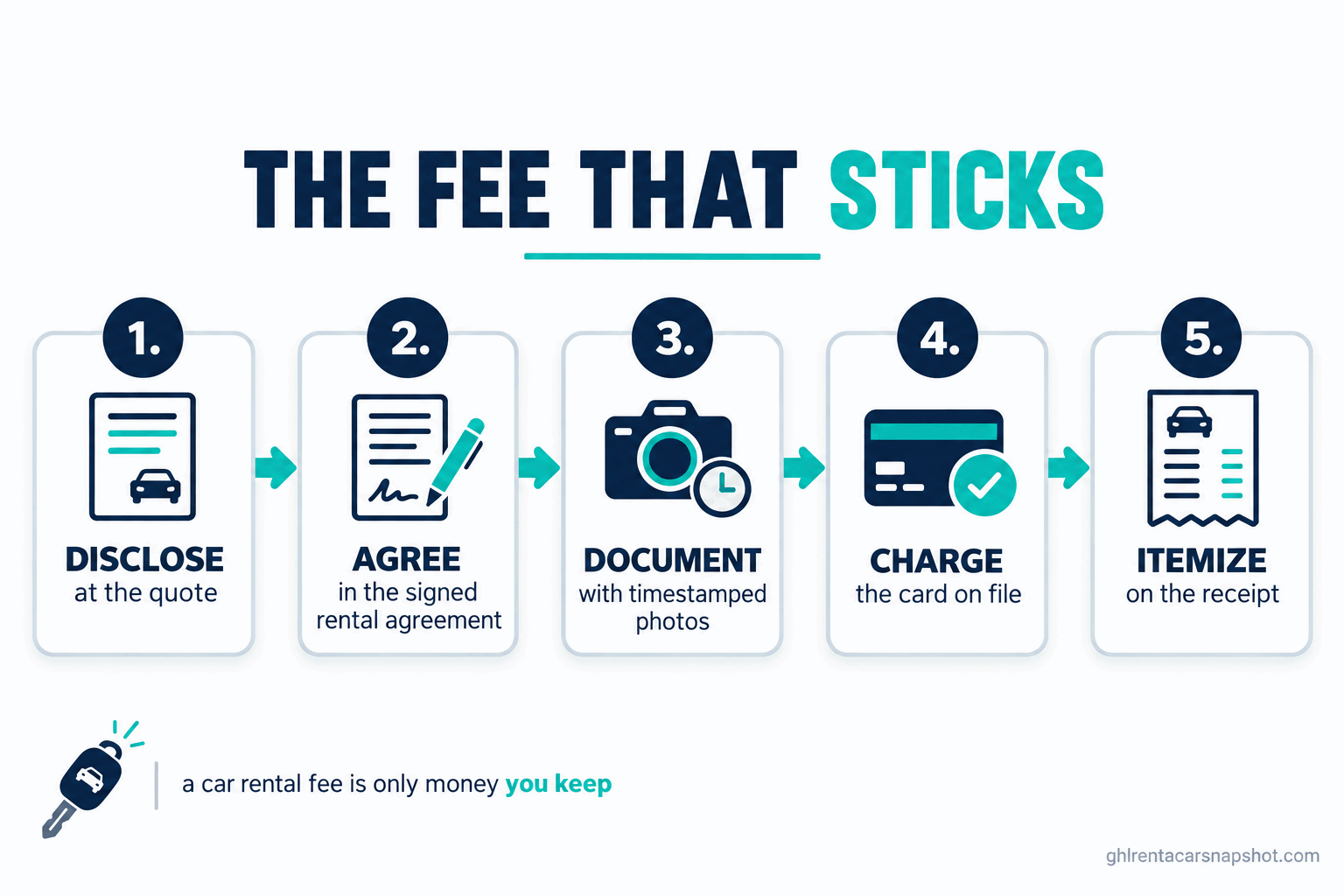
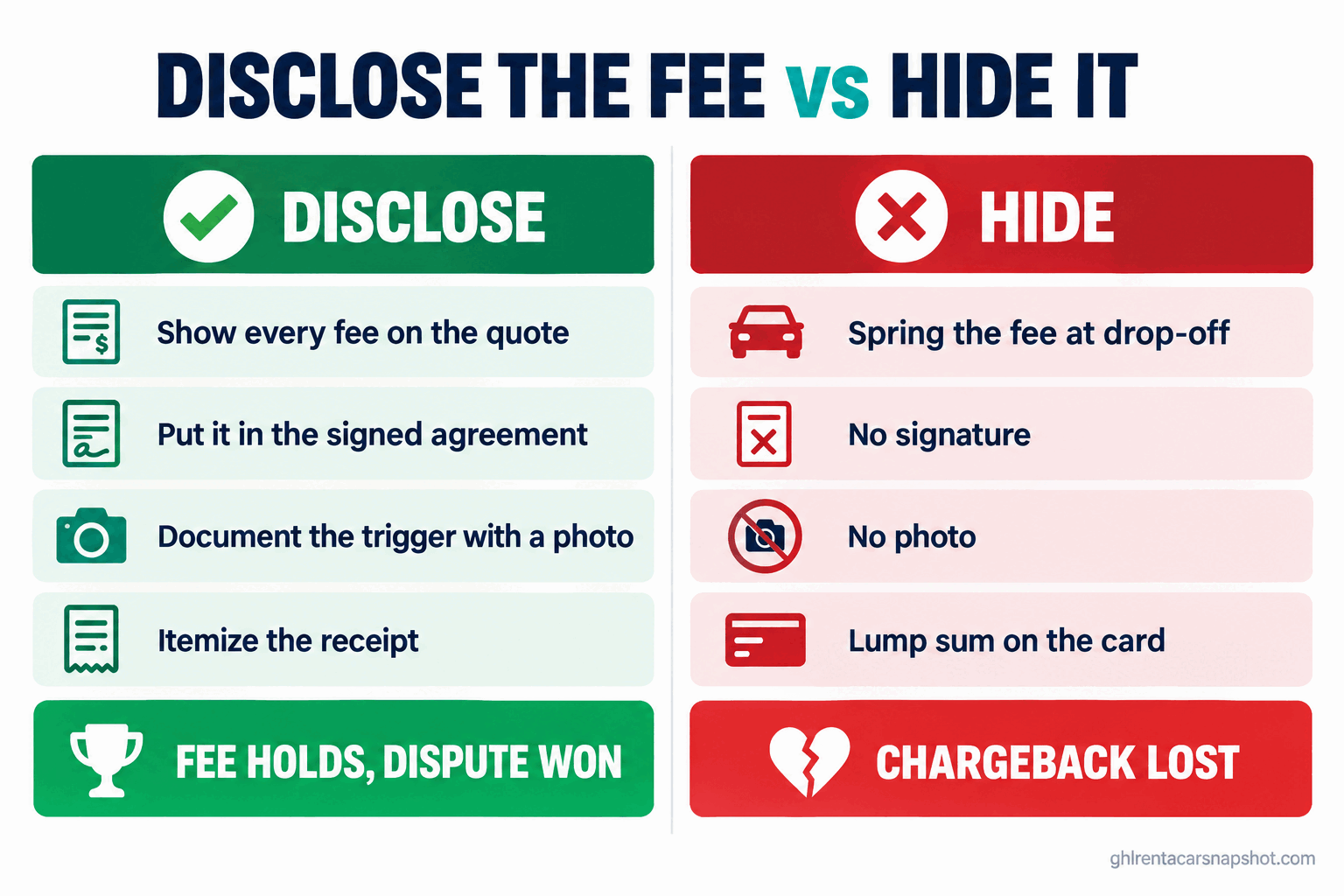
Here is the short version so you can stop losing these. A car rental fee is not money you charge. It is money you keep, and you only keep it when the fee was disclosed before the rental, agreed to in writing, documented when it applies, and itemized on the receipt. The number on your fee schedule is the easy part. The system that makes it stick is the whole game, and most independent operators never build it. This guide covers every fee you can charge in 2026, the real amounts the big brands use, the wording for your agreement, and how to collect each one.
Key Takeaways
- A fee you cannot document is worse than no fee. An undisclosed charge invites a chargeback that costs you the fee, the labor, and a mark against your merchant account.
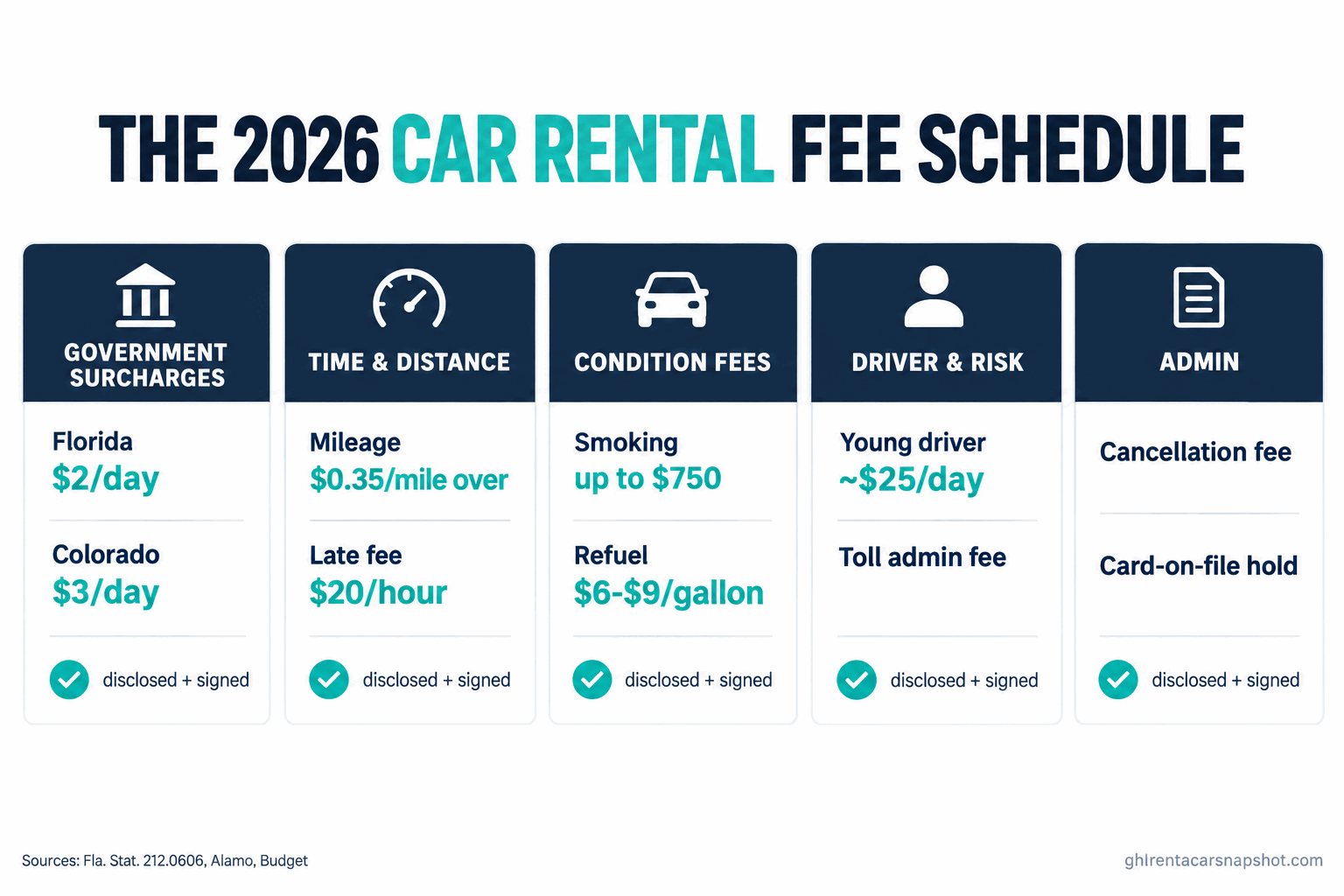
- Government surcharges are not yours to absorb. Florida adds $2 a day and Colorado adds $3 a day on every short-term rental. You collect and remit them, you do not eat them.
- The majors trained your renters to expect add-ons. Budget charges up to $750 to clean a smoked-in car and Alamo averages about $25 a day for young drivers, so a clearly disclosed fee feels normal.
- Disclosure is a legal duty. The FTC’s 2025 hidden-fee rule does not cover car rentals, but the FTC Act and state laws still punish a surprise fee. Collect with a card on file and an all-in quote, and the renter who signed for every fee almost never disputes it.
Table of contents
- What an undisclosed fee really costs you
- Government surcharges you must pass through
- Time and distance fees
- Condition fees that protect your deposit
- Driver fees that price risk
- Admin fees renters hate, and how to charge them anyway
- Three fee schedules: solo, airport lot, exotic fleet
- Are these fees even legal? The 2026 disclosure rules
- Steal these: the fee-disclosure scripts
- Common objections, answered
- Frequently asked questions
What an undisclosed fee really costs you
Think about what that Sunday chargeback drains. You lose the $400 and the detailer’s labor you already paid. Your processor logs the dispute, and once your dispute ratio climbs, processors raise your rates or freeze payouts. Then the renter posts a one-star review about a “surprise $400 charge” that your next customer reads before they call. One undisclosed fee cost you four ways.
Now flip it. The same fee, disclosed at the quote, signed for in the agreement, and backed by a dated ashtray photo, is money you keep and a dispute you win. The fee did not change. The paperwork did.
This matters more for you than for a national brand. The big chains have a chargeback department that fights disputes for a living. You have yourself and whatever you wrote in your agreement, backed by the same timestamped damage photos that defend your deposit. If you came off a platform like Turo, with its roughly 150,000 hosts (TechCrunch, 2024), the dispute desk is now you.
Government surcharges you must pass through
These are the easiest fees to get right and the most expensive to get wrong. The state or airport sets them and you are only the collection agent. Absorb them and you pay a tax for your renter; forget to remit them and you have a compliance problem.
| Surcharge | Amount | Where | Source |
|---|---|---|---|
| State rental surcharge (Florida) | $2 per day, first 30 days | Florida | Fla. Stat. 212.0606 |
| Peer-to-peer car-sharing surcharge (Florida) | $1 per day, first 30 days | Florida | Fla. Stat. 212.0606 |
| Congestion impact fee (Colorado) | $3 per day | Colorado | Colorado Politics, 2026 |
| Airport concession recovery fee | ~10% to 12% of base rate | Most airport operations | varies by airport |
| Airport facility charge | a few dollars per day | Most airport operations | varies by airport |
Florida’s surcharge is set by Fla. Stat. 212.0606: “$2 per day or any part of a day” for the “first 30 days.” Colorado’s $3-a-day congestion fee, enacted in 2024, was upheld by a divided 10th Circuit in July 2026, which ruled the fee lands on the consumer while the company is only the collector (Colorado Politics, 2026; Auto Rental News, 2026). Near an airport you also pass through a concession recovery fee plus a per-day facility charge.
Time and distance fees
These track how long the renter keeps the car and how far they drive it. Because they map to usage, they are the least disputed fees here when disclosed.
Mileage overage. If you cap miles, state the cap and the per-mile charge, usually 20 to 40 cents over the allowance. Unlimited mileage is simpler and a selling point for a local lot, so only cap when a long trip would wreck your maintenance schedule.
Late and extension fees. A car back late costs you the next rental, not just an hourly fee. Charge hourly past a stated grace period, cap it at one day rate, then a fresh day beyond. The full ladder and the reminder texts that prevent late returns are in the late-return policy playbook. Always offer the extension before the fee.
One-way and drop fees. If you allow returns to another location, the car is stranded somewhere you must reposition it from, so a flat drop fee covering that cost is fair.
Condition fees that protect your deposit
This is where the money and the disputes both live. These fees only hold up with proof.
Cleaning and smoking fees. Budget charges “up to $750” to clean a car of tobacco odor and residue (Budget), and Hertz, Dollar, and Thrifty commonly charge around $400 (Elliott Advocacy). A general cleaning fee for a filthy car runs smaller, often $50 to $150. The amount is not what wins the dispute. The timestamped photo of the ashtray is.
Refueling. On a full-to-full rental returned low, charge a refueling service fee on top of the fuel, typically $6 to $9 or more per gallon (Elliott Advocacy). That premium pays for the trip to the pump, and renters accept it when the rule was stated up front and shown on the pickup gauge.
Damage and excessive wear. The big one, and a chargeback magnet when done sloppily. A damage charge only survives with a dated pre-rental photo showing the car clean and a dated return photo showing the new damage. When a renter still fights it, the chargeback evidence system wins the dispute.
Per-day add-ons renters already pay at the major brands (US dollars), so a clearly disclosed fee reads as normal. Sources: Fla. Stat. 212.0606, Colorado Politics, Alamo.
Driver fees that price risk
These price the extra risk a renter brings. They are standard, but most often applied inconsistently, which is how an operator gets a discrimination complaint or a lost dispute.
Young-driver surcharge. Drivers 21 to 24 carry more risk, and the majors price it. Alamo averages about $25 a day, from $15.50 in Michigan to $33.25 in New York (Alamo). Set one number, apply it to every renter in the band, and never waive it as a favor, because an age fee applied inconsistently is a legal risk.
Additional-driver fee. A per-day charge for each extra authorized driver is standard. Keep it modest and waive it for a spouse if that is your policy, but write the policy down so it is a rule, not a mood.
Toll administration. Hand the renter a transponder and you can charge a daily convenience fee on any day a toll is incurred, plus the tolls. Disclose both halves, or the renter who gets a toll fee they never heard of disputes the whole invoice.
After-hours and delivery. Pickup or drop-off outside posted hours, or delivery to a hotel or airport curb, is real labor and a fair flat fee, often the most profitable one on an exotic lot.
Admin fees renters hate, and how to charge them anyway
Some fees are legitimate but feel like nickel-and-diming, so they draw the most “this is a scam” reactions. You can still charge them, you just show them early.
Booking or processing fee. A small flat fee is defensible but reads as padding. If you charge it, name it plainly and show it at the quote, never at the counter.
Cancellation and no-show fees. A last-minute cancel or no-show costs you a car that sat idle on a day it could have earned. A tiered fee, free beyond a window and a percentage inside it, is fair, and the no-show recovery workflow turns some dead bookings back into rentals. State the terms at booking, not in fine print.
Card-on-file hold. A hold is not a fee. It is a pre-authorization you release at return, and confusing the two is how operators get into trouble. The renter needs to know the hold amount, that it is temporary, and when it drops off. The mechanics are in the security-deposit hold guide; getting the language right prevents half your “why did you charge me” calls.
Three fee schedules: solo, airport lot, exotic fleet
The same fees apply differently depending on your lot. Your pricing strategy sets the day rate; these fees sit under it. Here is how the schedule shapes up at three sizes.
Solo operator, 10 cars, local. Keep it lean. Unlimited local mileage, one late-fee ladder, a cleaning fee, a fuel rule, and whatever state surcharge applies. Four or five fees, all on the quote and signed. Set a minimum age instead of a young-driver surcharge. Simplicity is your edge over the airport brands.
Mid-size lot, 30 cars, airport-adjacent. Now the pass-through fees matter: concession recovery fee, facility charge, state surcharge, plus a young-driver surcharge and a toll-admin fee for out-of-towners. This operator most needs the all-in quote, because an airport customer comparing you to Hertz will not forgive a surprise.
Exotic or luxury fleet, 60-plus cars. Your fees skew toward risk and service: higher deposit holds, a real mileage cap, a delivery fee that is pure margin, and a strict detailing schedule backed by obsessive photos. The renter expects white-glove handling, so delivery and after-hours fees are features, not friction. One bad rental here costs five figures, so the damage-photo workflow is not optional.
Are these fees even legal? The 2026 disclosure rules
Short answer: yes, the fees are legal, and hiding them is what gets you in trouble. The rules are about disclosure.
Many operators heard the FTC was cracking down on “junk fees” and assumed car rentals got an all-in pricing mandate. They did not. The FTC’s Rule on Unfair or Deceptive Fees took effect May 12, 2025, but covers only live-event ticketing and short-term lodging (FTC; Holland & Knight). Car rentals are not named. That does not let you hide fees: Section 5 of the FTC Act bars deceptive practices, and every state’s consumer-protection law treats a surprise mandatory fee as deceptive too.
Some states go further. California’s SB 478 took effect July 1, 2024 and bans drip pricing across almost all consumer transactions, with a $1,000-per-violation penalty, though a Senate Judiciary analysis notes rental vehicle transactions were specifically exempted (Pillsbury). Exempt or not, an ambushed California renter can still use the broader statute, so the safe move is the same everywhere: show the fee up front.
One more piece most operators miss. The moment you text a renter about a fee or a deposit, you are inside SMS rules. A2P 10DLC campaign registration requires a published privacy policy and terms URL as of June 30, 2026, and laws like Florida’s FTSA carry a private right of action for bad texting. (If anyone says a “one-to-one consent” rule applies, it does not: that rule was vacated in early 2025.) The full ruleset is in the TCPA and 10DLC compliance guide.
Steal these: the fee-disclosure scripts
Copy these, swap your numbers in, and you have disclosed every fee before it applies.
Common objections, answered
“Won’t all these fees scare renters away?” Not if you show them at the quote. Renters do not hate fees, they hate surprises. A renter who sees an all-in number at booking and signs for it has already accepted every fee on it. The scare only happens when a fee is hidden until drop-off.
“Can I just keep the deposit instead of charging a fee?” No, and it is a fast way to lose a dispute. A hold is a pre-authorization you release, not a slush fund. To keep money for damage, charge a specific disclosed fee with documentation and release the rest. Treating the whole deposit as yours is what gets a chargeback won against you.
“Do I need a lawyer to write these clauses?” You need a lawyer to review your agreement once, which is money well spent. The clauses here are a starting point to hand that attorney, not a finished contract. Get it reviewed for your state, then reuse it.
“My renter paid through a platform, can I still charge a fee?” It depends on the platform’s rules, one more reason operators move to direct booking. On your own system, with your own agreement and card on file, you control the fee schedule end to end. If fee control matters, running your own booking system is the path.
Frequently asked questions
What fees can a car rental company legally charge?
Any fee disclosed before the rental and signed for: government surcharges, mileage overage, late fees, cleaning and smoking fees, refueling, damage, young-driver and additional-driver surcharges, toll admin, delivery, and cancellation fees. The fee is rarely the legal issue; hiding it until drop-off is.
How much is a car rental smoking or cleaning fee?
Budget lists a smoking-cleaning fee of up to $750, and Hertz, Dollar, and Thrifty commonly charge around $400. A general cleaning fee for a dirty car runs $50 to $150. The fee only survives a dispute with a dated return photo, so document it before you charge.
Does the FTC junk-fee rule apply to car rentals?
No. The FTC's 2025 Unfair or Deceptive Fees Rule was narrowed to live-event ticketing and short-term lodging only. Car rentals are not named. That does not let you hide fees: Section 5 of the FTC Act and state consumer-protection laws still treat a surprise mandatory fee as deceptive, so all-in disclosure is the safe standard.
Can I keep the security deposit to cover a fee?
No. A deposit hold is a temporary pre-authorization, not money you own. To cover damage or cleaning, charge a specific disclosed fee against the card with documentation, then release the rest. Keeping the whole hold without an itemized charge is the fastest way to lose a chargeback.
How do I charge a fee without getting a chargeback?
Disclose it at the quote, get it signed in the agreement, document the trigger with a timestamped photo, charge the card on file, and send an itemized receipt. A fee that passes all five steps you can defend to the card network. One that skips any of them you will likely refund.
Back to that Sunday counter. Run this system and it ends differently. The smoking fee was on his quote as a “condition fee if triggered,” spelled out in section 6 of the agreement he e-signed, and your return photo shows the interior with the timestamp. You charge the card, the itemized receipt hits his inbox, and when he opens his banking app there is nothing to dispute because every number has a reason attached. That is the point of a fee schedule: not to charge more, but to make every charge one you actually keep.