

A renter backs your $45,000 SUV into a pole, hands you the keys, and says the dent was already there. You reach for the agreement he signed, and it is a one-page form you copied off another lot three years ago. No line about the deposit, nothing about who inspects the car or the photos you took at pickup. You know you are right. You just cannot prove it on paper, and the deposit you held is already arguing back.
Here is the short version so you can fix this today. Your rental agreement is the only thing standing between you and a lost deposit, a denied insurance claim, or a TCPA lawsuit. A good one is not longer, it is more complete: it names the car and the renter, spells out every fee, authorizes the deposit hold, limits who drives and where, records the car’s condition, and captures consent to e-sign and to text. Get those clauses right, signed before the keys leave your hand, and most disputes end before they start. This is the clause-by-clause template, including the clauses that change by state.
Key Takeaways
- A rental agreement is a risk document, not paperwork. Every clause protects a specific dollar, or it is wasting a line.
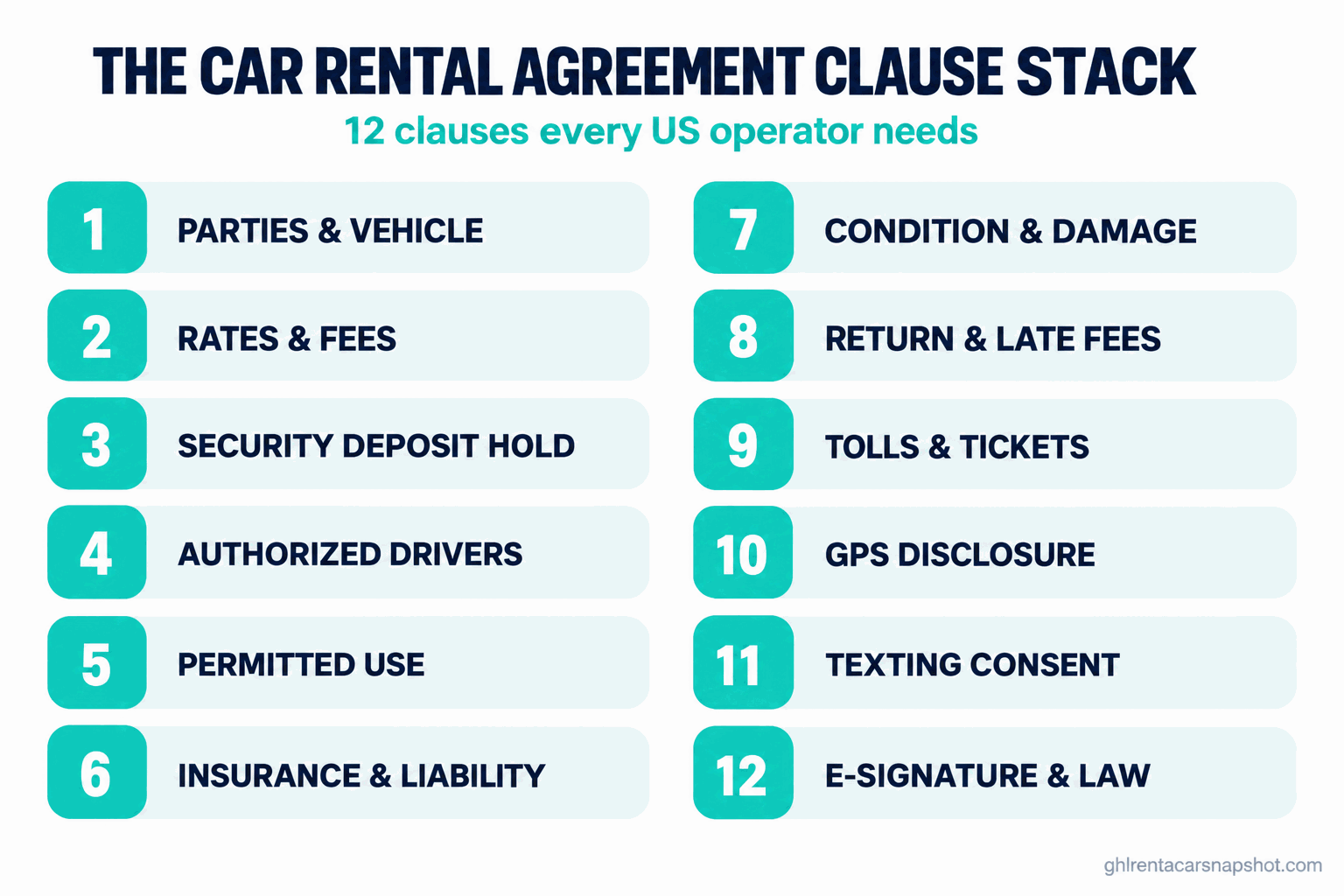
- Twelve clauses cover almost every dispute: parties, rates, deposit, drivers, use, insurance, condition, return, tolls and tickets, GPS disclosure, texting consent, and the signature block.
- A handful change by state. California limits GPS tracking and damage-waiver pitches, Florida adds a $2 per day surcharge and a mini-TCPA, New York signs under its own statute.
- The consent block is where operators get sued. An unwanted marketing text can cost $500 to $1,500 under the TCPA, so capture texting consent the right way.
Table of contents
- What a weak rental agreement actually costs you
- The twelve clauses every car rental agreement needs
- Clause 1: Parties, vehicle, and rental period
- Clause 2: Rates, fees, and what counts as extra
- Clause 3: The security deposit and card-on-file hold
- Clause 4: Authorized drivers
- Clause 5: Permitted use and what you prohibit
- Clause 6: Insurance, damage waiver, and liability
- Clause 7: Condition, damage, and the photo record
- Clause 8: Return, late fees, and extensions
- Clause 9: Tolls, tickets, and admin fees
- Clause 10: The GPS and telematics disclosure
- Clause 11: The texting consent clause
- Clause 12: E-signature, no verbal changes, governing law
- The clauses that change from state to state
- Three agreements: solo host, 25-car lot, multi-state
- Sending and signing it without a TCPA problem
- Common objections, answered
- Frequently asked questions
What a weak rental agreement actually costs you
When a renter disputes a damage charge, the bank reads the paperwork, not your word or his. If your agreement never defined the deposit or referenced a photo record, the processor sides with the cardholder and you eat the loss. That is the whole fight in most car rental chargebacks: friendly fraud that wins because the operator could not document the deal.
The agreement is also where you capture permission to text the renter, and texting the wrong way is expensive. Under the federal Telephone Consumer Protection Act, an unwanted marketing text runs $500 per violation, up to $1,500 if willful (47 U.S.C. 227); Florida’s mini-TCPA carries its own private right of action in the same range (Fla. Stat. 501.059). A sloppy consent line times a few hundred contacts is a bet-the-business number.
Statutory damages per unwanted text, in dollars. Sources: 47 U.S.C. 227 (TCPA), Fla. Stat. 501.059 (FTSA).
The twelve clauses every car rental agreement needs
The agreement is a stack: each clause defends one thing, a dollar, a car, a license, or a lawsuit, and a risk with no clause leaves you exposed. This is a starting template, not legal advice, so have an attorney in your state review it.
Clause 1: Parties, vehicle, and rental period
Name the renter exactly as the license reads, the vehicle by make, model, plate, and VIN, and the period with a specific return time.
This Rental Agreement is between {Business Legal Name} (“we,” “us”) and {Renter Full Name, as shown on driver license} (“you,” “Renter”). Vehicle: {Year/Make/Model}, plate {Plate}, VIN {VIN}. Rental period: {Pickup date and time} to {Return date and time} at {Return location}.
Clause 2: Rates, fees, and what counts as extra
List the base rate and every add-on charge. This clause kills “I never agreed to pay for that.”
Base rate: {rate} per day. Included miles: {number} per day; additional miles {rate} each. Fuel: return at the same level or pay {rate} per gallon plus a {amount} refueling fee. Cleaning beyond normal use: {amount}. Additional driver: {amount} per day. Young driver (under 25): {amount} per day. Taxes and government surcharges apply as required by law.
Every fee you will charge later has to live here first, the discipline behind a healthy fleet utilization rate.
Clause 3: The security deposit and card-on-file hold
The clause operators leave fuzzy and the bank reads first. State the hold amount, that it is an authorization not a charge, what it covers, and when it is released.
At pickup we place a refundable authorization hold of {amount} on your card. This is a hold, not a charge. It secures payment for damage, fuel, cleaning, tolls, tickets, and late fees as described in this agreement. We release the remaining hold within {number} business days after the vehicle is returned and inspected. Your bank may take additional time to show the release.
“Hold, not a charge” plus a named release window prevents half your deposit calls; the mechanics are in how to automate security deposit holds.
Clause 4: Authorized drivers
Only people named here may drive, and the clause has to say what happens when someone else does.
Only the Renter and additional drivers listed and approved on this agreement may operate the vehicle. Each additional driver must present a valid license and meet our age and eligibility rules. Allowing any unlisted person to drive is a breach of this agreement and may void coverage and forfeit the deposit.
Some states set a floor: California deems a renter’s spouse authorized by statute (Cal. Civ. Code), so add drivers, do not contradict it.
Clause 5: Permitted use and what you prohibit
Say where the car can go and what it cannot do. Quiet until a renter kills your insurance claim.
You agree not to use the vehicle: outside {permitted states or region} without written approval; off paved roads; to tow; for any race or driving instruction; while impaired; to carry passengers or property for hire, including rideshare or delivery; to re-rent or sublet it, including listing it on any peer-to-peer platform; or by any unauthorized driver.
The re-rent line backs the fight to stop double-booking between Turo and your direct lot; the geography line saves a claim the policy would otherwise exclude.
Clause 6: Insurance, damage waiver, and liability
State what coverage applies, what the renter owes, and what any damage waiver does and does not do.
You are responsible for all damage to or loss of the vehicle during the rental, up to its full value, plus loss of use, towing, and storage, regardless of fault, unless covered by a damage waiver you accept in writing. A damage waiver, if purchased, is not insurance; it waives or reduces your responsibility for certain damage subject to its terms. Your own auto policy or credit card may already provide similar coverage.
California mandates a disclosure that a waiver may duplicate coverage the renter already has, so treat “not insurance” and “may duplicate your own coverage” as required language.
Clause 7: Condition, damage, and the photo record
Tie condition to a record both sides can see. This clause wins deposit disputes by moving the fight from memory to evidence.
The vehicle’s condition at pickup and return is recorded by dated, timestamped photographs taken by us, which form part of this agreement. You may inspect the vehicle and note existing damage before departure. By signing, you agree the vehicle is in the condition shown in the pickup photos except as noted here: {pre-existing damage notes}.
The renter signed off on a clean panel and the return set shows the dent, the backbone of a damage-photo deposit shield.
Clause 8: Return, late fees, and extensions
Put the return time, grace period, and late-fee ladder in writing. You cannot charge for a time the renter never agreed to.
Return the vehicle by the date and time above. After a {number}-minute grace period, a late fee of {rate} per hour applies, capped at one full daily rate, after which each additional day is charged as a full rental day. To keep the vehicle longer, request an extension before the return time so we can confirm availability and charge the card on file.
The cap keeps the fee from boomeranging into a chargeback; the full playbook is the late-return policy.
Clause 9: Tolls, tickets, and admin fees
Say who pays for tolls, parking, and violations, and whether you add an administrative fee to process them.
You are responsible for all tolls, parking, traffic, and other violations incurred during the rental, plus an administrative fee of {amount} per citation we process on your behalf. We may charge these to the card on file as described in the deposit clause.
Keep the admin fee reasonable and disclosed: a $10 to $25 fee the renter signed for is defensible; a surprise $100 fee that appears nowhere is a chargeback.
Clause 10: The GPS and telematics disclosure
If your cars have GPS or telematics, disclose it, and know some states limit what you can do with the data.
This vehicle may contain GPS or telematics technology. We use location and vehicle data to recover the vehicle if it is stolen or not returned, to provide roadside assistance, and as otherwise permitted by law. We do not use it to track your routine use of the vehicle.
California bars using surveillance data to impose fines, allowing tracking only in narrow cases like a car not returned on time (Cal. Civ. Code 1939.23).
Clause 11: The texting consent clause
The biggest dollar-per-word clause: getting it wrong gets you sued. Capture consent here, separating operational from marketing texts.
I agree to receive text messages from {Business Name} at the number I provide about my reservation, including pickup, return, and account messages. Message and data rates may apply. Reply STOP to opt out. {Separate, unchecked box}: I also agree to receive occasional marketing texts from {Business Name}. Consent to marketing is not a condition of renting.
A separate, unchecked marketing box renting is never conditioned on, plus the saved record, makes it defensible. Skip any “one-to-one consent” shortcut: that federal rule was vacated by the Eleventh Circuit in January 2025 before it took effect (Morrison Foerster).
Clause 12: E-signature, no verbal changes, governing law
Close with the clauses that make it hold: consent to sign electronically, that only written changes count, and the governing state.
You agree to sign this agreement electronically and that your electronic signature is as binding as a handwritten one. You consent to receive this agreement and related records electronically; you may request a paper copy and may withdraw consent for future records. No change to this agreement is valid unless in writing and signed by both parties. This agreement is governed by the laws of {State}.
The e-signature holds under the federal E-SIGN Act, valid simply for being electronic once the consumer consents after a disclosure of their right to paper (15 U.S.C. 7001); the full signing flow is the digital rental agreement and e-sign flow.
The clauses that change from state to state
Most of the template is the same everywhere. A few clauses shift with the state, and these get an out-of-state template owner in trouble. Match the clause to the state; do not copy a California agreement into a Texas lot and hope.
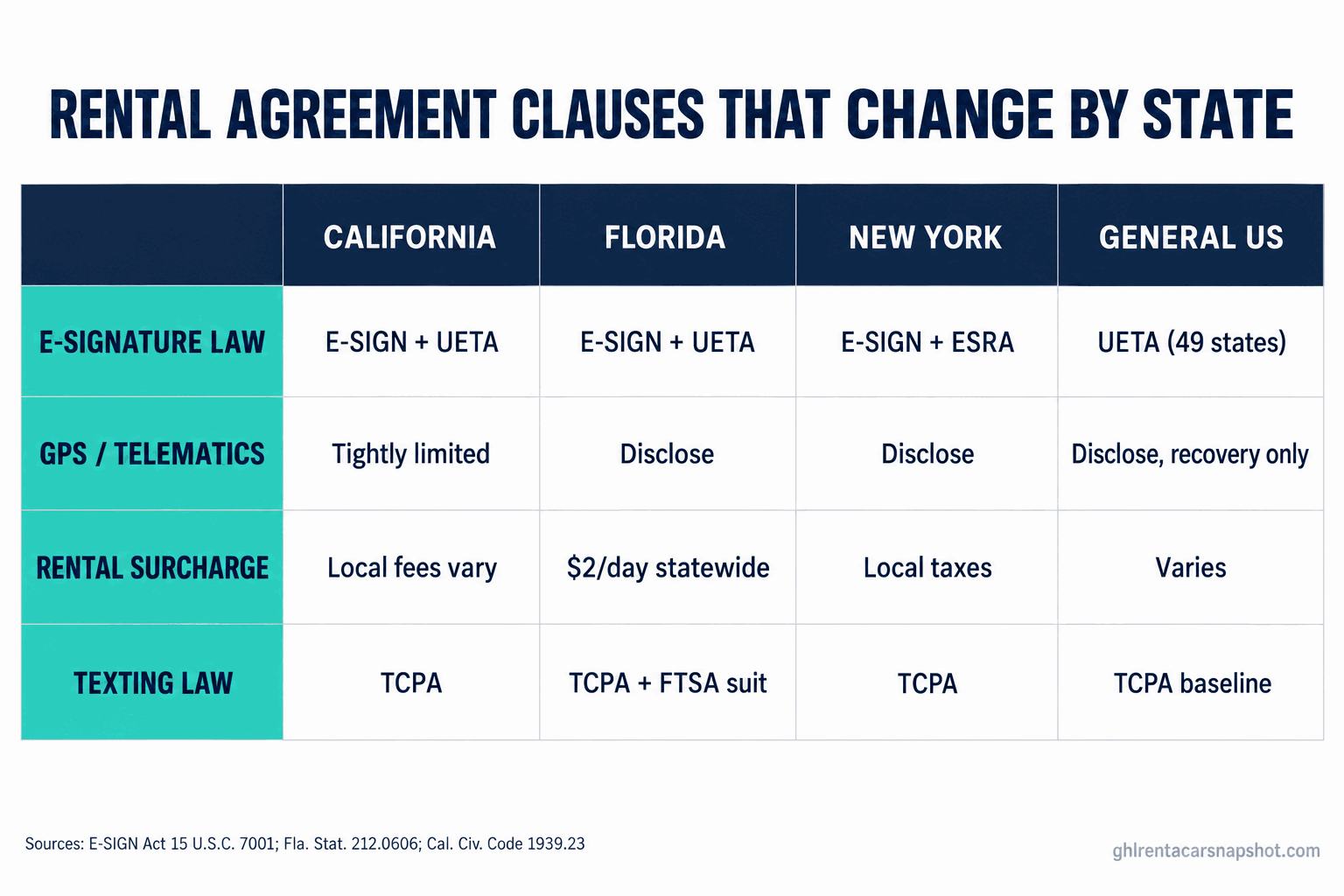
| Clause area | California | Florida | New York | General US |
|---|---|---|---|---|
| E-signature law | E-SIGN + UETA | E-SIGN + UETA | E-SIGN + state ESRA | E-SIGN + UETA (49 states) |
| GPS / telematics | Tightly limited by statute | Disclose, fewer limits | Disclose, fewer limits | Disclose, limit to recovery |
| Damage waiver pitch | Mandatory counter disclosure | Disclosure expected | Disclosure expected | “Not insurance,” may duplicate |
| State rental surcharge | Local/tourism fees vary | $2 per day statewide | Local taxes vary | Varies; disclose as gov charge |
| Texting law | TCPA | TCPA + FTSA private suit | TCPA | TCPA baseline |
Two cells deserve attention. New York signs electronic contracts under its own Electronic Signatures and Records Act, not the UETA that 49 states and D.C. adopted (Adobe, US e-signature law). Florida adds a flat $2 per day surcharge on a car carrying fewer than nine passengers, for the first 30 days, and you must collect it (Fla. Stat. 212.0606), so disclose it as a line in your rates clause.
Three agreements: solo host, 25-car lot, multi-state
The twelve clauses are the same for everyone. What changes is how you deliver and store the agreement.
The solo host, 8 to 15 cars. A former Turo host going direct. Stop emailing a PDF: build the twelve clauses once for your state, send an e-sign link before pickup, and store the signed copy and photos together. Your real risks are the deposit, condition, and texting clauses.
The 25-car lot with staff. Your failure is inconsistency: the verbal “sure” at the counter is your enemy. Lock the agreement so nobody hands over keys without a completed e-sign, and train the team that terms change only by a written amendment.
The multi-state operator, 50-plus cars. One agreement no longer fits. You need a base template plus state riders: California’s GPS and damage-waiver language, Florida’s surcharge line, New York under ESRA. Tag each contract by the state it was signed in.
Sending and signing it without a TCPA problem
How you send the agreement matters as much as the clauses: it is how you earn the right to message the renter.
You send the sign link by text, tied to a booking the renter just made. You still need A2P 10DLC registration, and the rules are tightening: from June 30, 2026, new 10DLC campaign registrations must include a public privacy policy URL and a terms and conditions URL or be rejected (Twilio). Put both pages on your site first.
Keep operational and marketing texts separate, which is why Clause 11 uses two boxes. If you rent to Floridians, run the strict version: the FTSA carries a private right of action, and even after its 2023 amendment narrowed text claims, the exposure is real (Fla. Stat. 501.059). See texting rental reminders without a TCPA problem and the TCPA-compliant messaging guide.
Common objections, answered
“My one-page form has worked fine for years.” Until the dispute you have not had yet, when the missing clause costs more than every rental the form ever processed.
“Won’t a longer agreement scare renters off?” A complete agreement signed on a phone in thirty seconds feels professional, not long. Length is not the enemy, friction is.
“Can I just download a free template and use it as is?” Use one as a skeleton, never the final word. A generic template will not have your fees, your deposit amount, your state’s GPS rule, or your texting-consent language, the clauses that win disputes.
“Do I need a different agreement for every state?” If you rent in more than one, yes, at least riders. The core clauses travel, but the e-signature statute, GPS limits, damage-waiver disclosure, and surcharge lines change by state.
Frequently asked questions
What should a car rental agreement include?
The parties and exact vehicle, the rental period and return time, the rate and every fee, the deposit hold, authorized drivers, permitted and prohibited use, insurance and liability, the condition and photo record, late fees, tolls and tickets, a GPS disclosure, texting consent, and an e-signature and governing-law block. Those twelve clauses cover almost every dispute.
Is an electronic signature legally binding on a car rental agreement?
Yes. Under the federal E-SIGN Act (15 U.S.C. 7001), a signature cannot be denied legal effect just for being electronic, as long as the consumer consented after a clear disclosure of their right to paper. Forty-nine states follow UETA; New York uses its own Electronic Signatures and Records Act.
Can I charge a renter's card for damage after they return the car?
Only if your agreement authorized it. A deposit clause securing payment for damage, fuel, cleaning, tolls, tickets, and late fees, plus a condition clause tied to timestamped photos, makes a post-return charge defensible. Charging for something the agreement never mentioned loses the chargeback.
Do I need a different rental agreement for each state?
The core clauses are the same everywhere, but a few change by state: California limits GPS tracking and the damage-waiver pitch, Florida adds a $2 per day surcharge and the FTSA private right of action, and New York signs under its own statute. Use one base template with state riders.
How do I add texting consent without breaking TCPA rules?
Capture consent with the renter's number and signature, and separate operational from marketing texts with a distinct, unchecked opt-in box. Never make renting conditional on marketing consent, always include a STOP opt-out, and keep the record. Do not rely on the vacated one-to-one consent rule.
Back to the dented SUV. Run the template and it ends differently. He signed an agreement that named the car, authorized a hold, and tied condition to photos. The pickup set shows the panel clean, the return set shows the dent, and there is nothing to argue about. A rental agreement is not paperwork. It is the cheapest insurance you will ever write, and it only works if you put all twelve clauses down before the keys leave your hand.