

It is a Wednesday morning and your whole business is on somebody else’s dashboard. You have twelve cars, four out on trips, and the email you just opened says Getaround is winding down in the US. New rentals stop in days. The insurance and car-protection program you leaned on might lapse 48 hours later. Your renter list, your reviews, your booking calendar, all of it lives inside an app turning off the lights. If the platform you built on is gone, how do you keep earning next weekend?
The fastest safe move is not to scramble onto another marketplace that takes a cut of every booking. It is to use this forced reset to go independent: get your renter data and reviews out now, line up your own insurance and deposits, stand up a direct booking path, and wire the follow-up a marketplace never let you own. Below is the stage-by-stage playbook, the exact messages, and where each step breaks if you rush it.
Key Takeaways
- Getaround ended US operations. It stopped new US rentals after February 11, 2025 and warned coverage “might” end from February 13, citing “an ongoing lack of liquidity” (Getaround). HyreCar wound down too (PYMNTS).
- Do not just jump to the next marketplace. On Turo’s 2026 plans hosts keep 70, 80, or 90 percent of the trip price, so the platform keeps 10 to 30 percent of every booking (Turo).
- Your first job is data. Export renter contacts, trip history, and review screenshots before access disappears. A dead platform owes you nothing later.
- Going independent means owning four things the marketplace owned for you: insurance, the agreement and deposit, the booking path, and the follow-up.
- The booking is the easy part. Capturing every inquiry, reminders, damage photos, and reviews is the system that actually grows a lot.
Table of contents
- The 60-second answer
- What actually happened to Getaround
- What getting this transition wrong costs you
- The six-stage path to independent
- Stage by stage, with the failure mode
- Steal these renter messages
- Same move, three fleet sizes
- The texting rules you now own
- Objections, answered
- FAQ
The 60-second answer
You have two real paths. Re-list on another marketplace, usually Turo, and keep renting under someone else’s cut. Or run your own lot: your booking page, your deposit, your renter list. Most operators should do both for a while, lean on a marketplace for discovery while you build direct, then move the repeat renters to where you keep almost the whole fare. The one move that costs you is waiting, because by the time a shutting-down company answers your questions, your data may be gone. Start the export today.
What actually happened to Getaround
Getaround did not pause. It left the US. The company said it “will stop accepting new US rentals after February 11, 2025,” and warned that “starting February 13, 2025, we might not be able to provide liability insurance coverage or the car protection program” (Getaround). The reason it gave was “an ongoing lack of liquidity” that made US operations “no longer viable.”
Two details matter. First, the insurance cliff was real and fast: roughly 48 hours between new rentals stopping and the protection program possibly ending, so a car still out on a trip into that window was a genuine exposure. Second, this was not only Getaround. HyreCar, the platform Getaround acquired, wound down its US business at the same time (PYMNTS). Europe kept running, but for a US host that is cold comfort.
- •Feb 11, 2025
New US rentals stop
Getaround stops accepting US bookings.
- •Feb 13, 2025
Coverage may lapse
Liability and car protection may end.
- •End of 2025
US exit done
US carsharing shut; Europe continues.
The lesson is not that marketplaces are evil. It is that a platform can turn off your business with two days’ notice and you get no vote.
What getting this transition wrong costs you
The expensive mistakes here are quiet ones. The first is losing your renter relationships. On a marketplace you rarely controlled a contact list, so if the app goes dark before you export anything, you start at zero and every past renter is a stranger you must pay to reach.
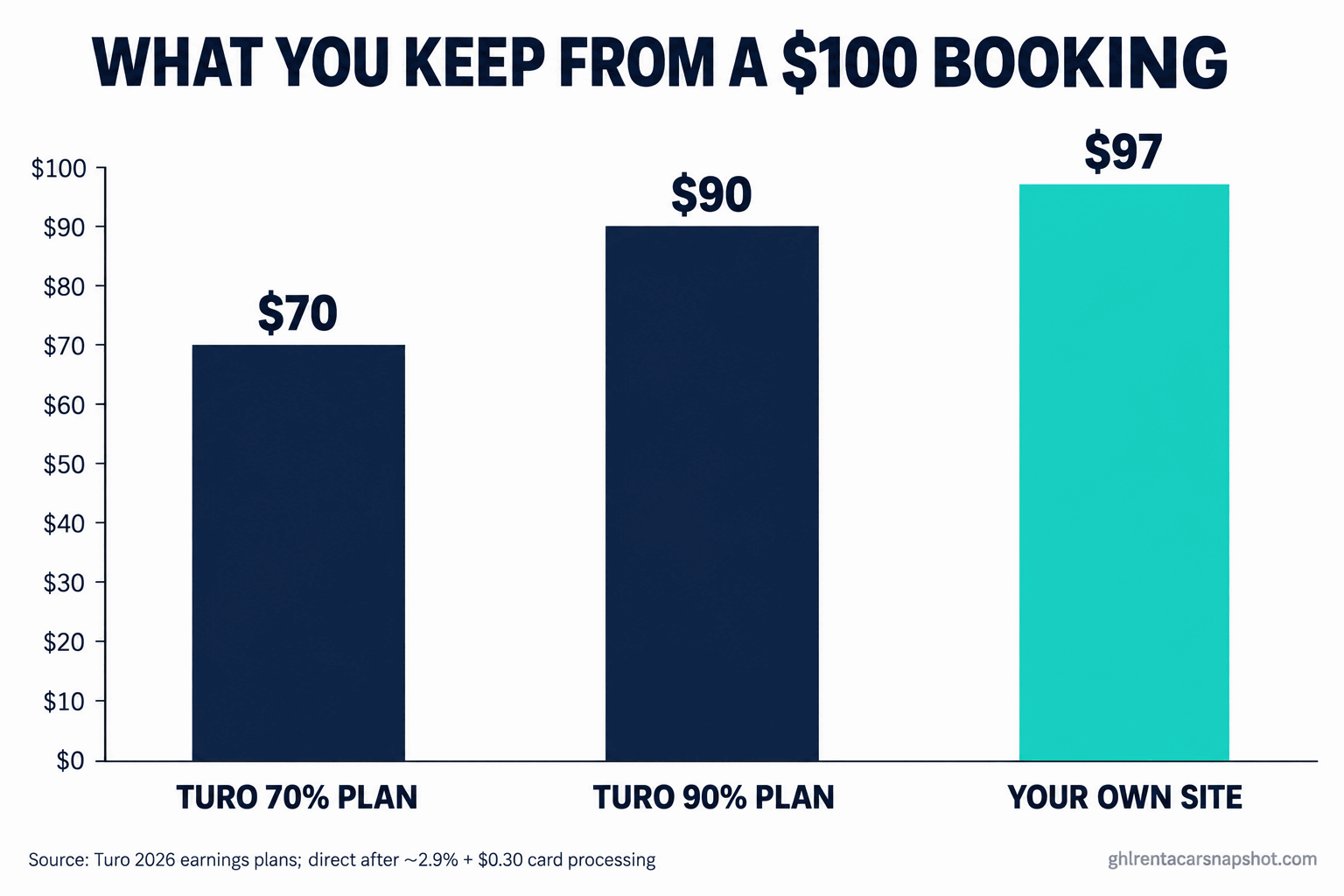
The second is the reflex jump to another platform’s commission. It feels safe to re-list on Turo and keep the lights on, and for discovery that can be the right call. But on Turo’s 2026 earnings plans the host keeps 70, 80, or 90 percent of the trip price, which means Turo keeps 10 to 30 percent of every booking (Turo). Trade one landlord for another and you still rent your own customers back.
The gap is stark. On a $100 booking, a 70-percent Turo plan leaves you $70; booked on your own site, after card processing of about 2.9 percent plus 30 cents (Stripe), you keep close to $97. That spread is the whole argument for building direct.
What you keep from a $100 booking. Turo shares from Turo’s 2026 earnings plans (host keeps 70/80/90%); direct is after ~2.9% + $0.30 processing. Sources: Turo, Stripe.
The third cost is the insurance and legal gap. Go independent without your own commercial coverage and a real rental agreement and you are not saving money, you are running uninsured. We went deep on the claim side in why insurance keeps denying your rental damage claims.
The six-stage path to independent
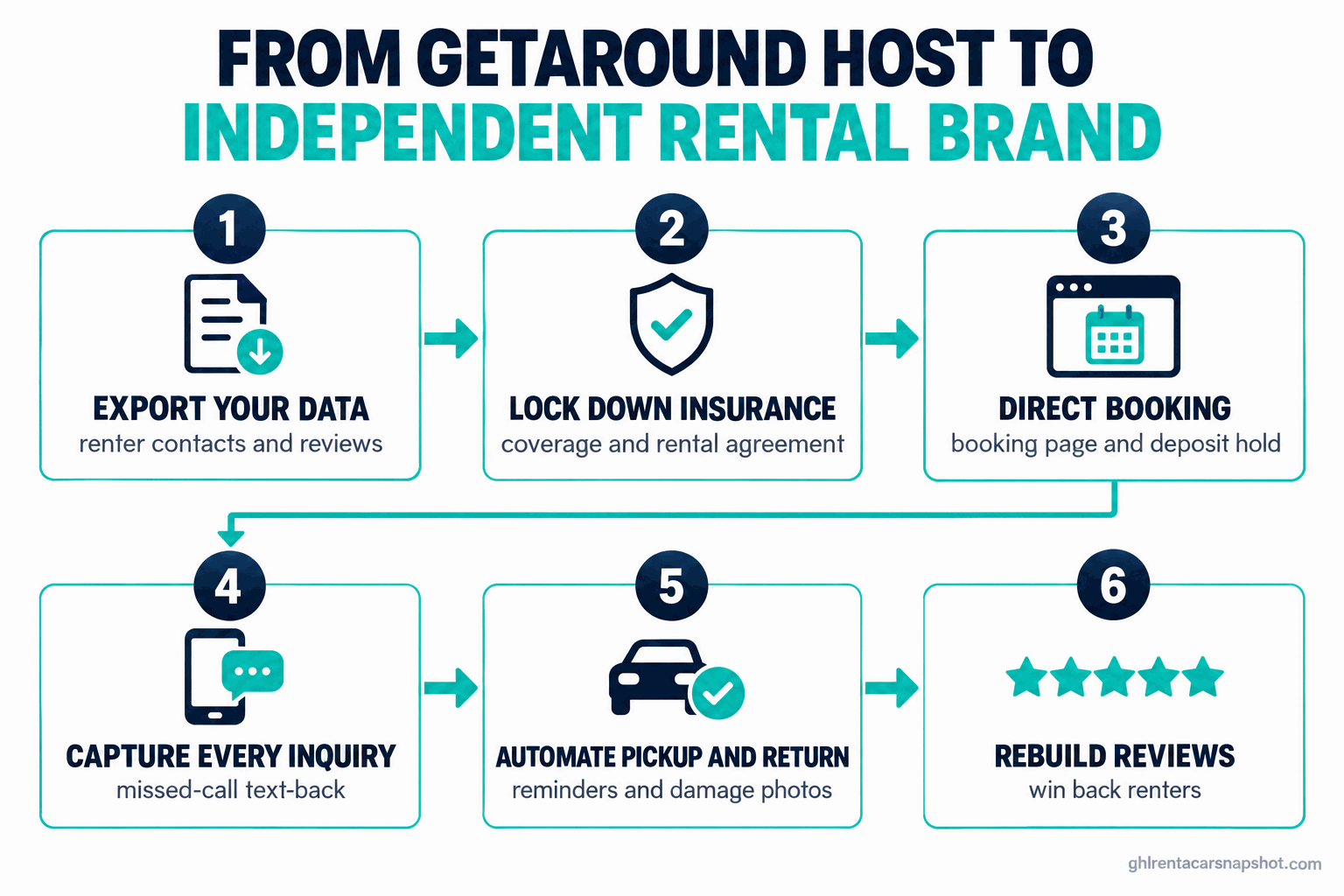
Here is the order that keeps you earning without a dangerous gap: (1) export your data and reviews, (2) lock down insurance and the agreement, (3) stand up a direct booking path with a deposit hold, (4) capture every inquiry, (5) automate pickup and return, (6) rebuild reputation and win back your renters. Run stages one and two in parallel this week. Three through six are the system that replaces what the platform did, and the part no vendor can switch off. Each stage below has a setup, real copy, and how it breaks.
Stage by stage, with the failure mode
Stage 1: Get your data and reviews out now
Before anything else, pull everything a dying platform still lets you see: renter contacts, every past and upcoming trip, vehicle records, and payout history. Then screenshot your reviews and overall rating, because you cannot export a star count. Save it somewhere you own, not another app.
Where it breaks: waiting. A company winding down is not staffing a desk to help you leave, so if the app still loads, today is the best access you will ever have. Grab the contact details first, since that is the asset you cannot rebuild.
Stage 2: Lock down insurance and the rental agreement
This is the stage people skip and regret. The marketplace carried a protection program; now you carry it. Call a broker who writes commercial auto and rental risk, not your personal carrier, and get real coverage before a car goes out under your name. In parallel, put a rental agreement in front of every renter, with deposit, mileage, fuel, and late-return rules spelled out. A digital agreement with e-sign makes this painless, as in the digital rental agreement and e-sign flow.
Where it breaks: renting on a handshake during the transition. One uninsured incident can cost more than a year of commission. No keys leave without coverage in force and an agreement signed. None of this is legal advice; confirm with a broker and a lawyer.
Stage 3: Stand up a direct booking path with a deposit hold
Now give people a way to book you that is not an app store. At minimum you need a booking page with your vehicles, real-time availability, a card captured, and a pre-authorization hold before pickup. The hold protects you against damage and no-shows the way the platform used to, as in how to automate car rental security deposit holds.
Where it breaks: a booking page that takes a reservation but never collects a card or sets a hold. That is a contact form with extra steps. If money and a deposit authorization do not move at booking, you have replaced the platform with a worse version.
Stage 4: Capture every inquiry, including after hours
On a marketplace, the app answered at 11pm. Now your phone does, and a missed call on a Friday is a booking that went to whoever picked up. The fix is a text-back on every missed call and an after-hours responder that captures the name, dates, and vehicle, then books or holds the slot. The lead replied to in seconds is the one you keep.
Where it breaks: treating the website and the phone as separate worlds. If a web inquiry, a missed call, and a DM land in different places, something falls through on your busiest day. Route every inquiry into one inbox with one sequence.
Stage 5: Automate pickup and return, with damage photos
This is where you stop being a worse version of the app and start being better than it. Send a pickup reminder the day before with the time, address, and what to bring, and a return reminder the morning it is due. At handoff, take timestamped photos of the car out and back, so a deposit dispute is settled by evidence, not argument, as in protecting the deposit with damage photos.
Where it breaks: doing it by memory. The reminder you forget is the no-show you eat, and the photos you did not take are the chargeback you lose. Automate the reminders and make the photo step required.
Stage 6: Rebuild reputation and win back your renters
Your Getaround rating does not transfer, so you rebuild. After every clean return, ask for a Google review while the renter is still happy, and route anyone unhappy to a private reply first. Then reach back to the list you exported in stage one with a reason to book direct. The full flow is in the five-star review pipeline.
Where it breaks: asking everyone at the wrong moment, or never asking at all. Time the request to the clean return, make it one tap, and follow up once. Reviews are a system, not luck.
Steal these renter messages
The hardest part of going independent is moving your renters without dropping a booking. Here is copy you can lift. Keep transactional messages transactional, and get consent before anything that reads as marketing.
The win-back to your exported renters (email, marketing, needs consent):
Subject: We’re still renting, now direct and a little cheaper
Hi [first name], you rented the [vehicle] from us before. That marketplace closed its US service, but we are still here and now booking direct. Same cars, same lot, and because we skip the platform fee we can usually do better on price. Book or ask about dates here: [link]. Reply STOP to opt out.
The pickup and return pair (text, transactional):
Pickup, day before: Hi [first name], your [vehicle] pickup is tomorrow at [time], [address]. Bring your license and the card on file. Reply with any questions.
Return, morning of: Morning [first name], your [vehicle] is due back today by [time] at [address]. Need another day? Reply and we will check availability before any late fee.
The review request after a clean return (text):
Hi [first name], thanks for renting with [lot name]. If the pickup and car were easy, would you leave us a quick Google review? It helps a small lot like ours: [link].
Those messages carry your repeat renters through the switch and start your direct reputation at once. The reminder flow and the consent rules behind it are in texting pickup and return reminders without a TCPA or 10DLC disaster.
Same move, three fleet sizes
The transition looks different depending on how many cars you run. Same six stages, three different emphases.
Solo or side-hustle, about 3 to 8 cars. Keep it lean. A simple booking page, a card on file with a hold, and the missed-call text-back cover most of your leakage. Re-list on a marketplace for traffic, but push every repeat renter to direct. At this size your exported contact list might be your whole marketing budget. The biggest risk is skipping insurance to move fast. Do not.
Growing shop, about 10 to 30 cars. This is where the follow-up system pays for itself. A forgotten reminder or an un-recovered no-show is real money every week. Put every inquiry into one inbox, automate the reminders, and make damage photos a required step. A hybrid is fine, but your goal is to flip the ratio so most bookings are direct within a season. See the platform math in Turo versus your own booking system.
Established fleet, 40-plus cars. You are a company now, not a host. You likely need real rental software for the fleet and rates, plus the owned follow-up layer on top. Shop the platforms deliberately using a buyer’s guide like the Navotar alternatives rundown. At this size, owning your renter list is the difference between a vendor’s price increase being an annoyance and being a crisis.
The texting rules you now own
On a marketplace, the app handled compliance for the texts it sent. The moment you text renters yourself, that job is yours, and it bites hardest in Florida, a top rental market with a law that has teeth.
First, A2P 10DLC. To send business texts in the US you register your brand and campaign through the carriers. New campaign registrations after June 30, 2026 must include a public privacy policy URL and a terms URL, both live and reachable without a login, or they are rejected at review (Twilio, error 30933). If your new site has no privacy and terms pages, build those first.
Second, Florida’s FTSA. The Florida Telephone Solicitation Act is a mini-TCPA with a private right of action and statutory damages, so renters and the lawyers who find them can sue over improper marketing texts. A 2023 amendment narrowed the autodialer definition (K&L Gates), but the private right of action is still live.
The practical rule: transactional texts like booking and return reminders are lower risk, because the renter gave you their number to do business. Marketing texts, including the win-back to your old list, need real logged consent. Keep that consent trail somewhere you control.
Objections, answered
“Shouldn’t I just re-list on Turo and move on?” For discovery, re-listing can be smart, but treat Turo as a billboard, not a landlord. It keeps 10 to 30 percent of every booking on its 2026 plans (Turo), so meet renters there and move the repeat ones to direct.
“I lost my reviews and rating. Doesn’t that kill me?” It stings, but your rating never transferred between platforms anyway. Start the review pipeline on day one, reach back to renters who already loved you, and you can rebuild a strong Google profile in a season.
“What about cars that were mid-trip when it shut down?” That is why stage two is insurance before anything else. Any car out under your name needs your coverage in force, not a protection program that “might” end in 48 hours. Your own policy first, then bookings.
Finishing that Wednesday morning
So the shutdown email sits in your inbox and four cars are still out. Before lunch: export every contact and screenshot every review while the app still loads, and call a commercial rental insurance broker. This week: stand up a one-page booking site with a card hold and turn on a missed-call text-back so Friday’s calls stop leaking.
You did not choose this reset, but you can use it. A platform could end your business with two days’ notice because it owned the renter relationship and you only rented access. Put that relationship somewhere you own, bolt the follow-up on top, and no company’s liquidity problem is ever your shutdown notice again. When you are ready to replace what the platform did in one move, the plans page shows how the done-for-you build is priced, and you can also get a conversion-ready rental website to book on.
Frequently asked questions
Is Getaround really gone in the US?
Yes. Getaround stopped accepting new US rentals after February 11, 2025 and warned that liability insurance and the car protection program might end from February 13, citing a lack of liquidity. Europe continues, but the US marketplace closed.
Did HyreCar shut down too?
Yes. HyreCar, which Getaround had acquired, wound down its US operations around the same time. The same go-independent playbook applies: export your data, line up insurance, build a direct booking path.
Should I move to Turo after Getaround closed?
You can, and for discovery it may help, but on Turo's 2026 earnings plans you keep 70, 80, or 90 percent of the trip price, so Turo keeps 10 to 30 percent of every booking. Use a marketplace for reach while you build direct, then shift repeat renters to your own site.
What do I need to run my own car rental legally?
At minimum: commercial auto and rental insurance, a rental agreement with deposit and mileage terms, a way to collect payment and place a card hold, and compliant texting. This is general information, not legal advice; confirm with a broker and a lawyer in your state.
How do I keep my renters when the platform is gone?
Export your renter contacts and screenshot your reviews before access disappears, then send a win-back message letting past renters book direct. That contact list is the most valuable asset you take with you.
Do I have to worry about TCPA and A2P 10DLC now?
Yes, because you are the sender now. New A2P 10DLC campaign registrations after June 30, 2026 must list a live privacy policy URL and terms URL, and Florida's FTSA adds a private right of action for improper marketing texts. Keep logged consent either way.